

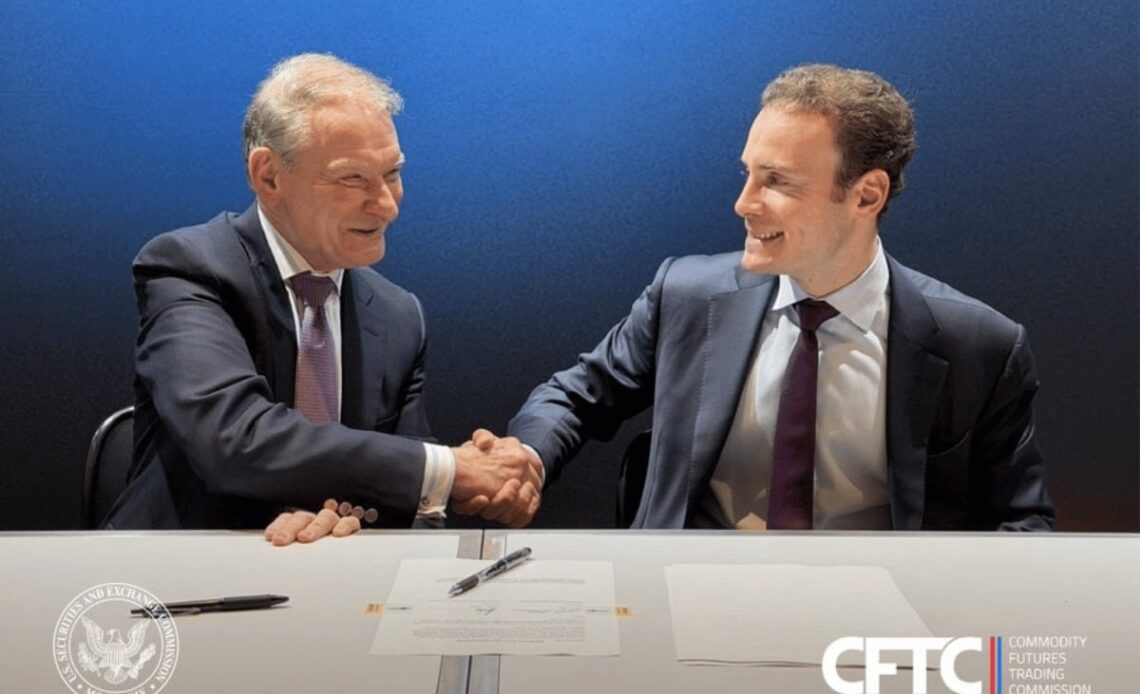
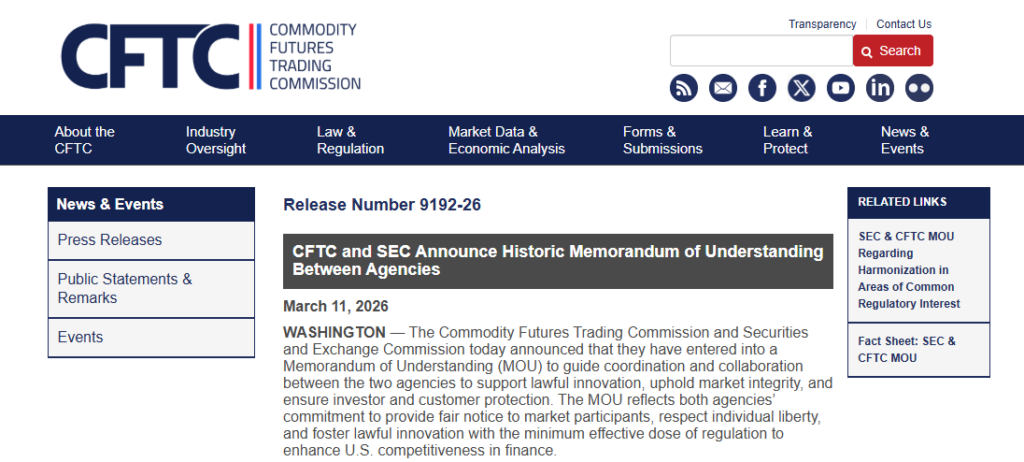
American financial regulators have taken an important step toward forming a unified policy for the cryptocurrency market. The U.S. Securities and Exchange Commission (SEC) and the U.S. Commodity Futures Trading Commission (CFTC) have signed a memorandum of understanding intended to ensure closer coordination between the two agencies in the regulation of digital assets and financial technologies.
The document предусматривает systematic cooperation between regulators, information sharing, joint development of regulatory approaches, and coordination of supervisory practices. The main goal of the agreement is to support lawful innovation in the financial sector while ensuring market transparency, protecting investors and clients, and strengthening the stability of the financial system.
In essence, this is an attempt to resolve a long-standing conflict of authority between the two key U.S. financial regulators. For many years the SEC and the CFTC interpreted the status of crypto assets differently. The SEC tended to consider many tokens as securities, while the CFTC traditionally viewed major cryptocurrencies, including Bitcoin, as a form of commodity assets. This led to legal uncertainty, numerous court cases, and criticism from industry participants.
The new memorandum is intended to put an end to the so-called “regulatory wars” between the agencies and create a more coordinated system of oversight. Under the agreement, regulators will actively exchange data, coordinate inspections, and jointly analyze risks in financial markets. This should help avoid duplication of functions, reduce the bureaucratic burden on companies, and close regulatory gaps.
According to CFTC Chairman Michael S. Selig, U.S. financial markets remain among the most advanced and dynamic in the world precisely because they are able to adapt to new technologies and investor needs. He emphasized that regulatory mechanisms must evolve as quickly as the markets themselves.
Selig noted that the signing of the memorandum confirms the commitment of the two agencies to harmonize their rules and provide more comprehensive oversight of financial markets. Joint work will help eliminate excessive requirements and contradictory regulations that previously created difficulties for businesses. He also stated that coordinated policy could open a new era in the development of the American financial sector and strengthen the competitiveness of the United States in the global financial system.
A similar view was expressed by SEC Chairman Paul S. Atkins. According to him, for decades disagreements between the SEC and the CFTC, different registration requirements, and conflicting regulatory regimes created obstacles for innovation. As a result, some companies preferred to develop their projects in other jurisdictions where the rules were clearer and more predictable.

Atkins emphasized that the new memorandum should serve as a roadmap for a new era of cooperation between the agencies. It will align definitions of financial instruments, organize secure data sharing between regulators, and provide transparent rules for market participants. Ultimately, this should increase investor confidence and strengthen the leadership of the United States in financial technologies.
One of the key elements of the agreement is the so-called Joint Harmonization Initiative – a joint initiative aimed at harmonizing regulation. Its task is to develop coordinated approaches in areas of the financial market where the authority of the SEC and the CFTC overlaps.
Within this initiative regulators plan to clarify legal definitions of different types of financial products, including digital assets, through joint interpretations and new regulatory acts. The modernization of clearing systems, margin requirements, and collateral mechanisms is also planned.
Particular attention will be given to reducing administrative barriers for exchanges, trading platforms, and intermediaries that fall under the regulation of both agencies. In addition, regulators intend to develop a specialized regulatory framework for crypto assets and other emerging technologies, including blockchain-based solutions.
An important part of the initiative will be simplifying reporting on trading data, investment funds, and intermediaries. Regulators also plan to jointly conduct inspections, economic market analysis, risk monitoring, and enforcement oversight.
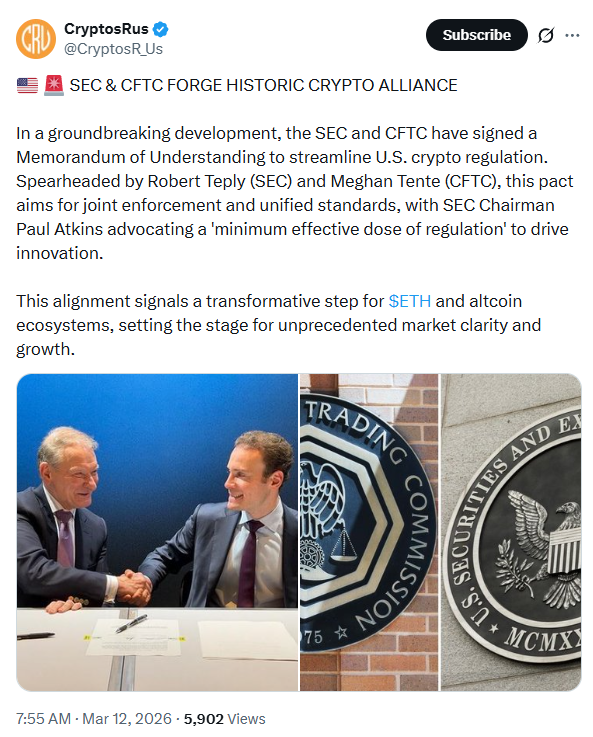
The harmonization work will be coordinated by representatives of both agencies – Meghan Tente from the CFTC and Robert Teply from the SEC. They will be responsible for synchronizing policies, conducting joint research, and developing new regulatory solutions.
One of the most interesting principles embedded in the memorandum is the concept of the “minimum effective dose” of regulation. This concept assumes that government oversight should be sufficient to protect the market and investors while not suppressing innovation and the development of new technologies.
Regulators emphasize that future rules will be technologically neutral. This means that the regulatory framework will take into account the specifics of modern financial systems, including on-chain infrastructure, automated protocols, smart contracts, and other elements of the digital economy.
Essentially, regulators are trying to find a balance between financial market security and support for technological progress. Excessively strict regulation may slow down innovation, while the absence of rules creates risks for investors and financial stability.
The signing of the memorandum has become an important signal for the cryptocurrency industry. In recent years many companies have complained about so-called “regulation through lawsuits”, when rules were formed not through clear laws and guidelines but through court cases and legal precedents. This created an atmosphere of uncertainty and increased legal risks for businesses.
Market participants now expect that the joint work of the SEC and the CFTC will help create a clearer and more predictable regulatory environment. In the long term this may contribute to the development of cryptocurrency projects, attract investment, and strengthen the position of the United States as one of the key centers of financial innovation.
In addition, the agreement provides for active interaction with the public and the market. Regulators plan to collect proposals and comments from industry participants, experts, and investors. This should help create a more balanced system of rules that will take into account the real needs of the market.
Thus, the memorandum between the SEC and the CFTC may become one of the most significant steps in forming a modern system of cryptocurrency regulation. If the initiative is successfully implemented, it could reduce uncertainty in the market, stimulate the development of new financial technologies, and strengthen the role of the United States in the global digital economy.
All content provided on this website (https://wildinwest.com/) -including attachments, links, or referenced materials — is for informative and entertainment purposes only and should not be considered as financial advice. Third-party materials remain the property of their respective owners.