


One of the most dramatic and grim episodes in Bitcoin’s early history is the loss of a huge amount of cryptocurrency by a Bitcointalk forum user known as Allinvain. The event occurred on June 13, 2011, when an astronomical sum of 25,000 BTC was withdrawn from his wallet. At the time, this was roughly equivalent to $500,000, and at today’s prices, considering Bitcoin’s growth, the sum exceeds $2.2 billion.
The funds were sent to the address 1KPTdMb6p7H3YCwsyFqrEmKGmsHqe1Q3jg and never returned. The case became infamous in the crypto community, highlighting the vulnerability of early infrastructure and the human factor in managing private keys.
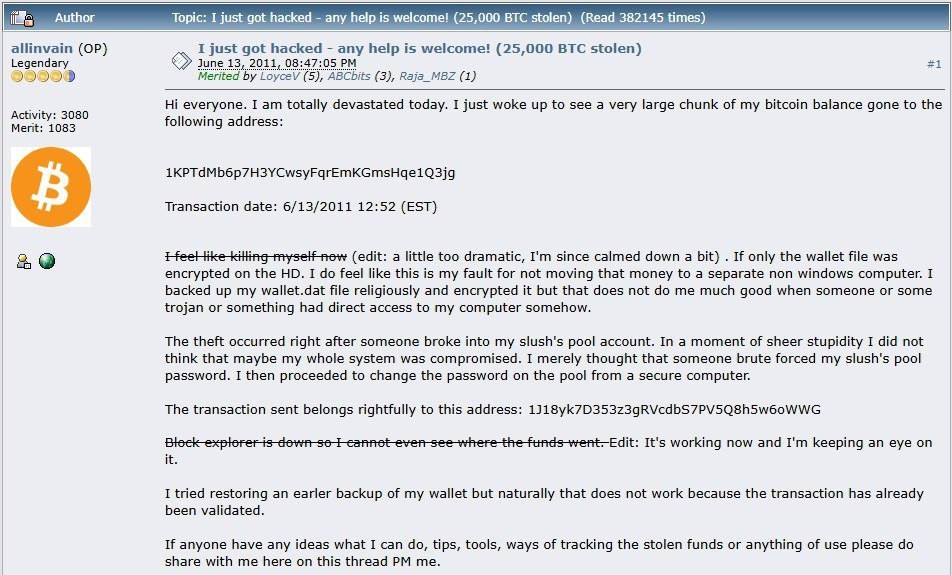
The theft occurred due to a hack of Allinvain’s account on Slush Pool — one of the first and largest mining pools at the time. The attacker, exploiting the lack of two-factor authentication, changed the payout address and redirected the mined coins to their own wallet.
The key mistake of the wallet owner was storing the wallet.dat file unencrypted on a standard Windows PC, running software from various sources. The private keys in the file were copied by the attacker, and all 25,000 BTC were withdrawn almost instantly, with no way to stop or recover them.

As a result, the 25,033 BTC were gradually broken up and transferred to numerous other addresses, making them practically unrecoverable. Only 0.004 BTC remained in the original wallet. The perpetrator’s identity was never discovered, and the case became one of the most famous and instructive warnings about the importance of securely storing cryptocurrency and protecting private keys.
This story still serves as a reminder that even massive sums in digital currencies can be lost due to human negligence or insufficient security measures, providing an important lesson for all crypto market participants.
All content provided on this website (https://wildinwest.com/) -including attachments, links, or referenced materials — is for informative and entertainment purposes only and should not be considered as financial advice. Third-party materials remain the property of their respective owners.