

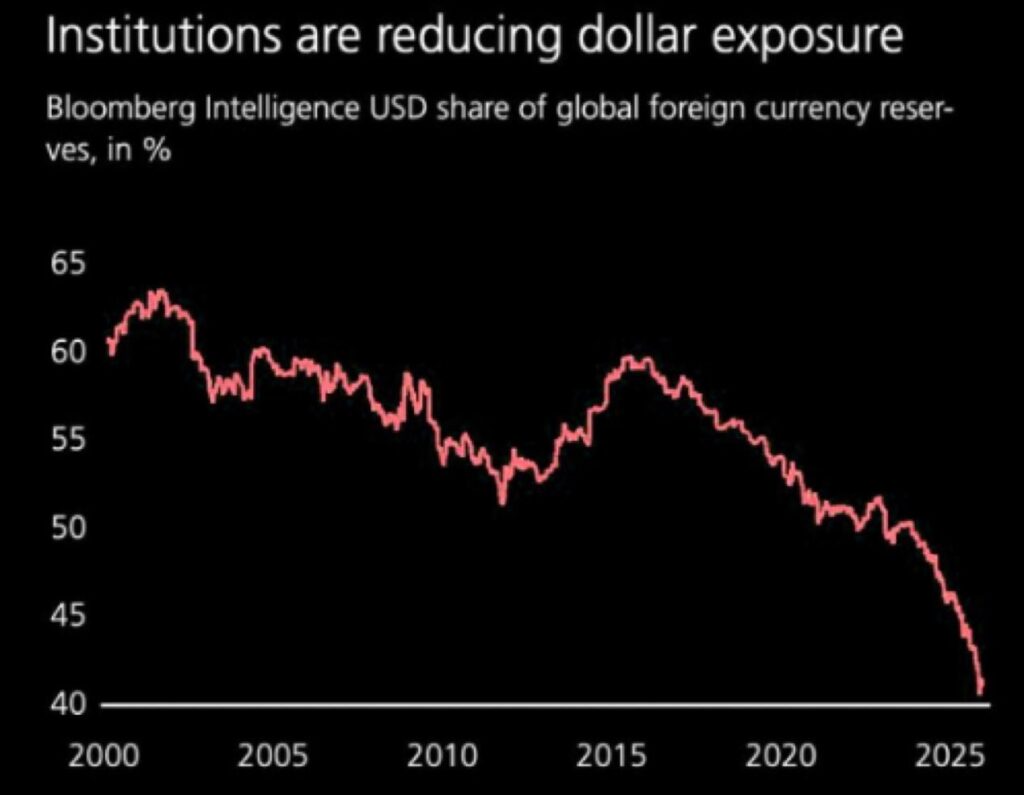
The share of the US dollar in global foreign exchange reserves has fallen to its lowest level in the entire 21st century, and this is no longer just statistics from central bank reports, but a reflection of a deeper shift in the global financial system. Formally, the dollar still remains the main reserve currency, but its position is gradually eroding – not through a sharp collapse, but through slow yet steady erosion.
Back in the early 2000s, the dollar’s share in reserves exceeded 70%. Today, according to international financial institutions, it is significantly below that level, gradually approaching marks that were previously considered psychologically important. At the same time, this does not mean that central banks are massively getting rid of the dollar. Rather, they are increasingly diversifying their reserves, reducing dependence on a single currency.
The reasons for this process have been building up over more than a year. First, the structure of the global economy has changed. While the United States used to be the main center of consumption and finance, today a significant part of global trade has shifted toward Asia. This automatically increases the role of other currencies in settlements and, consequently, in reserves. When trade is not conducted in dollars, the need to hold them in прежних volumes decreases.
Second, geopolitics is increasingly influencing the behavior of central banks. The use of financial sanctions as a tool of pressure has forced many countries to consider the risks of holding reserves in dollars. Even if such measures do not directly affect them, the precedent itself changes perception. Reserves cease to be purely an economic instrument and become an element of political security.
An additional role is played by the growth of alternatives. The euro is gradually strengthening its position as a regional reserve currency, especially in Europe and neighboring countries. The yuan, despite limitations, is expanding its presence through trade with Asia, Africa, and the Middle East. In recent years, China has been actively promoting settlements in its national currency by concluding bilateral agreements and creating financial infrastructure that reduces dependence on the dollar system.
At the same time, interest in gold is growing. Central banks are increasingly increasing its share in reserves, viewing the metal as a neutral asset not tied to the policy of any specific country. This is especially noticeable amid rising global uncertainty: when confidence in currencies fluctuates, gold once again becomes that “anchor” that does not depend on government decisions and sanctions regimes.
It is important to understand that a decline in the dollar’s share does not necessarily mean its weakening in absolute terms. In some cases, the volume of dollar reserves may even grow, but other components are increasing faster. As a result, the share changes, although the dollar itself remains a key element of the system.
At the same time, the United States still retains strong structural advantages. The American financial market is the deepest and most liquid in the world. Treasury bonds remain the main instrument for placing reserves, and the infrastructure of dollar settlements – from the banking system to global payment channels – still dominates. This creates an inertia effect: even if countries want to diversify, they cannot fully abandon the dollar without significant costs.
Nevertheless, the trend is obvious. The world is gradually moving from a unipolar currency system to a more fragmented model. This is not a revolution, but an evolution – slow, sometimes almost imperceptible, yet strategically significant. In such a system, the dollar remains the largest player, but no longer the only center of attraction.
For markets, this means one thing: the stability that investors are used to is becoming more conditional. Currency fluctuations, changes in the structure of reserves, and the growth of alternative settlement systems will occur more frequently. This means that the importance of trust, liquidity, and political stability will only increase.
And the main conclusion here is quite pragmatic. The dollar is not disappearing and does not lose its status overnight. But it is gradually ceasing to be without alternative. And in the financial world, this is already half of a change in the rules of the game.
All content provided on this website (https://wildinwest.com/) -including attachments, links, or referenced materials — is for informative and entertainment purposes only and should not be considered as financial advice. Third-party materials remain the property of their respective owners.