

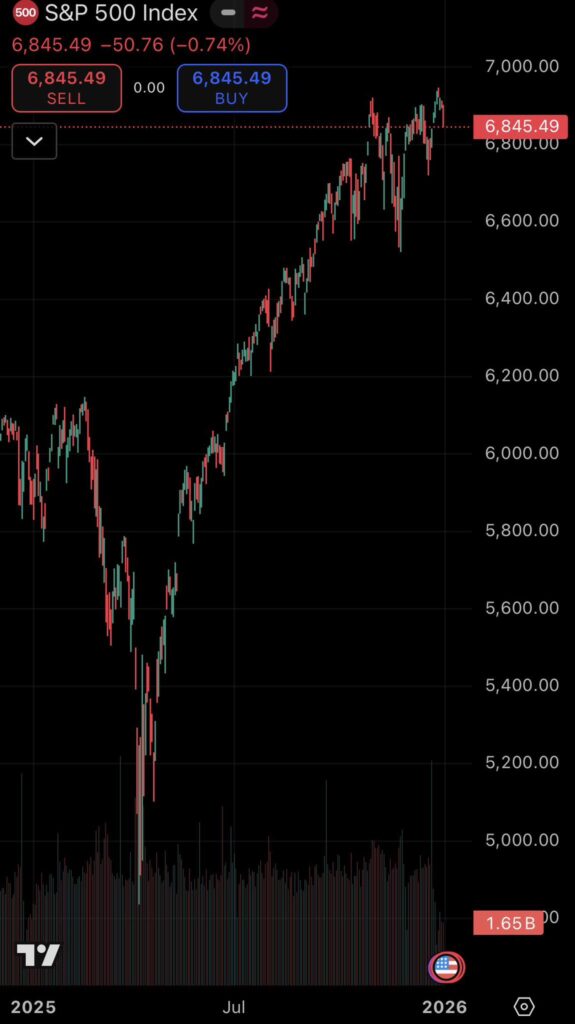
The year 2025 turned out to be demonstrably uneven for the U.S. stock market: the S&P 500 index as a whole rose by 16.39%, but within the index the gap between winners and laggards was enormous. It was a year when investors clearly separated companies of the future, companies of the “here and now,” and businesses the market temporarily turned away from.
? Nvidia:+38.9% ? Apple:+8.6% ? Google: +65.4% ? Microsoft: +14.7% ? Amazon: +5.2% ? Meta Platforms: +12.7% ? Broadcom: +49.3% ? Tesla: +11.4% ? Berkshire Hathaway: +10.9% ? Eli Lilly: +39.2% ? Walmart: +23.3% ? JPMorgan: +34.4% ? Visa: +11% ? Oracle: +17% ? Mastercard: +8.4% ? Exxon Mobil: +11.9% ? Johnson & Johnson: +43.1% ? Netflix: +5.2% ? Palantir: +135% ? Abbvie: +28.6% ? Bank of America: +25.1% ? Costco: -5.9% ? AMD +77.3% ? Home Depot: -11.5% ? Procter & Gamble: -14.5% ? General Electric: +84.7% ? Micron: +239.1% ? Chevron: +5.2% ? Cisco: +30.1% ? Coca-Cola: +12.3% ? UnitedHealth: -34.7% ? Wells Fargo: +32.7% ? Morgan Stanley: +41.2% ? IBM: +33% ? Caterpillar: +57.9% ? Goldman Sachs: +53.5% ? Merck: +5.8% ? American Express: +24.7% ? Philip Morris: +33.3% ? Salesforce: -20.8% ? Raytheon: +58.5% ? Applovin: +108.1% ? T-Mobile: -8% ? Abbott: +9% ? Thermo Fisher: +10.2% ? McDonald’s: +4.1% ? Lam Research: +3.2% ? Citi: +64.4% ? Applied Materials: +54%
The main driver of growth once again was the technology sector, above all everything related to artificial intelligence, semiconductors, and high-performance computing. The absolute phenomenon of the year was Micron, whose shares rose by more than 239%. Such growth reflects not only the cyclical recovery of the memory market, but also the strategic role of DRAM and HBM chips in AI infrastructure. Micron became a symbol of how a “boring” component company can suddenly find itself at the center of a global technological boom.
The results of Palantir (+135%) and Applovin (+108%) looked no less impressive. Palantir finally stopped being perceived as a niche analytics company and secured its status as a key player at the intersection of big data, defense contracts, and commercial AI. Applovin, in turn, became a beneficiary of the growth of mobile advertising and algorithmic optimization of app monetization.
It was also a strong year for classic industrial and infrastructure giants. General Electric gained almost 85%, Caterpillar about 58%, and Raytheon more than 58%. This reflects the global trend toward reindustrialization, rising defense budgets, and investment in infrastructure, energy, and manufacturing. Investors once again remembered that the “old economy” has not gone anywhere and at certain moments can look no less attractive than big tech.
The semiconductor sector as a whole became one of the main winners of the year. Nvidia rose by almost 39%, AMD by more than 77%, Broadcom by 49%, Applied Materials by 54%, while Lam Research showed moderate but positive growth. Even Google, with its +65%, was largely perceived by the market not as a search engine, but as an AI platform. It was a year when investors voted with their money for computing power, clouds, and AI-related hardware.
The financial sector also surprised with its resilience. JPMorgan gained more than 34%, Goldman Sachs over 53%, Morgan Stanley more than 41%, Citi around 64%, Wells Fargo nearly 33%, and Bank of America over 25%. Against the backdrop of high interest rates, rising margins, and the stabilization of the banking system after previous stresses, financial giants once again began to look like reliable profit-generating machines.
Pharmaceuticals and healthcare showed mixed, but overall positive dynamics. Eli Lilly rose by more than 39% amid hype around weight-loss drugs. Johnson & Johnson gained over 43%, AbbVie nearly 29%, Abbott around 9%, and Merck a modest 5.8%. At the same time, UnitedHealth became one of the main disappointments of the year, losing almost 35%, reminding investors that even defensive sectors are not immune to regulatory and operational risks.
The consumer sector looked far less clear-cut. Walmart rose by more than 23%, Coca-Cola added around 12%, and McDonald’s showed a modest 4%. However, Costco, Home Depot, and Procter & Gamble closed the year in the red, reflecting pressure on consumer spending, rising costs, and changing consumer habits amid high inflation and interest rates.
Big tech as a whole spent the year without euphoria, but also without collapses. Apple added 8.6%, Microsoft nearly 15%, Amazon around 5%, Meta Platforms 12.7%, and Tesla 11.4%. It was a year of consolidation rather than explosive growth: companies earned money, optimized their businesses, invested in AI, but the market was no longer willing to pay any price for them.
Berkshire Hathaway also deserves a separate mention, having risen by nearly 11%. In a world of high technology and speculative stories, Buffett’s portfolio once again confirmed its reputation as a quiet harbor, where growth is not the fastest, but it is steady.
As a result, 2025 became a clear lesson in selectivity. The index as a whole was rising, but real alpha was delivered not by “everything at once,” but by specific themes: AI, semiconductors, defense, infrastructure, and strong financial institutions. It was a year when the market did not forgive weakness, but generously rewarded those who found themselves at the right point in the technological and economic cycle.
All content provided on this website (https://wildinwest.com/) -including attachments, links, or referenced materials — is for informative and entertainment purposes only and should not be considered as financial advice. Third-party materials remain the property of their respective owners.