


In 2010, a unique website appeared that forever changed the way Bitcoin spread and influenced attitudes toward cryptocurrencies. Any user could claim 5 BTC by completing a simple captcha. At the time, this was literally just a few cents, but with today’s price, one such “gift” is worth approximately $430,000.
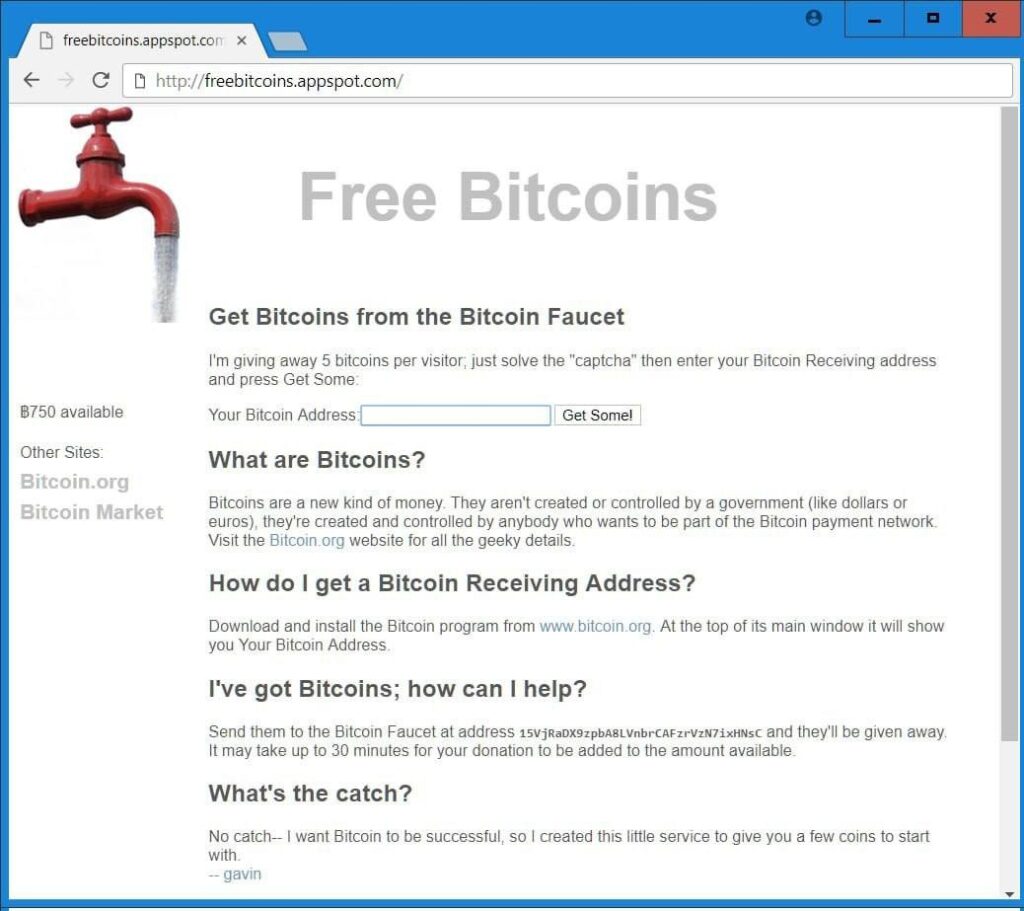
The faucet was initiated by Gavin Andresen, one of Bitcoin’s key developers, who wanted to popularize the network and teach people how to use crypto wallets. His goal was simple: to show that Bitcoin is accessible to everyone, even those who don’t understand mining or complex crypto operations.
Around 19,700 BTC were distributed through this faucet, and early users received their first coins in just a few clicks. The original faucet gave away 5 BTC to every new network participant for free, and Andresen himself funded it with 1,100 BTC, seeing it as a way to organically grow the network.

The idea was successful: thousands of people were introduced to Bitcoin through the faucet. It served as an educational tool, allowing newcomers not just to receive coins, but also to understand how wallets, transactions, and network interactions work. At the time, acquiring or mining BTC was complicated, requiring knowledge and significant effort, and the faucet became a true “gateway” into the world of cryptocurrencies.
By the time the faucet was closed, payouts had reduced to fractions of BTC, but its cultural impact remained legendary. It became a symbol of the early Bitcoin community, representing openness and an educational approach. Considering the rapid rise in BTC’s value over the following decade, many of the faucet’s first users literally became millionaires.
Today, the legendary BTC faucet is viewed not just as a technological experiment — it is a prime example of how a small idea aimed at learning and engagement can create long-term change in the global financial landscape. A small click then, a giant fortune now — that’s the lesson of Bitcoin history.
All content provided on this website (https://wildinwest.com/) -including attachments, links, or referenced materials — is for informative and entertainment purposes only and should not be considered as financial advice. Third-party materials remain the property of their respective owners.