


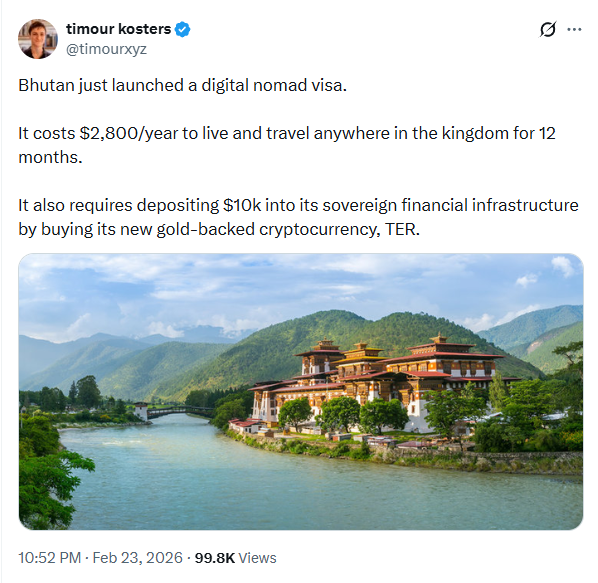
The Kingdom of Bhutan is betting on the digital economy and launching a new model for attracting foreigners – a crypto visa for digital nomads. The initiative is designed for those who work remotely and are ready to combine life in the Himalayas with participation in a state crypto experiment.
The government announced the launch of a one-year visa costing $2,800. It grants the right to legally reside and travel in Bhutan for 12 months. However, a key condition for participation is a mandatory contribution of $10,000 into the new state cryptocurrency TER. These funds are not a visa fee in the classical sense – they are placed in a token which, according to the authorities, is backed by physical gold stored in state reserves.

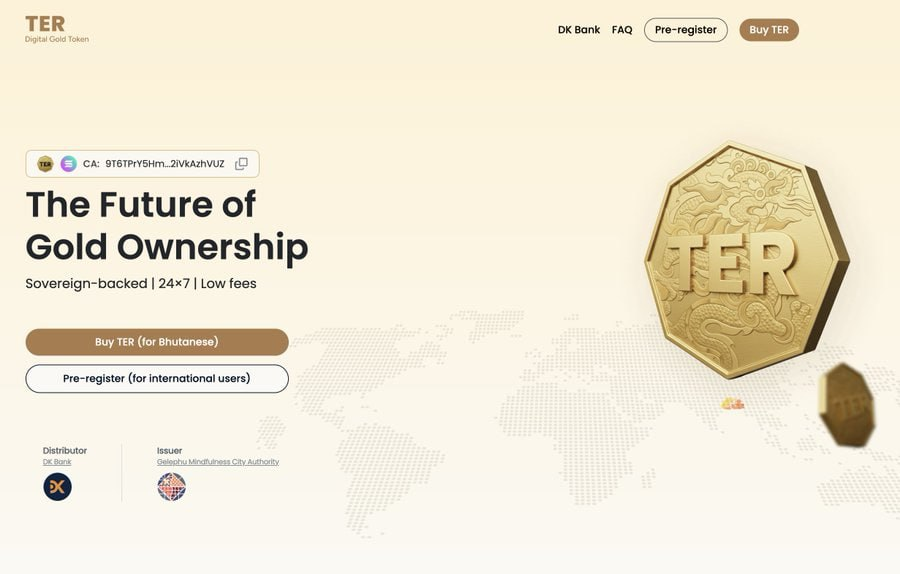
The TER token is issued on the Solana blockchain. The choice of this network is explained by high transaction speed and low fees. According to the developers’ concept, TER is intended to perform several functions at once: to serve as a means of payment within the country, a temporary store of funds for foreigners, and an element of a broader strategy for digitizing the financial system. The authorities promise to return the contributed funds upon the participant’s departure from the country, making the model similar to a time-limited deposit.
According to representatives of the tourism department, one of the motivations for launching the project was difficulties with international banking settlements. Many travelers face SWIFT system restrictions, transfer delays, and fees when paying for services abroad. The authorities state that the use of cryptocurrency solutions and, in particular, the Binance Pay service allows these limitations to be bypassed, ensuring fast and direct settlements between tourists and local merchants.
The head of Binance, Richard Teng, called the project the first national crypto payment system integrated at the state level. According to his estimate, the average crypto tourist spends about $1,000 per trip – almost three times more than a regular tourist. At the same time, entrepreneurs receive settlements instantly, without banking delays or additional fees. This is especially important for small businesses in the tourism sector.
At present, more than 1,000 local merchants – from hotels and restaurants to craft shops – have already joined the system. The promotion of digital payments within the country is handled by DK Bank, which is actively implementing infrastructure for QR payments and mobile wallets. According to the bank’s management, Bhutan already has a high level of retail payment digitization, so the integration of crypto assets is perceived not as a revolution, but as a logical continuation of the existing financial ecosystem.
The project is also linked to the broader development strategy of the Gelephu Mindfulness City region – a special economic zone focused on sustainable development, technology, and international investment. Project representatives emphasize that cryptocurrencies are viewed not as a side experiment, but as one of the key drivers of the country’s future economic growth.
Bhutan’s interest in digital assets is also confirmed by its position in global rankings. According to data from BitcoinTreasuries, the country ranks sixth in the world by the volume of state bitcoin reserves. Bhutan holds 12,062 BTC on its balance sheet, making it one of the largest bitcoin holders among sovereign states.
Thus, Bhutan is attempting to combine its traditional model of controlled tourism with a modern financial infrastructure. The country, known for its philosophy of Gross National Happiness, is now testing a model in which digital assets become a tool for attracting capital, increasing settlement transparency, and shaping a new type of tourist flow – more technological and, as the authorities expect, more solvent.
All content provided on this website (https://wildinwest.com/) -including attachments, links, or referenced materials — is for informative and entertainment purposes only and should not be considered as financial advice. Third-party materials remain the property of their respective owners.