


Amid the recent Bitcoin rally, an interesting but highly debated theory has emerged and is actively discussed on X. Its core idea is that one factor behind BTC’s price strengthening may be linked not so much to classic drivers like institutional demand or macro liquidity, but to events in the Middle East, particularly the situation surrounding Iran.
Proponents of this view argue that for many years, Iran has been one of the hidden but significant players in the mining industry. With access to relatively cheap electricity domestically, the cost of Bitcoin mining could be significantly lower than global averages. This allowed mining cryptocurrency with high margins and using it as a tool to bypass sanctions, finance imports, and support the economy under limited access to the international financial system.
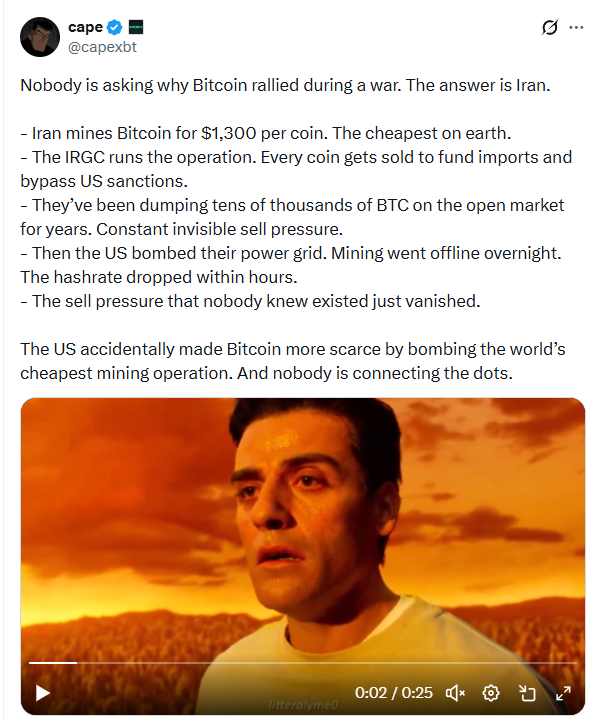
According to this logic, mined coins were not hoarded for the long term but regularly sold on the market. And we are not talking about isolated transactions, but potentially a systematic flow of supply that was not obvious to most market participants. This “invisible seller” could create constant downward pressure on the price, smoothing growth and limiting upward movement.
The theory then takes a key turn. After strikes on Iran’s energy infrastructure, discussed in the context of geopolitical escalation, a significant portion of mining capacity may have been offline. As a result, the global network hashrate temporarily decreased, which was indeed observed in certain periods. More importantly — if we follow this hypothesis — the constant flow of sales that had previously restrained growth may have disappeared from the market.
Consequently, the balance of supply and demand shifted. With demand sustained or rising and supply simultaneously reduced, the price gains a natural upward impulse. Proponents of the theory put it simply: if one of the largest “cheap” miners suddenly disappears, Bitcoin becomes a scarcer asset.
However, like any attractive market story, this version requires caution. First, exact mining volumes in Iran, especially if involving semi-state or shadow entities, remain unknown. Estimates vary, and confirming the scale of their impact on the global market is extremely difficult.
Second, even if Iran’s contribution to mining is significant, today’s Bitcoin market is a multi-trillion-dollar ecosystem with enormous liquidity. To exert systemic pressure on price, sales volumes must be truly substantial and regular. Evidence of such a scale of “hidden supply” is not found in public data.
Third, BTC price movements are almost always the result of multiple factors. Macroeconomics, central bank policies, inflows into investment instruments, behavior of large holders, and overall market sentiment all play a role. Attempting to explain a price rally with a single event, even a notable one, oversimplifies the real picture.
Nevertheless, the logic underlying this theory deserves attention. The crypto market is indeed sensitive to changes in supply structure, and mining remains a key element of this system. Any disruptions in mining, especially in regions with cheap electricity, can affect network dynamics and indirectly influence price.
Ultimately, the story of Iran is a good example of how geopolitics, energy, and finance intersect in the crypto industry. Even if the specific theory is overstated, the very discussion highlights how global and interconnected the market has become, influenced by factors that just a few years ago seemed distant from digital assets.
The main takeaway remains the same: in crypto, there is rarely a single reason for growth or decline. It is usually a complex cocktail of factors, where the truth lies somewhere in between — between a compelling story and the hard numbers.
All content provided on this website (https://wildinwest.com/) -including attachments, links, or referenced materials — is for informative and entertainment purposes only and should not be considered as financial advice. Third-party materials remain the property of their respective owners.