

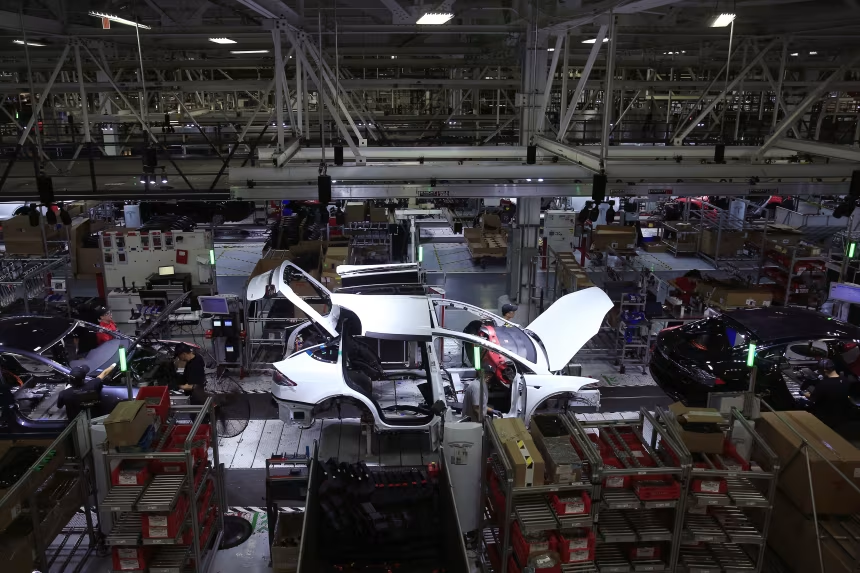
Tesla is making a sharp strategic pivot: the company is discontinuing production of the Model S and Model X and redirecting freed-up manufacturing capacity to the production of humanoid robots. Elon Musk announced this during the quarterly earnings call, effectively acknowledging that the era of Tesla’s flagship electric vehicles is coming to an end.
The irony of the situation is that it was precisely the Model S and Model X that once made Tesla what it is today. These models helped Musk transform a niche electric car maker into a company that reshaped the entire automotive industry. Now, however, he is “pulling the plug” on projects that were once symbols of the brand’s technological superiority.
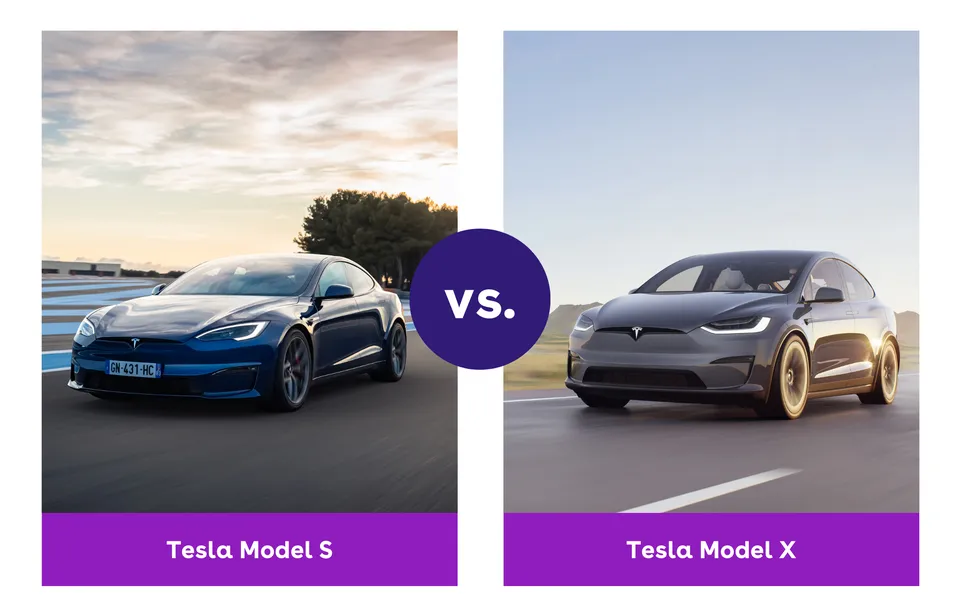
The decision was announced against the backdrop of another weak quarter. Tesla is experiencing a prolonged downturn: sales are falling, profits are declining, and competitive pressure is intensifying. Musk explicitly stated that production facilities previously used for the Model S and Model X – among the most expensive vehicles in the lineup – will be repurposed for assembling humanoid robots. In doing so, he made it clear that he sees Tesla’s future not so much in cars as in autonomous systems, AI, and robotics.
Moreover, the tone of Musk’s statements suggests that selling electric vehicles will become a secondary business for Tesla over time. His primary bet is on robotaxis and autonomous technologies. Musk once again reiterated his claim that the two-seat Cybercab – a driverless taxi without a steering wheel or pedals – will eventually be sold in volumes “several times greater” than the combined sales of all other Tesla models.
The problem is that reality is still lagging far behind these projections. Tesla’s robotaxi service has yet to be deployed at full scale. In its current version, the vehicles rely on company employees as “safety monitors,” while competitors already offer fully driverless rides in dozens of cities. At the same time, sales of electric vehicles and the profits generated from them remain the primary source of cash flow that Tesla uses to fund its ambitions in AI and autonomy.
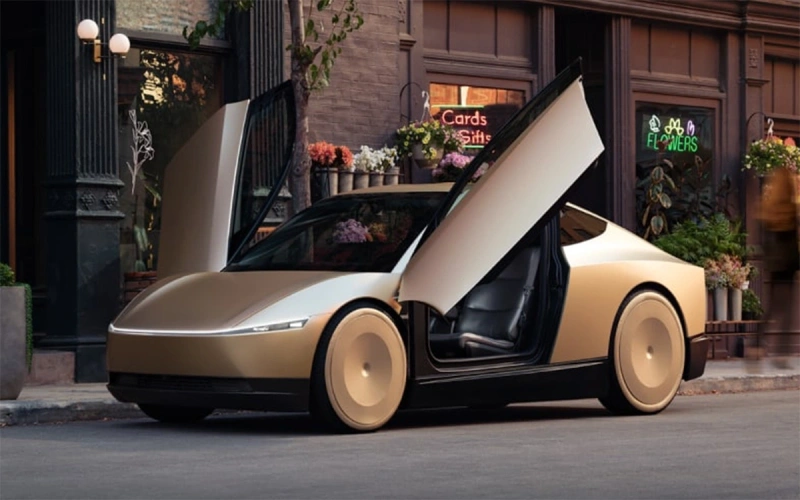
CyberCab (Robotaxi) (Foto: Tesla)
Financial results confirm the strain. Tesla reported that adjusted profit for the last three months of 2025 declined by 16%. Net income fell even more sharply: down 61% quarter-over-quarter and down 46% for the year. In absolute terms, this represents a reduction in profit of $3.3 billion.
The fourth quarter of 2025 was the worst in Tesla’s history in terms of year-over-year sales volume. The decline in annual sales was the largest ever for a company that had previously grown at a pace of nearly 50% per year. Tesla’s profits declined in nine of the last ten quarters. By the end of 2025, the company’s annual profit amounted to only about 30% of its record 2022 level, when Tesla earned $12.6 billion.
An additional source of pressure has been brand reputation. In 2025, Tesla faced backlash from some customers in the US and Europe related to Elon Musk’s political activity and his close relationship with US President Donald Trump. At the same time, the overall electric vehicle market in the US slowed after the cancellation of the $7,500 federal tax credit for EV buyers.
Competition is also intensifying, especially in China – Tesla’s second most important market after the US. In 2025, Tesla lost its status as the world’s largest electric vehicle manufacturer, ceding the position to China’s BYD. Against this backdrop, abandoning the Model S and Model X is unlikely to have a significant impact on sales volumes: together, these models account for only about 3% of the company’s global deliveries. Production is expected to be fully halted within the next quarter.
In its report, Tesla also disclosed for the first time details of a $2 billion investment deal with xAI, an AI startup founded by Elon Musk in 2023. The same structure also owns the social media platform X. This move once again underscores Tesla’s strategic focus on artificial intelligence and autonomous systems.
Promises of robots and robotaxis have repeatedly inspired investors. These narratives helped Tesla’s shares reach an all-time high in December, although the stock has since pulled back somewhat. After the earnings release, Tesla shares edged higher in post-market trading when the company announced plans to expand its robotaxi service to seven markets in the first half of the year, in addition to the two currently active.
Previously, Tesla claimed that by the end of 2025 its robotaxi service would be available to half of the US population. Musk revised the forecast, stating that by the end of 2026 fully autonomous vehicles would be available across 25-50% of the country – subject to regulatory approval.
As a result, Tesla is increasingly transforming from an automaker into a bet on AI, autonomy, and robotics. The only question is whether the company has enough time and financial runway to survive until these promises begin generating real money, rather than merely sustaining investor belief.
All content provided on this website (https://wildinwest.com/) -including attachments, links, or referenced materials — is for informative and entertainment purposes only and should not be considered as financial advice. Third-party materials remain the property of their respective owners.