


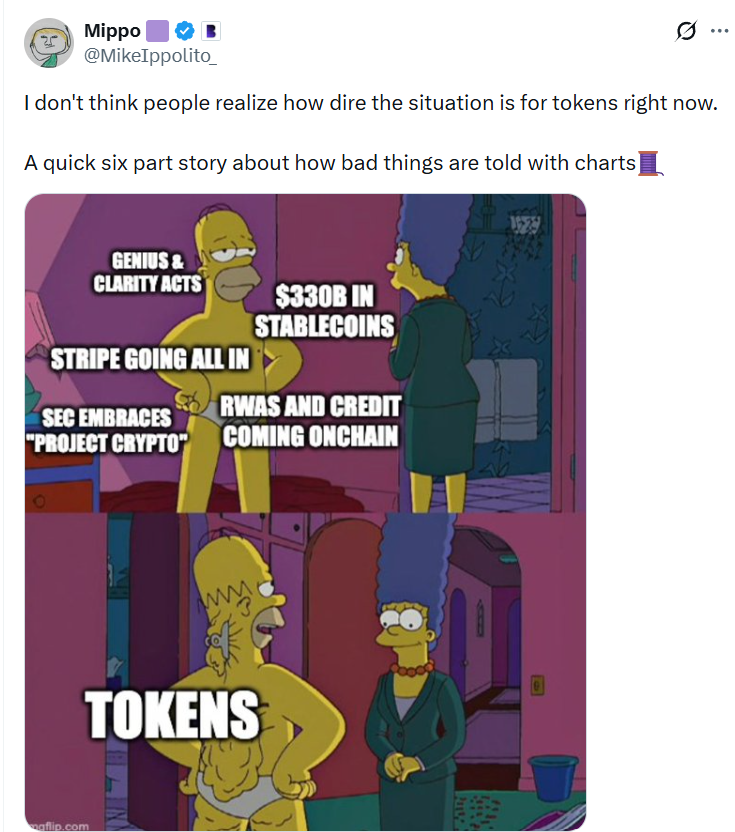
The growth in the number of cryptocurrency tokens is increasingly outpacing the real value they create. And this is no longer just a market feature – it is a systemic issue that could shape the future of the entire industry. This point is highlighted by Blockworks founder Michael Ippolito, who analyzed the situation in a series of posts.

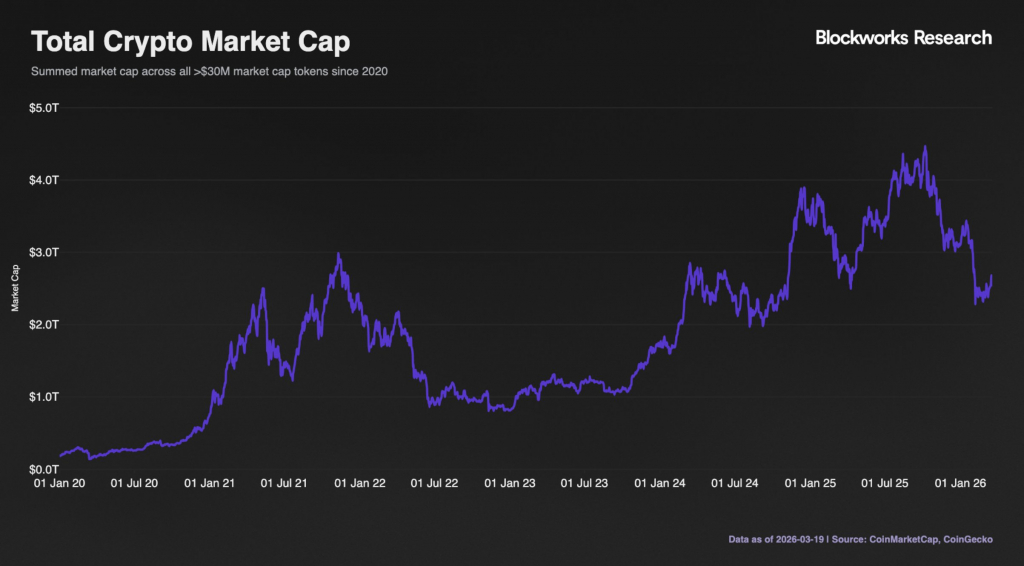
At first glance, the market looks quite stable. The total crypto market capitalization remains at high levels, creating an impression of stability and even growth. But this is one of those cases where the “average temperature in the hospital” is more comforting than accurate.
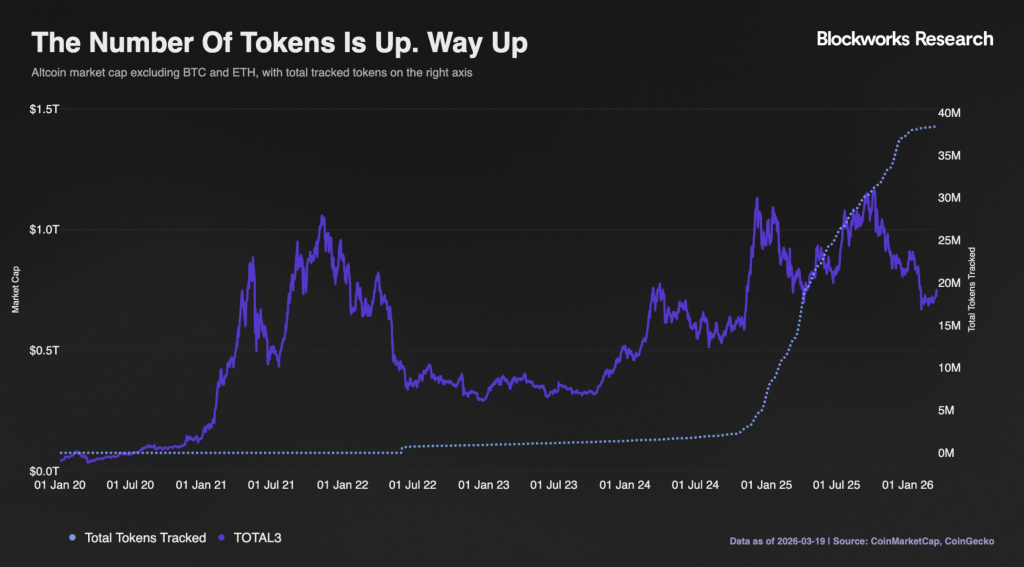
If Bitcoin and Ethereum are excluded from the calculation, the picture changes dramatically. The remaining market essentially falls back to levels seen five years ago. And this is a key signal: all visible growth is driven by a narrow group of leaders, while the majority of tokens are either stagnating or losing value.
The reason is largely mathematical, but the consequences are very practical. Market capitalization is the product of price and supply. If supply grows faster than demand, the outcome is clear. Today the industry is minting new tokens at such a pace that even capital inflows simply cannot keep up.
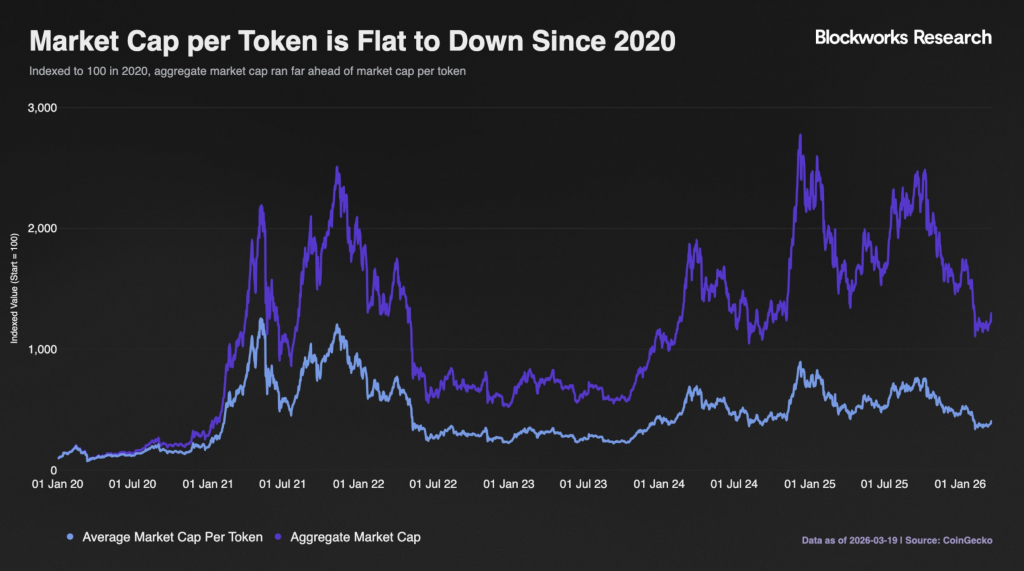
In effect, the market has reached a point where each new asset dilutes the value of existing ones. Over recent years, a huge number of tokens have been created, but the overall pie has not grown proportionally. As a result, the average value of a single coin remains close to 2020 levels, and since 2021 it has declined by roughly 50 percent.
If we remove the dilution effect and look only at price, the picture becomes even harsher. Median token returns show a drop of about 80 percent from peak levels. This is no longer just volatility – it is a sign that the market no longer treats all projects equally.
But the most telling divergence appears elsewhere. In 2021, token prices and real blockchain revenue moved almost in sync. The logic was clear: more users – higher revenue – higher token value. Today that link is broken. In 2025, blockchain revenue increased significantly, but token prices did not follow.
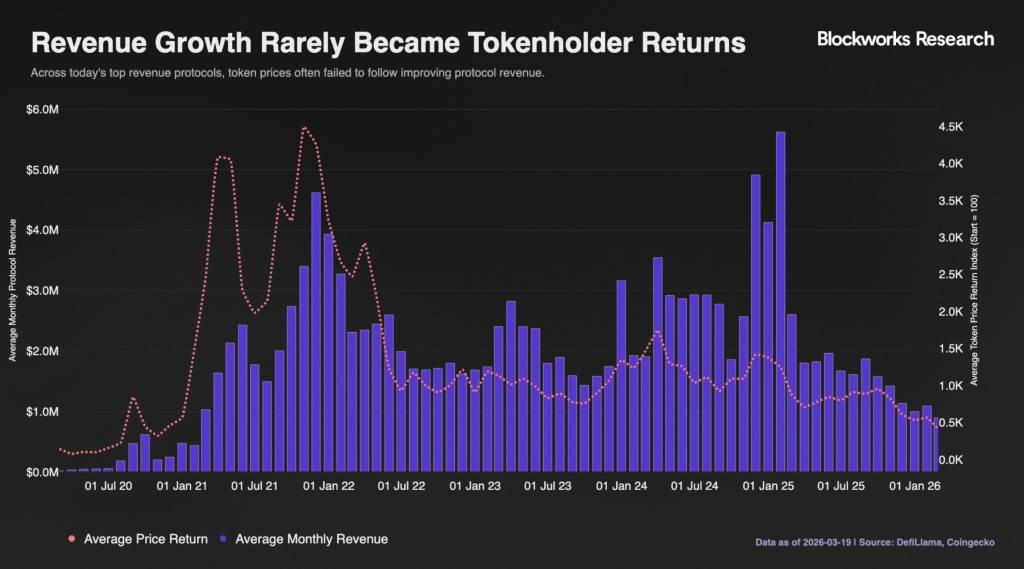
This signals a fundamental shift in perception. Investors no longer view tokens as a direct reflection of protocol performance. If a token once functioned like a “stock” within a blockchain economy, it is now increasingly seen as a separate and not always necessary element.
Ippolito directly points to the risks of such a scenario. Tokens are the core incentive for most market participants. They create a sense of participation, provide access to investment opportunities, and form the so-called “user economy.” If this mechanism stops working, the industry risks losing one of its core ideas.
In the worst case, the crypto market could transform into an infrastructure layer for traditional finance – useful and technologically advanced, but lacking the investment appeal that once attracted millions of users.
From a broader historical perspective, this situation is not unique. Markets have gone through similar cycles before. In 2017-2018, during the ICO boom, dozens of new tokens were created daily, many of which had no real value. The market then corrected through a sharp decline and reassessment.
Today the difference is that technology has made token creation almost trivial. Any project can launch a token in a matter of hours. As a result, the speed of new token issuance has increased dramatically, while quality filters have nearly disappeared.
Another important factor is dilution, which remains underappreciated. Even if a project shows revenue growth, an increase in token supply can completely offset this effect for investors. In simple terms, the business grows, but the token price does not. This creates an internal contradiction: the protocol’s economy expands, but token holders do not receive proportional benefits. Over time, this undermines trust and pushes investors toward more predictable and understandable instruments.
In the end, the market once again finds itself in an experimental phase. The industry continues to search for a balance between technology, economics, and participant interests. New value distribution models may emerge, where tokens play a clearer and more justified role. Or the market may simply go through another cleansing phase.
For now, the situation looks rather straightforward: there are more and more tokens, but not enough value to go around. And in such conditions, it is not those who create assets faster who win, but those who can truly maintain user attention, trust, and capital.
All content provided on this website (https://wildinwest.com/) -including attachments, links, or referenced materials — is for informative and entertainment purposes only and should not be considered as financial advice. Third-party materials remain the property of their respective owners.