


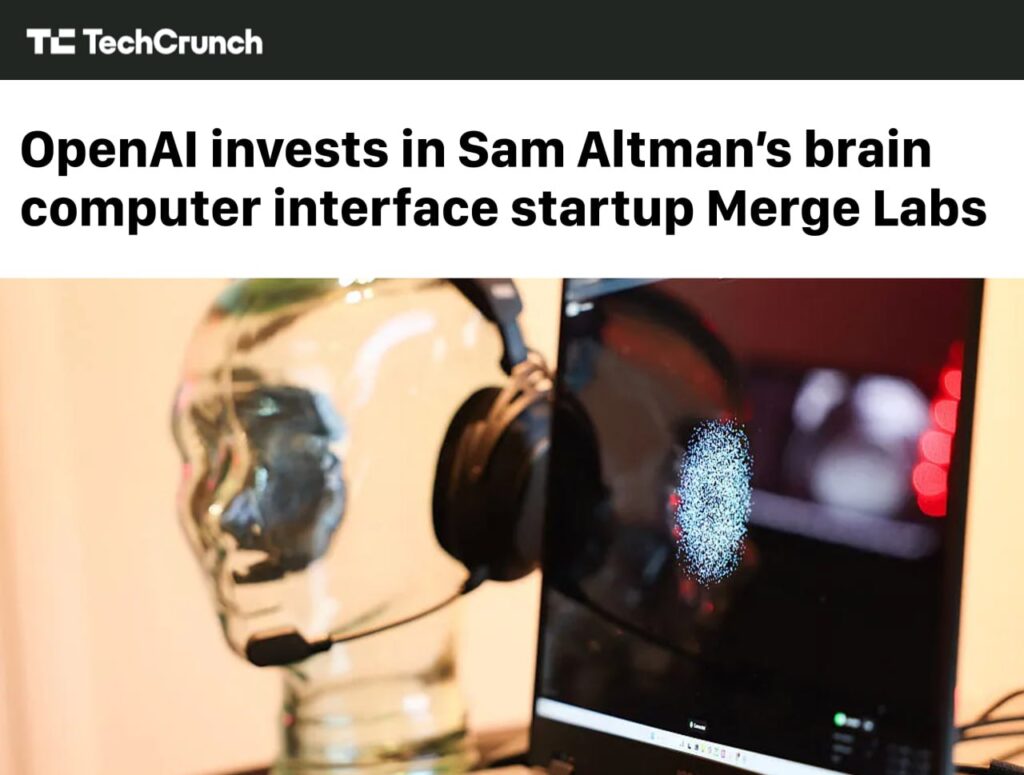
The idea of directly connecting the human brain to artificial intelligence, which until recently sounded like science fiction, is gradually moving out of futuristic presentations into the realm of real startups, laboratories, and checks worth hundreds of millions of dollars. Sam Altman has introduced Merge Labs – a company working on a new type of neural interface that promises to connect the brain and AI without chips, surgery, or skull trepanation.
The startup emerged from stealth mode loudly. The seed round totaled $252 million, and the company’s valuation reached $850 million. OpenAI became the largest investor. Bain Capital and Gabe Newell, co-founder of Valve, also participated in the round. Altman himself is formally involved “in a personal capacity,” but his influence is obvious: Merge Labs is effectively being built as a future interface between humans and OpenAI products.
How Merge Labs differs from Neuralink
Comparisons with Elon Musk’s Neuralink are inevitable, but the approaches are fundamentally different.
Neuralink is about surgery, implants, and electrodes implanted directly into the brain. Yes, the technology is already being tested on humans, and to date implants have been installed in 12 volunteers. But the cost of this approach is open-brain surgery, medical risks, and an extremely narrow scalable market.
Merge Labs is betting on a non-invasive method. The core of the technology is ultrasound combined with special molecules that amplify and make neural signals more readable. Essentially, the system allows brain activity to be read without opening the skull, influencing neurons from the outside.
The development grew out of the non-profit laboratory Forest Neurotech, where experiments have already been conducted on patients with traumatic brain injuries. This is an important point: this is not pure theory, but technologies that have already undergone clinical testing.
Who is behind the project
Among the co-founders are serious names from neuroscience and engineering:
- Mikhail Shapiro (Caltech), one of the leading researchers in ultrasound neuromodulation
- Tyson Aflalo and Sumner Norman from Forest Neurotech
- Alex Blania and Sandro Herbig – CEO and product leader of Tools for Humanity, the company behind the World project and iris-scanning technology
This lineup clearly shows that Merge Labs sits at the intersection of three fields: neurobiology, mass identification technologies, and AI interfaces.
Why OpenAI is interested
OpenAI officially explains its interest simply: neural interfaces could become the most natural way to interact with AI. Without a keyboard, screen, voice, or even gestures.
Translated from corporate language into human terms, the idea looks like this:
a person formulates a question in their mind, the system reads it, and the answer returns not as text but as sensations, images, or a directed stream of thoughts.
For OpenAI, this is potentially a strategic asset. If the technology works, Merge Labs will become not just a startup but a universal control panel for AI. Whoever controls the interface no longer needs intermediaries in the form of devices, operating systems, or platforms.
A new round in the Altman-Musk conflict
Against this backdrop, the confrontation between Sam Altman and Elon Musk reaches a new level. In June 2025, Neuralink raised $650 million at a valuation of around $9 billion and is actively pursuing a medical trajectory.
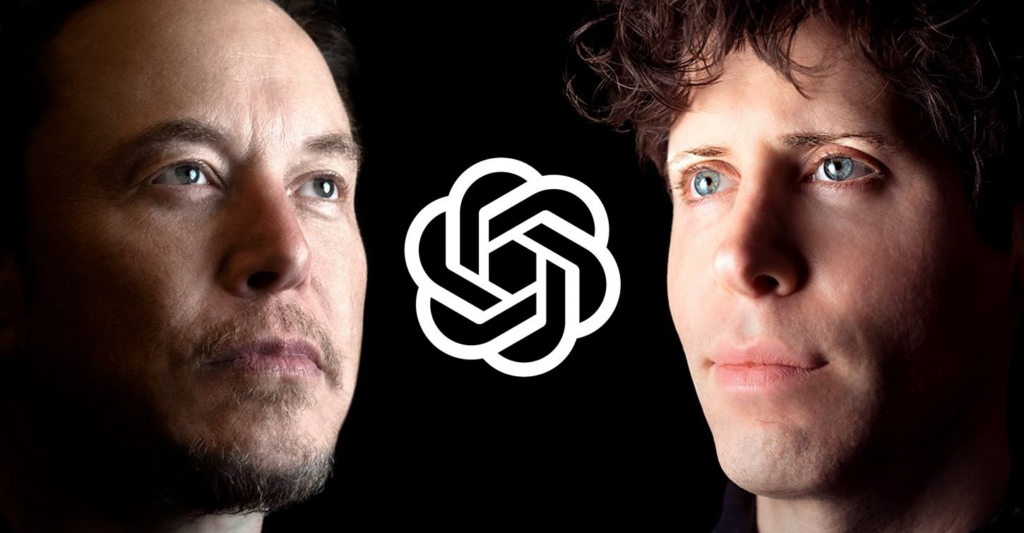
Merge Labs is more honest in its expectations: the company openly says that development will take decades, not years. But the bet is on scale and mass adoption. Remove surgery and chips, and the market becomes an order of magnitude larger.
Morgan Stanley estimates the neural interface market at around $400 billion in the US alone. And that is without accounting for the global market and consumer use cases.
The most disturbing question
Technologically, all of this looks exciting. Philosophically, it is disturbing. If AI begins not just to answer questions but to interact directly with human thinking, the boundary between a tool and part of one’s identity starts to blur.
And this is where the main paradox of the era emerges:
People say: we are tired of AI, it is everywhere, it pressures and overwhelms us
OpenAI’s response: “great, then let’s put it directly into your head”
The story of Merge Labs is not just a startup news item. It is a signal of where the biggest players are looking. Screens, keyboards, and even voice are temporary interfaces. The ultimate goal is obvious: direct access to human thought.
The question is no longer whether this is technically possible. The question is whether people are ready for it – and who will keep their hand on the off switch.
All content provided on this website (https://wildinwest.com/) -including attachments, links, or referenced materials — is for informative and entertainment purposes only and should not be considered as financial advice. Third-party materials remain the property of their respective owners.