

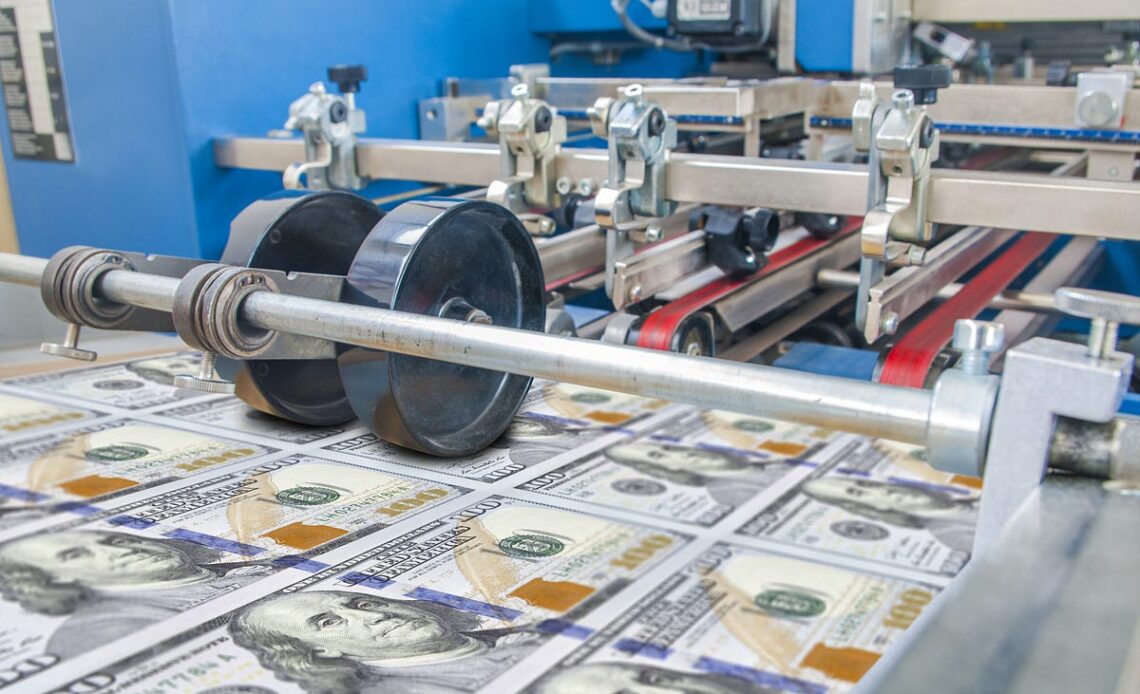
Talks about the “printing press,” supposedly turned on only in emergencies, are looking increasingly naive. In practice, the monetary system works much more subtly: liquidity is added not through loud announcements, but via careful, almost imperceptible operations. And the past few months provide a striking example of this.
Since the end of 2025, the Federal Reserve’s balance sheet has indeed begun to grow — by roughly $110.6 billion in total. Formally, this is not a declared round of quantitative easing; no “QE 5” was announced at press conferences. But looking at the operational dynamics, the picture becomes much more interesting: regular purchases of government bonds in almost serial volumes of $6–8 billion.
Recent dates confirm the rhythm of the process. March 16 — $6.7B, followed by several $8.0B operations a couple of days apart, again $6.7B at month’s end, and similar purchases in early April. This is not a one-time intervention, but a systematic market support with liquidity — quietly, without unnecessary noise. For clarity, here is the recent schedule of US Treasury bond purchases:
- March 16: $6.726B
- March 19: $8.071B
- March 24: $8.071B
- March 26: $8.071B
- March 30: $6.726B
- April 1: $8.071B
- April 7: $8.071B
At first glance, nothing unusual. Central banks always manage liquidity. But the context matters. After aggressive rate hikes in previous years, the market expected tightening rather than a gentle return to pumping money into the system. What happens instead is something in between: officially — fighting inflation; in practice — careful easing.
Why is this happening? The answer lies in the balance of risks. On one hand, inflation remains a sensitive issue. On the other hand, the financial system is too fragile to sharply deprive it of liquidity. Public debt is rising, the market needs buyers, and banks and funds are not always willing to participate at previous volumes. In such a situation, the regulator acts as an “invisible buyer of last resort.”
By purchasing bonds, the Fed effectively injects money into the system. These funds do not sit idle — they begin circulating. Some go into lending, some into the stock market, and some into alternative assets. And here is the most interesting part: liquidity rarely stays where it was “officially” directed.
Historically, such periods often coincide with a rise in risk assets. Stocks, tech companies, cryptocurrencies — everything sensitive to excess money begins receiving support. It does not always appear as a direct consequence of Fed policy, but the connection is clear.
However, there is a flip side. When liquidity is added to a system already experiencing high price pressures, there is a risk of amplifying inflation. Simply put, the money supply grows faster than the production of goods and services. And that is the classic formula for price increases.
The paradox is that ordinary consumers may face two opposing forces simultaneously. On one hand — decreasing purchasing power due to inflation. On the other — asset markets rise, creating an illusion of wealth, but accessible to far from everyone.
The question of the dollar in this context is inevitable. The US dollar remains the world’s reserve currency, backed by the scale of the economy, depth of financial markets, and investor trust. But trust is not infinite.
If the market begins to perceive Fed actions as hidden easing amid high inflation, it may put pressure on the currency. Not necessarily a crash — such scenarios are usually overstated — but gradual erosion of purchasing power and reduced real returns are possible.
It’s important to understand: talk of a “dollar collapse,” which has persisted for decades, is often premature. The US financial system has tremendous resilience. However, this does not change the fact that the current balance between inflation, debt, and liquidity is becoming increasingly fragile.
2026 could indeed be an interesting year from a monetary policy perspective. The Fed will have to navigate between controlling inflation and avoiding market destabilization. Such periods rarely go unnoticed by investors.
In summary, we are witnessing not so much the “switching on of the printing press” as its quiet operation in the background. Without loud announcements, but with tangible consequences. And, as often happens, the main effect will not appear immediately — but later, when the accumulated liquidity starts finding its use.
Under such conditions, the market behaves predictably: as long as money exists, growth continues. The question is only what will have to be paid for that growth later.
All content provided on this website (https://wildinwest.com/) -including attachments, links, or referenced materials — is for informative and entertainment purposes only and should not be considered as financial advice. Third-party materials remain the property of their respective owners.