


The labor market in the era of artificial intelligence is indeed starting to change faster than both companies and employees are ready for. The statement by Palantir CEO Alex Karp only added fuel to the fire, but in essence, he voiced what the industry has been discussing for years — just in a harsher and more provocative form.
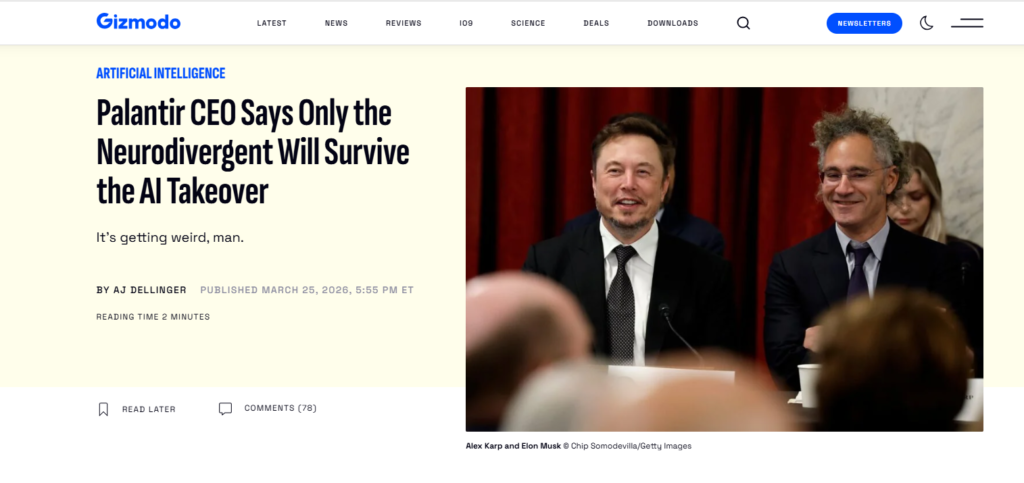
According to Karp, the development of AI will lead to the traditional “broad” labor market narrowing. If previously the economy could absorb people with different levels of skills, now, in his view, only two устойчивых scenarios remain. The first is applied professions, where a person performs specific, measurable work, often connected to the physical world or specialized skills. The second is people with non-standard thinking — the so-called neurodivergent individuals — who can work differently from the majority and find solutions where algorithms still fall short.
Neurodivergence refers to a wide range of traits — from autism to ADHD and dyslexia. Karp himself has previously said he has dyslexia, and that it influenced his way of thinking. It is important to understand that this is not about “superpowers,” but about a different way of processing information. Such individuals often see connections others miss, recognize patterns faster, or, conversely, go beyond standard solutions. These qualities become especially valuable in an era where routine tasks are increasingly handled by algorithms.
Interestingly, similar ideas are voiced by others as well. Elon Musk has linked his traits to the autism spectrum, and Peter Thiel has described Asperger’s syndrome as an advantage in innovation. This is shaping a new narrative: what used to be seen as a challenge requiring adaptation is now increasingly viewed as a potential competitive advantage.
However, this is where the most delicate part of the discussion begins. Because the line between “equal opportunity” and “advantage” is very thin. If earlier the conversation focused on how to help people with differences integrate into the system, now some voices in big tech suggest that such individuals may actually be better adapted to the new reality.
Karp has already taken concrete steps in this direction. After one of his speeches went viral, the company launched the Neurodivergent Fellowship program aimed at attracting and developing neurodivergent talent. This is no longer just rhetoric, but an attempt to institutionalize a new hiring approach.
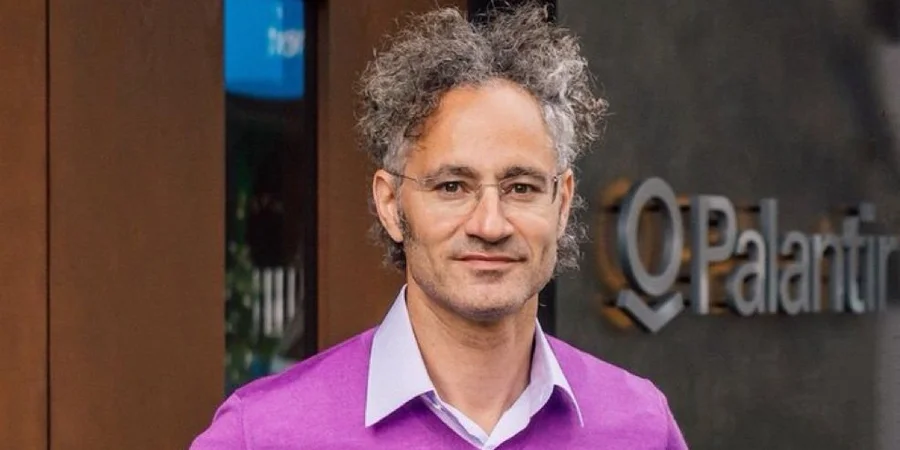
But beyond the bold language lies a deeper process. Artificial intelligence is gradually taking over everything that can be standardized: data processing, routine analysis, and part of creative work. As a result, value is shifting either toward highly practical skills or toward unconventional thinking. The middle segment — the so-called “office class” with routine tasks — is coming under pressure.
This explains the sense of a “narrowing corridor” that Karp describes. Not because there will be less work in absolute terms, but because its structure will change. The market is becoming more polarized: on one side, applied specialists; on the other, people capable of creating new ideas, models, and approaches.
At the same time, it is important not to fall into extremes. The idea that “only the neurodivergent will survive” sounds striking, but reality is more complex. First, the category itself is broad and heterogeneous. Second, success depends not only on thinking style, but also on environment, education, access to resources, and the ability to work in teams. Even the most unconventional genius rarely builds sustainable systems alone.
Rather, the point is different: the market is starting to value differences. Where systems once tried to standardize people, they now increasingly benefit from diversity in thinking. This makes sense — AI handles the “average” very well but struggles with what falls outside established patterns.
In a broader context, such statements reflect a shift in how work is perceived. Work is no longer just a source of income; it is increasingly a function of how well a person can either complement algorithms or do what they cannot. This is changing education, career strategies, and approaches to skill development.
And if the key question used to be “what can you do,” it is now increasingly “how do you think.” In that sense, Karp’s words are less a prediction and more a signal. The market is indeed changing. But the real question is not who will “survive,” but who will adapt faster to the new rules of the game.
All content provided on this website (https://wildinwest.com/) -including attachments, links, or referenced materials — is for informative and entertainment purposes only and should not be considered as financial advice. Third-party materials remain the property of their respective owners.