

The Solana ecosystem has suffered another serious setback. Three interconnected projects — Step Finance, SolanaFloor, and Remora Markets — announced they are ceasing operations following a major hack and unsuccessful attempts to secure funding.
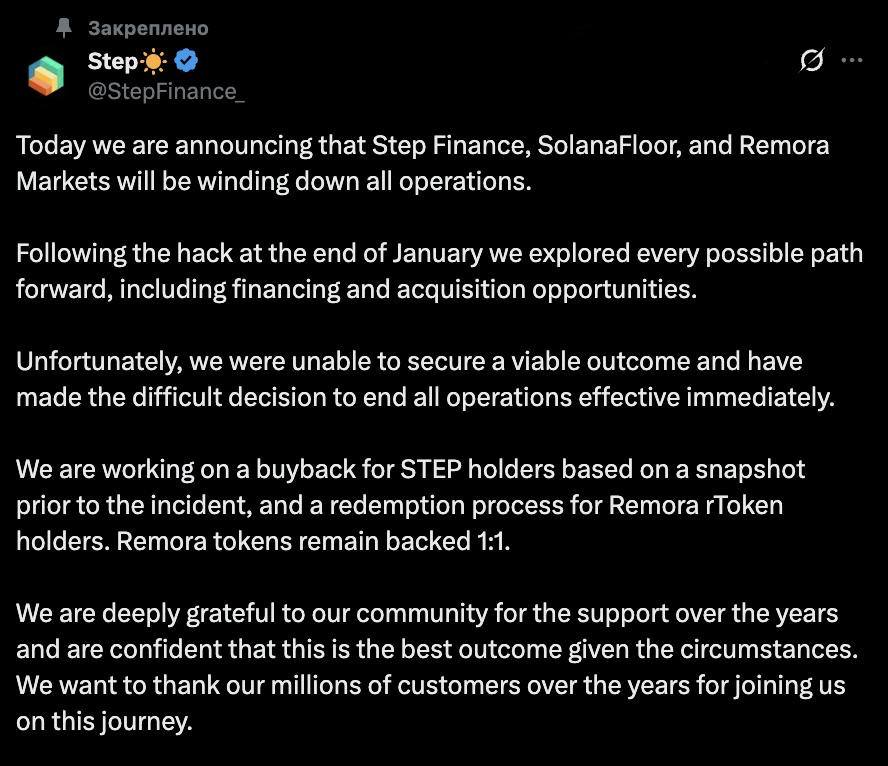
The crisis began in late January when Step Finance reported a “security breach of certain treasury wallets.” According to blockchain security analysts at CertiK, attackers withdrew 261,854 SOL, valued at approximately $27 million at the time.
The company stated it immediately engaged cybersecurity specialists to investigate the incident. However, the consequences proved far deeper than a one-time financial loss.
For a project closely tied to Solana’s DeFi infrastructure, losing tens of millions of dollars from its treasury dealt a blow not only to its balance sheet but also to user and investor confidence.
After the attack, Step Finance leadership explored several continuation scenarios, including raising an interim funding round and selling the business to a strategic investor.
Co-founder George Harrap said acquisition offers were indeed received. However, none resulted in a deal under acceptable terms.
According to the team, all possible options were examined — from capital raising to asset restructuring. Nevertheless, amid time constraints and deteriorating liquidity, the decision was made to immediately cease operations.
The shutdown affects not only Step Finance itself but also its affiliated initiatives:
- SolanaFloor — a media platform covering Solana ecosystem news and analytics.
- Remora Markets — a DeFi lending protocol offering yield tools to users.
Effectively, an entire mini-ecosystem within Solana — combining infrastructure, media, and financial products — has been dismantled.
The financial impact on STEP token holders has been dramatic. Following the hack, the asset lost around 96% of its value within days. .
An additional 36% decline followed the official closure announcement. According to CoinGecko, the token is now trading at approximately $0.00057.
For comparison, in August 2021 STEP reached an all-time high of $10.20. From its peak, the market has effectively collapsed — a painful reminder of DeFi sector risks.
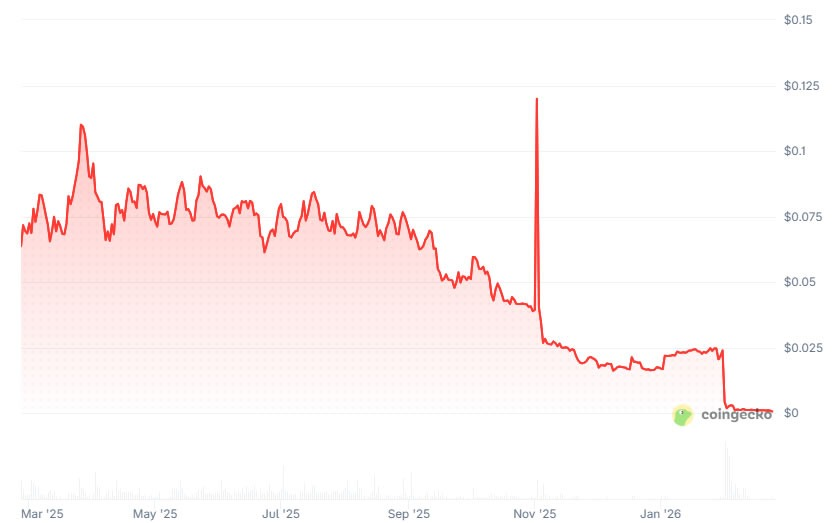
STEP prices have effectively collapsed. Source: CoinGecko.
Despite the shutdown, the team announced plans for partial compensation.
A buyback of native STEP tokens is planned based on a pre-hack balance snapshot. Holders of Remora’s rToken will also be able to recover part of their funds through a redemption process.
While this aims to mitigate losses for loyal users, full compensation is unlikely
The closure of Step Finance comes amid broader difficulties in the DeFi sector. Earlier, the protocol Structured also announced it was shutting down after offering yield through tokenized bitcoin versions and derivatives.
In recent years, Solana positioned itself as an alternative to Ethereum, emphasizing speed and low fees. However, high yields and aggressive growth have often come with elevated security risks.
An additional pressure factor is unrealized treasury losses from holding significant amounts of SOL. Volatility of the native token amplifies financial instability for projects whose operating models depend on reserve asset valuations.
A Lesson for the Market
The Step Finance case highlights the vulnerability of even relatively mature projects amid cyberattacks and limited access to venture capital.
In bull markets, such incidents are often offset by fresh investments. In more restrained market environments, the consequences can be fatal.
The closure of three interconnected projects is not merely an isolated hack story. It underscores how fragile DeFi business models can be when security, liquidity, and user trust are simultaneously compromised.
For the Solana ecosystem, this is another resilience test. For investors, it is a reminder that high-tech protocols remain high-risk environments, where a single incident can erase years of growth.
All content provided on this website (https://wildinwest.com/) -including attachments, links, or referenced materials — is for informative and entertainment purposes only and should not be considered as financial advice. Third-party materials remain the property of their respective owners.