

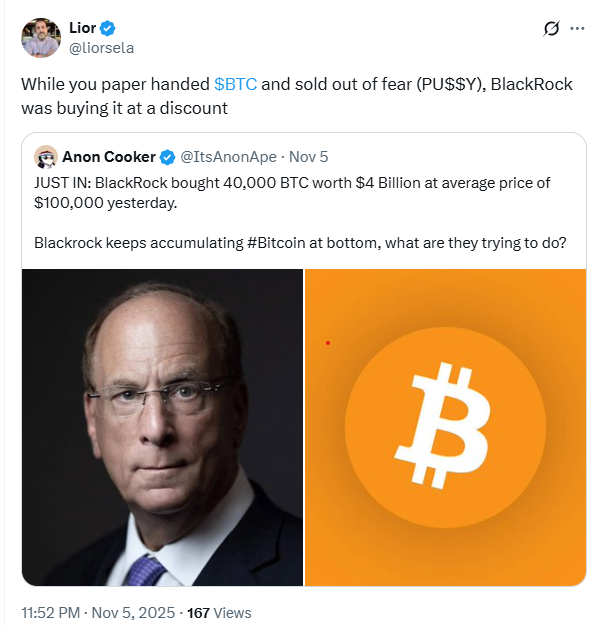
? BlackRock has reportedly purchased around 40,000 BTC worth approximately $4 billion, at an average price of about $100,000 per coin.
It’s important to note that there’s no official confirmation from the company yet, and the figures may be approximate or incomplete. Nevertheless, if the sources are accurate, this purchase could be a major signal for the cryptocurrency market.
It’s important to note that no official confirmation has been provided by the company yet, and the figures may be incomplete or approximate. Still, if true, this could represent a major signal for the crypto market.
Why it matters
- Institutionalization of Bitcoin:
BlackRock is the world’s largest asset manager, and its active accumulation of BTC reinforces the signal that cryptocurrency is moving from a fringe investment to a legitimate asset class for traditional finance. - Price benchmark around $100,000:
An average purchase price near $100,000 suggests that BlackRock either considers the market undervalued or is following a dollar-cost averaging strategy at high levels. Either way, it signals confidence in Bitcoin’s long-term potential. - Market signal:
Such large-scale purchases can influence market sentiment — encouraging both retail and institutional investors to enter or retest key support levels. Bitcoin as a reserve asset:
If an institution of BlackRock’s scale treats Bitcoin as a strategic reserve holding, it further strengthens BTC’s position as a store of value and hedge asset.
Context
- BlackRock has already expressed significant interest in digital assets and was among the first to launch a spot Bitcoin ETF.
- Reports of similar large-scale acquisitions by institutional players are becoming more common, showing a clear capital migration trend from traditional assets into crypto.
- However, some analysts remain cautious — citing the lack of official confirmation, possible market speculation, and regulatory uncertainty as reasons for restraint.

What Could Follow
- Bitcoin price growth:
Such a major purchase could act as a “green light” for new investors, triggering a new wave of buying pressure. - Increased volatility:
Large accumulations often lead to short-term fluctuations — as traders speculate on potential profit-taking or corrections. - Reduced sell-side liquidity:
Removing a significant number of coins from circulation tightens supply, potentially accelerating upward momentum if demand rises. Regulatory and risk aspects:
Institutional involvement attracts more attention from regulators — particularly in the U.S. This can lead to both increased trust and tighter oversight.
What It Means for Different Players
- For institutional investors:
A signal that Bitcoin is increasingly seen as a core strategic asset worthy of inclusion in diversified portfolios. - For retail investors:
Possibly a good entry signal or a reason to reassess positions — but not without risk. - For the crypto market overall:
A substantial inflow of institutional capital could become a driving force for the next major bull cycle, provided that liquidity, regulation, and infrastructure remain supportive.

Cautions
- The information remains unverified — no confirmed data on volume, timing, or purchase conditions.
- Even major asset managers are not immune to crypto risks such as volatility, regulation, or technical vulnerabilities.
- A large acquisition does not guarantee price growth — without external catalysts, capital may remain idle until market momentum returns.
? Conclusion
If this purchase truly occurred, it could mark a milestone in Bitcoin’s institutional journey.
BlackRock would thus strengthen its role not only as a participant in the crypto ecosystem but also as a leader of financial transformation.
Still, investors should remain cautiously optimistic: the signal is strong — but far from guaranteed.
All content provided on this website (https://wildinwest.com/) -including attachments, links, or referenced materials — is for informative and entertainment purposes only and should not be considered as financial advice. Third-party materials remain the property of their respective owners.