

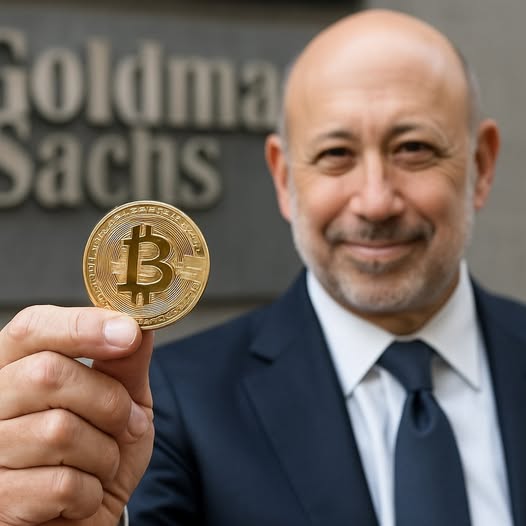
Turnarounds in the rhetoric of major bankers are rarely accidental. When a person who recently was skeptical about cryptocurrencies begins, albeit cautiously, to personally invest in them, this almost always reflects deeper changes in the system itself. This is exactly what is now happening around Goldman Sachs and its head David Solomon.
Solomon admitted that he owns a “very small” amount of Bitcoin. The wording is extremely careful – not an investor, not an advocate, but rather an observer. But in the world of finance, such nuances matter. This is no longer an external assessment of the asset, but personal participation, even if symbolic. In essence, it is a transition from the position “we look from the outside” to the position “we keep a hand on the market”.
It is important that this statement was made not somewhere behind the scenes, but in a public forum. And Solomon’s key idea was not so much about Bitcoin itself, but about how the financial system as a whole is changing. According to him, cryptocurrencies are part of a long-term transformation of market infrastructure. Not a separate world, not an alternative, but an element of one large system.

Goldman Sachs CEO David Solomon at the Liberty World forum in Palm Beach. (CoinDesk)
This idea is probably the most important. Just a few years ago, the conversation about crypto was often built on the principle “either banks or blockchain”. Now this approach is gradually disappearing. Solomon directly says: this is not a zero-sum game. Traditional finance and digital assets do not replace each other, but begin to coexist within one architecture.
Such a shift fits well into a broader trend. Large banks are gradually stopping ignoring the crypto market, but they are not rushing to fully dive into it either. They take a wait-and-see position, study the infrastructure, test individual directions and, importantly, closely watch regulation. It is this factor that Solomon calls the key limitation for more active participation.
If we look at competitors, the picture becomes even more interesting. JPMorgan Chase and Morgan Stanley are already moving toward digital assets more actively, offering clients access to products and infrastructure related to cryptocurrencies. Against this background, Goldman Sachs looks like a more cautious player. But this is not falling behind, but rather a different strategy – not to run ahead of the market, but to enter when the rules of the game become clearer.
Special attention should be paid to the topic of tokenization, which Solomon emphasized. In his logic, it can become a bridge between traditional finance and the new digital economy. This refers to the transfer of real assets – from bonds to real estate – into digital form on the blockchain. This direction is already actively discussed by the largest financial institutions because it solves specific tasks: it speeds up settlements, reduces costs and increases transparency.
It is interesting that in this picture Bitcoin itself occupies a special place. For bankers, it still remains more an object of observation than a full-fledged tool. Solomon directly says: he continues to understand this market. This is an honest position that contrasts with more categorical statements of past years, when cryptocurrency was either declared a “bubble” or, on the contrary, the future of the entire financial system.
Today the tone is changing. Instead of loud assessments – careful analysis. Instead of denial – partial participation. And this is probably the main signal. The cryptocurrency market is ceasing to be a marginal phenomenon and is gradually integrating into the global financial system.
At the same time, it is important to understand: this is not a sharp turn. Goldman Sachs still acts carefully, limiting its participation and avoiding direct bets on volatile assets. But the very fact that the head of the bank personally holds Bitcoin, even in a small amount, shows a change in attitude at the level of thinking.
In simple terms, previously banks looked at crypto as an experiment. Now – as a factor that is already influencing the market and cannot be ignored. And in this logic, Solomon’s words sound not like a recognition of love for Bitcoin, but like a recognition of reality.
In the end, the question is no longer “will banks accept cryptocurrencies”. The question is how exactly they will integrate them into their system. And judging by current signals, this process is ongoing – slowly, cautiously, with regard to regulators, but already without former skepticism. Sometimes big changes start exactly like this: not with loud statements, but with the phrase “I have a little”.
All content provided on this website (https://wildinwest.com/) -including attachments, links, or referenced materials — is for informative and entertainment purposes only and should not be considered as financial advice. Third-party materials remain the property of their respective owners.