


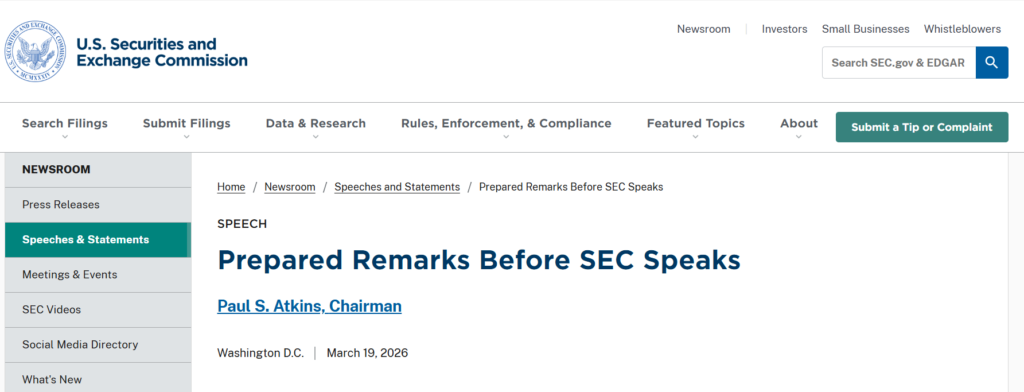
The American crypto market has finally received what it lacked for years — perhaps not perfect, but at least a clear regulatory logic. The head of the U.S. Securities and Exchange Commission, Paul Atkins, stated on March 19: the current clarification on digital assets is not the end, but only the beginning. Formally, this sounds cautious, but in essence, it is honest: rules have appeared, but they are not yet set in stone.
The notice itself, published the day before, does what the market has debated for years. Most cryptocurrencies no longer fall under securities laws. Translated from legalese to normal language — they are no longer treated as stocks or investment contracts. They are now closer to commodities, like gold or oil. And that already implies a completely different regulatory logic, different risks, and, most importantly, a different level of government pressure.
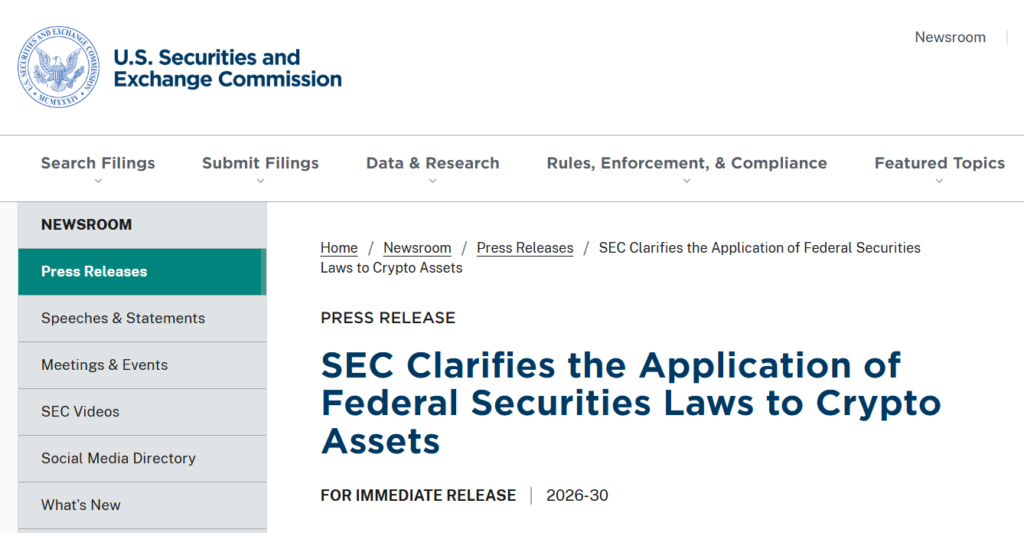
The only exception remains tokenized traditional securities. Wrapping a stock in blockchain does not make it stop being a stock. Everything else goes into the category of “digital commodities” and related classes. The SEC has effectively proposed a new market map: digital commodities, digital instruments, digital collectible assets (including NFTs), stablecoins, and digital securities. And here comes the key pivot — the first four categories largely fall outside direct SEC control.
Control is gradually shifting to the Commodity Futures Trading Commission. This is not just a bureaucratic reshuffle, but a change in regulatory philosophy. The SEC has historically viewed the market through the lens of investor protection and strict issuer requirements. The CFTC, on the other hand, focuses on trading, liquidity, and market functioning. As a result, the crypto industry is effectively moving from a “constant defense” mode to a more neutral environment, where it is being integrated into the system rather than crushed through courts.
This pivot is not accidental. It followed an agreement between the SEC and CFTC signed a week earlier. Regulators essentially acknowledged the obvious: the market has grown so much that it cannot be regulated by old templates. At the same time, practices have changed — the SEC has begun winding down some investigations and lawsuits against crypto companies. What recently looked like systemic pressure is gradually turning into an attempt to negotiate with the market.
But this entire structure is temporary. It was conceived as a “bridge” until a full law appears. This refers to the CLARITY Act, which has already passed the House of Representatives but is stalled in the Senate. And as often happens, the process is slowed not by ideology, but by details.
The main dispute now concerns stablecoins and their yields. The banking sector is not thrilled about competition with “digital deposits,” while the crypto industry is, conversely, supportive. According to Senator Cynthia Lummis’ team, an agreement is nearly reached, but in politics, “nearly” sometimes takes longer than “never.” Patrick Witt is also involved in the negotiations, adding weight but not guaranteeing speed.
There is another factor the market currently underestimates. The SEC is not working at full capacity — there are only three commissioners out of five, all from the same party. A similar situation exists at the CFTC. This means that current policy is not a long-term consensus, but a reflection of the present balance of power. When the composition changes, the approach may also change. That is why Paul Atkins’ words about “the beginning of the journey” sound more like a warning than a formality.
Stripped of emotion, the situation looks like this. The crypto market has for the first time received a relatively clear regulatory map without waiting for another court case. This is a huge plus. But this map is drawn in pencil. Today, most cryptocurrencies are commodities. Tomorrow, this may be reconsidered. And for this, it is not even necessary to pass a new law — a change in interpretation within the regulator is sufficient.
There is also a practical question. The Commodity Futures Trading Commission is historically focused on derivatives. It is now effectively being given control over the spot crypto market, measured in trillions of dollars. Formally, this looks like a solution. In reality — it is more like transferring responsibility. Whether the CFTC has the resources, authority, and infrastructure to actually control this market, rather than just be listed as responsible, remains an open question.
Ultimately, the market received an important signal: cryptocurrencies are no longer viewed solely as a problem. They are beginning to be seen as an asset class. But a full, stable regulatory system is still far away. For now, this is not the end of the story, but a careful transition from chaos to managed uncertainty. And if the crypto market has learned anything over these years, it is to live in exactly this state — when everything seems clearer, but it is still too early to relax.
All content provided on this website (https://wildinwest.com/) -including attachments, links, or referenced materials — is for informative and entertainment purposes only and should not be considered as financial advice. Third-party materials remain the property of their respective owners.