


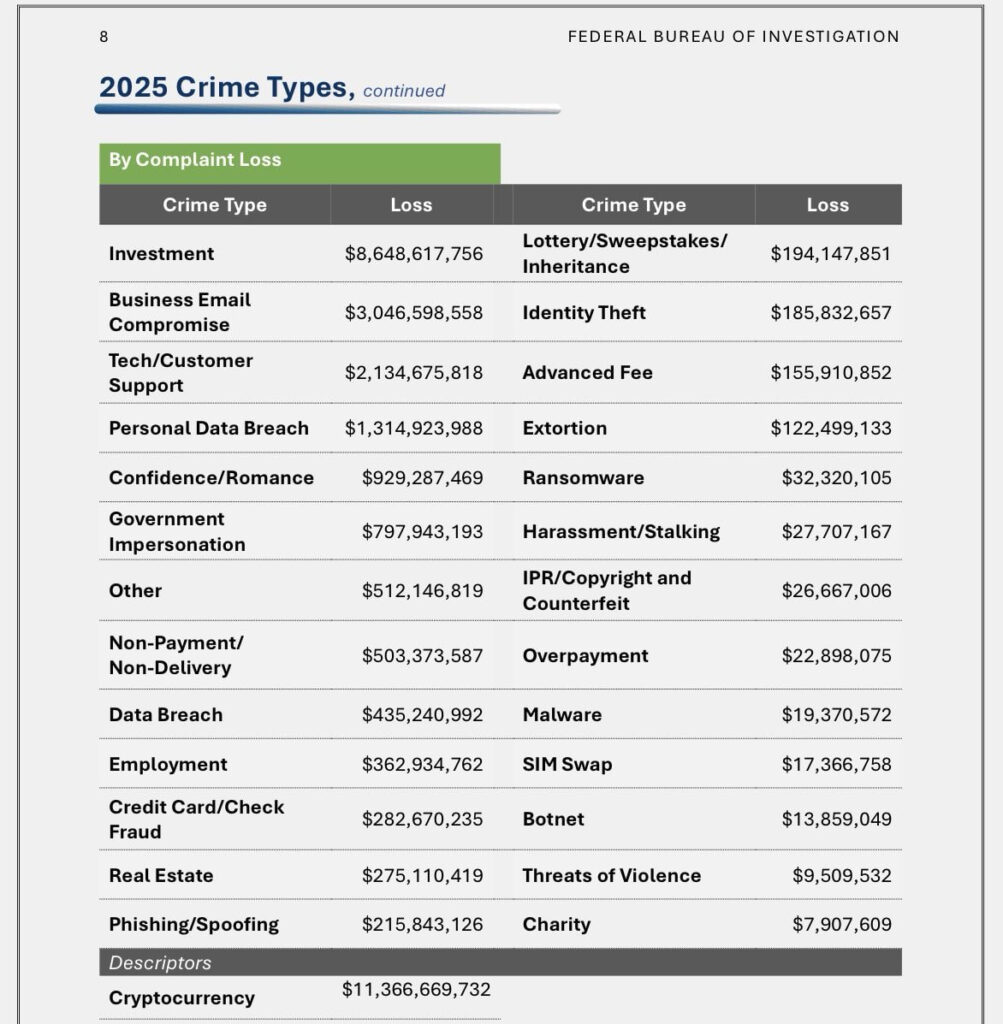
The numbers for 2025 look like a cold shower for the entire industry. According to the FBI Internet Crime Complaint Center, Americans lost $11.37 billion in schemes where cryptocurrency was used as a transfer tool. A year earlier, that figure was $9.3 billion – a 22% increase in just one year. And this is not market volatility, not bad investments, and not “wrong token choices”. These are direct losses from fraud. Looking deeper, the picture becomes even more telling.
These are direct losses from fraud. Looking deeper, the picture becomes even more telling. The main hit is not on “crypto geeks” or teenagers trading meme coins, but on people with capital. The 60+ age group lost about $4.4 billion, while another $2.1 billion came from the 50-59 group. These are people with savings, assets, and life experience, but often without a deep understanding of digital tools. The average loss per person is around $62,000. This is no longer an “inconvenience” – it is a financial trauma.
And here lies the key issue, far beyond the numbers themselves. These $11 billion are not just stolen funds. They are capital that could have entered the market. Potential investments into Bitcoin, Ethereum, or any other asset. Liquidity that could have supported growth, driven demand, and strengthened the market. Instead, it flows into the grey zone and disappears from the system.
A paradox emerges. On one hand, the industry is striving for mass adoption, building infrastructure, developing products, and trying to become part of the global financial system. On the other hand, it loses tens of billions every year due to fraud that undermines trust faster than any technological progress can restore it.
It is important to understand that for most victims, cryptocurrency stops being a “technology” or an “investment”. It becomes synonymous with deception. People do not distinguish between blockchain, DeFi, exchanges, and scams. For them, it is one story: “I was scammed through crypto”. And after that, they do not return to the market. Worse, they tell others about it.
This creates an effect that is hard to measure in numbers but has a stronger impact on the market than any report. It is reputational outflow. Every major scam is not only lost money but also lost future investors.
Another key point is how these schemes actually work. In most cases, these are not “hacks” in the traditional sense. They are social engineering attacks. People are convinced to transfer funds voluntarily. Promises of returns, creation of trust, use of authority, fear, or urgency – all are used. And in this sense, crypto becomes just a convenient tool – fast, irreversible, and global.
For scammers, this is the perfect environment. For the market, it is a weak point.
Looking at the dynamics, it becomes clear: the problem is not shrinking, it is growing. And this is no longer about individual users – it is a systemic risk for the entire industry. Because trust is the foundation of any financial market. Without it, no asset works, regardless of the technology behind it.
And here comes an uncomfortable but important conclusion. The main enemy of the crypto market is not regulators, not volatility, and not even bear cycles. The main enemy is scams. Because they do not attack price – they attack perception. And restoring price is far easier than restoring trust.
Until the industry learns to effectively protect users – not only technically, but also through education and communication – this outflow will continue. And every next billion lost to scams will not just be a loss, but a missed opportunity for the entire market.
In the end, the situation looks quite harsh. Crypto can grow, reach new highs, and attract institutions. But if for the average user it is associated with the risk of being scammed, mass adoption will not happen. And then the key question is no longer about technology, but whether the market can prove that it is safe to participate in.
All content provided on this website (https://wildinwest.com/) -including attachments, links, or referenced materials — is for informative and entertainment purposes only and should not be considered as financial advice. Third-party materials remain the property of their respective owners.