

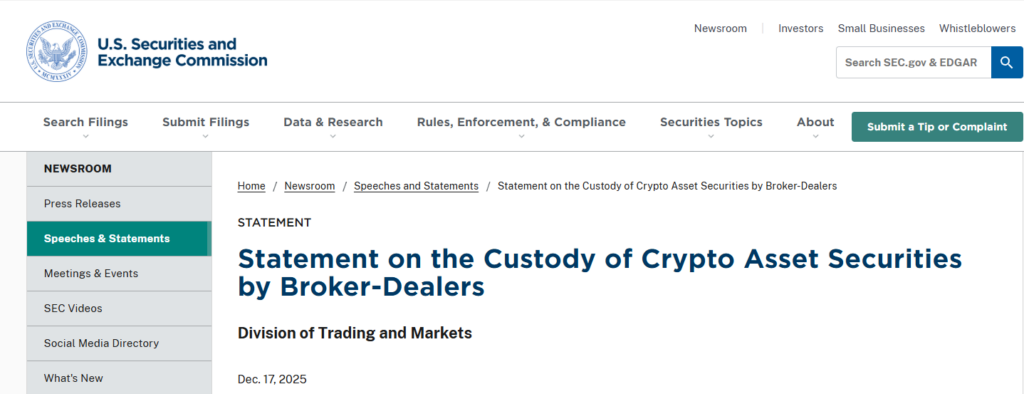
The Division of Trading and Markets of the U.S. Securities and Exchange Commission (SEC) has issued an official statement setting out in detail its views on the application of rules to crypto assets that qualify as securities, or “crypto asset securities.” The document is addressed to all broker-dealers that carry out transactions in such assets for their customers, including firms engaged in traditional securities market activities. The purpose of the publication is to increase transparency and provide practical guidance on the application of federal securities laws to new digital assets.
A broker-dealer is required to promptly obtain and thereafter maintain physical possession or control of all fully paid and excess margin securities held in customer accounts. In its statement, the SEC clarifies that this guidance is limited solely to this provision and does not extend to other broker-dealer obligations related to financial reporting or compliance with general securities law requirements.
Provided that a broker-dealer meets the conditions set out below, the Commission will not object to the broker-dealer deeming itself to have “physical possession” of crypto asset securities held in customer accounts.
The first requirement is direct access to the asset and the ability to transfer it via a blockchain or other distributed ledger technology. The broker must have full authority to manage the asset without intermediaries, ensuring immediate capability to transfer or otherwise dispose of it.
The second aspect is a mandatory assessment of the characteristics of the distributed ledger technology on which ownership transfers of the crypto asset are recorded. The broker must establish, implement, and adhere to internal policies and procedures that allow for the evaluation of the network’s operation and security, governance processes, methods for implementing updates, and potential vulnerabilities. This assessment must be conducted prior to commencing custody of the assets and periodically thereafter, in order to identify potential weaknesses that could affect possession of the assets and to take measures to mitigate such risks.
The third requirement is the refusal to deem possession of an asset in the event that material security or operational reliability issues with the network are identified. If a broker detects risks that could jeopardize the assets, it should not consider itself to be in possession of the relevant crypto asset until the threat has been addressed. The focus in this context is specifically on risks related to custody of the asset, rather than market or reputational risks.
The fourth requirement concerns the protection of private keys. The broker must ensure the safeguarding of keys that provide access to the assets by using internal procedures, policies, and control measures consistent with industry best practices. Neither customers nor third parties should have the ability to use the keys without the broker’s authorization, thereby ensuring full control over the assets.
The fifth requirement is an emergency action plan. The broker must develop and maintain procedures that ensure the safekeeping of assets and continued access to them in the event of any disruptions, including blockchain malfunctions, 51% attacks, hard forks, or airdrops. In addition, the plan must provide for the ability to comply with lawful orders to freeze, destroy, or transfer the assets, as well as for their transfer to another broker-dealer, trustee, liquidator, or similar entity in the event of bankruptcy or cessation of operations.
Accordingly, the SEC has for the first time officially clarified its approach to the custody of crypto assets that constitute blockchain-based securities for brokers. The Commission is not introducing new rules but is instead explaining the application of existing provisions, thereby shaping regulatory expectations and enhancing transparency for market participants. The core principles include full control over assets, regular assessment of network security, strict protection of private keys, and the existence of a detailed contingency plan for any unforeseen circumstances. This establishes a foundation for the secure custody and management of crypto assets in the institutional segment and enables the integration of digital securities into the existing financial infrastructure.
All content provided on this website (https://wildinwest.com/) -including attachments, links, or referenced materials — is for informative and entertainment purposes only and should not be considered as financial advice. Third-party materials remain the property of their respective owners.