


On social media and media platforms, an infocascade about “Rubber Strikes” is going viral. In recent days, posts, videos, and memes have been spreading at incredible speed, creating the illusion of a mass event in which supposedly Chinese military equipment mock-ups embarrassed the US in Iran.
The main thesis of the viral content is that Tehran purchased up to 900,000 mock-ups of tanks, missile systems, and aircraft from China, and that the Americans are allegedly striking these “toys,” spending limited ammunition and literally throwing millions of dollars away. At first glance, it looks like an absurd story from the “military memes” section, but this infocascade case is an example of how fake information can literally bury the information space, hiding important facts that really change the understanding of modern military confrontation.
The full chain of the infocascade looks like this: IDF video from March 4 showing a strike on a “helicopter,” which neither the Iranian nor the Israeli side officially confirmed. On March 5–6, skepticism appeared on social media regarding the video, and on March 7, an anonymous post with the figure “900,000” and mocking emojis triggered massive reposts. There are no official confirmations that Tehran purchased 900,000 military mock-ups, but layer by layer, fake information covers truly important insights about modern military strategies.
In reality, Chinese companies do sell cheap mock-ups of tanks, aircraft, and SAMs. The cost of such a mock-up is $2–7K, while a real HIMARS costs $5–7 million. The myth that Americans would strike rubber HIMARS with expensive ATACMS or PrSM missiles is pure fantasy. Even budget GMLRS M30/M31 (~$170K) for “rubber” targets is wasteful and absurd. Low-budget Chinese mock-ups are good only for creating “visibility” in satellite images, but modern multispectral sensors and thermal imagers will not be fooled.
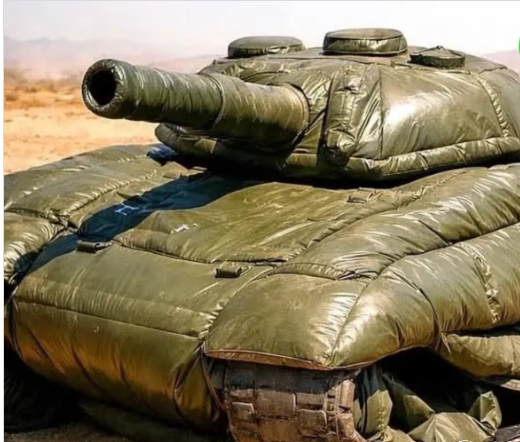
Serious engineering mock-ups are produced by European companies like Inflatech. Their products are designed to deceive multispectral reconnaissance systems, including optics, radars, and thermal imagers. They are much more expensive and simulate all features of real equipment: visual details, radar reflection, and engine heat output. If the goal is just to “fill the air” with noise, you buy thousands of cheap Chinese shells. If the task is to reliably lure a missile and protect real equipment, a European engineering level is required.
The principle of deception remains classic: a quality inflatable HIMARS costs around $20K, the enemy’s missile $1–3 million, and a real HIMARS $5–7 million. Spending $20K, you protect $7 million and make the enemy literally waste millions. The difference between the mock-up and the munition is pure profit in the “mathematics of deception.” The fake about 900,000 Chinese mock-ups is a viral meme that hides the real mechanics of the 21st century: using cheap engineering decoys, analyzing enemy sensors, and strategically managing the expenditure of expensive weapons.
The video of this “fake” can be viewed on our Telegram channel
All content provided on this website (https://wildinwest.com/) -including attachments, links, or referenced materials — is for informative and entertainment purposes only and should not be considered as financial advice. Third-party materials remain the property of their respective owners.