

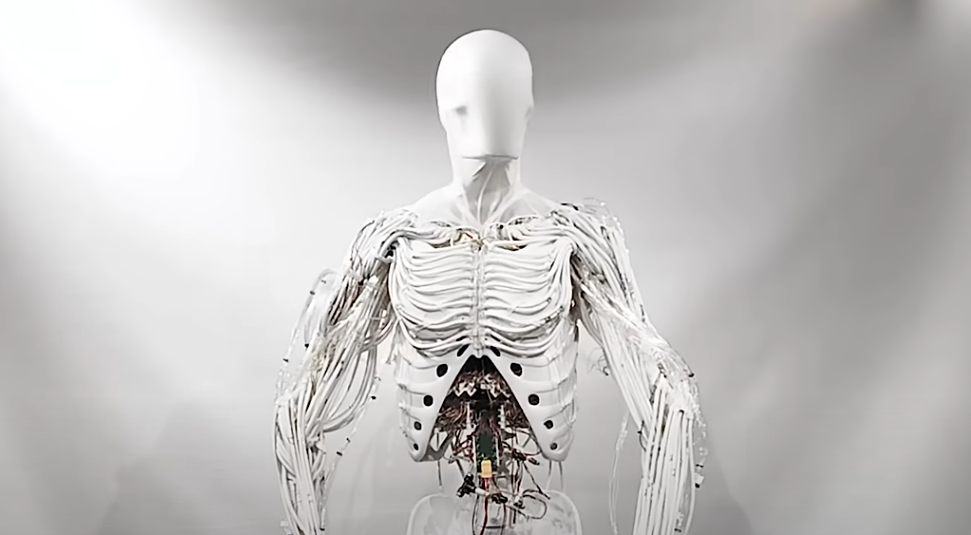
The Polish startup Clone Robotics has introduced Protoclone – a humanoid robot that looks like a greeting from a very strange but already almost arrived future. At first glance, it resembles a laboratory experiment or a scene from science fiction more than a finished technological product. It has no face, no familiar “robotic” shell or decorative panels. Instead, inside there is a structure that in complexity is beginning to approach the human body.
Synthetic muscles instead of motors
Protoclone is based on an unusual engineering idea. Instead of the classic electric actuators used in most robots, the developers employ a system of synthetic muscles.
Inside the structure there are more than one thousand artificial muscle elements. They are connected by a network of tendons and operate according to a principle that is as close as possible to human biomechanics. When a muscle contracts, it pulls a tendon and moves a joint, exactly as it happens in the human body.
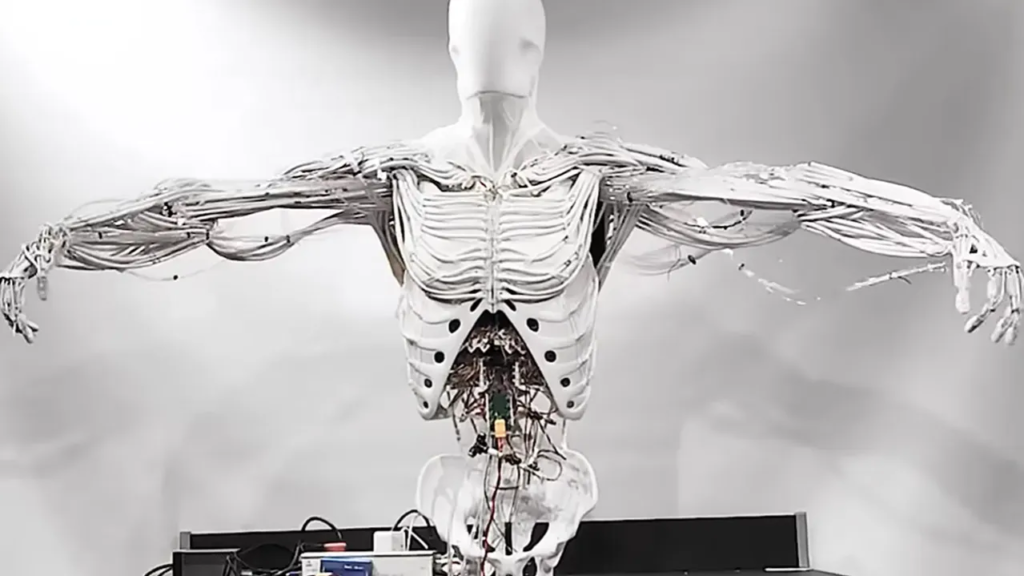
The robot’s frame also resembles a skeleton. The structure uses polymer bones printed on a 3D printer. They are connected by joints, forming the anatomical structure of arms, legs and the spine.
The entire system is supplemented by about five hundred sensors that record joint positions, pressure, load and other motion parameters. In essence, this is an analogue of the nervous system that transmits information to the control algorithm.
A robot that can “sweat”
The most unusual part of Protoclone is its cooling system. During active work, synthetic muscles generate heat, and the engineers decided to solve this problem in an unusual way.
Inside the body there is a network of microchannels filled with water. When the robot begins to move actively and the temperature rises, water circulates through these channels and evaporates. This process almost completely replicates the human sweating mechanism. The result is an almost surreal picture: a robot with artificial muscles literally begins to “sweat” under load. Not long ago such things existed only in science fiction, but now engineers are implementing them in real prototypes.
Biomimetics as a new engineering strategy
The Protoclone project is built on the principles of biomimetics – a field of science that attempts to copy solutions found in nature. The idea is simple: evolution has optimized the human body and movement for millions of years. Therefore, instead of inventing completely new mechanics, engineers try to reproduce an already existing biological system.
Such robots can potentially move more smoothly and naturally than traditional machines with rigid actuators. They adapt better to complex environments and are capable of performing tasks that are difficult to program for classical mechanisms.
The next stage – teaching it to walk
At the moment Protoclone remains an experimental prototype. It is already capable of performing individual movements, demonstrating the operation of synthetic muscles and joint mechanics.
According to engineers from Clone Robotics, the next task is to achieve stable balance. After that the developers plan to teach the robot to walk on two legs. According to their estimates, this stage could be reached within about a year. If the project succeeds, Protoclone will become one of the few humanoid robots built on a fully biomimetic architecture.

The global robot race
But not only the technology itself matters here. Protoclone is also interesting because of where it appeared. The robot was not created in Silicon Valley or in a Chinese laboratory. It was developed in Poland – a country that rarely appears in headlines about robotics.
This is another reminder that the global race of humanoid robots is no longer the monopoly of a few technology giants. Dozens of companies around the world are now working on similar projects. Among the most well known examples are projects by Tesla, Boston Dynamics and Figure AI.
The development of artificial intelligence and the reduction in manufacturing costs have made robotics far more accessible for startups.
Investment and a new technological industry
For investors, robotics is gradually turning into a new major industry. Analysts already compare the current stage of humanoid robot development with the early years of the electric vehicle market or artificial intelligence. As computing power grows, sensors improve and more efficient actuators appear, new teams are emerging that are ready to experiment with robot architectures.
And while similar projects once required billion dollar budgets from large corporations, today startups can launch developments with far fewer resources. Protoclone is one example of how such experiments are beginning to move out of laboratories and become part of the global technological race.
What it means in the end
On one hand, it is simply a strange robot without a face that still cannot even walk. On the other hand, inside it there are more than a thousand artificial muscles, hundreds of sensors, synthetic tendons and a cooling system that imitates human sweating. Robots are already beginning to copy human biology almost literally.
And if such projects continue to develop at the current pace, the question is no longer whether humanoid machines will appear next to us. The only question is when exactly this will become a normal part of everyday life.
A video fragment of this “humanization” can be watched on our Telegram channel.
All content provided on this website (https://wildinwest.com/) -including attachments, links, or referenced materials — is for informative and entertainment purposes only and should not be considered as financial advice. Third-party materials remain the property of their respective owners.