


An experimental course has been launched at Penza State University, already sparking lively debate within the professional community. Students are being taught JavaScript programming, but with one fundamental difference – the entire syntax has been adapted to Cyrillic. Future programmers write code in Russian, using Russian keywords, function names, and variable names.
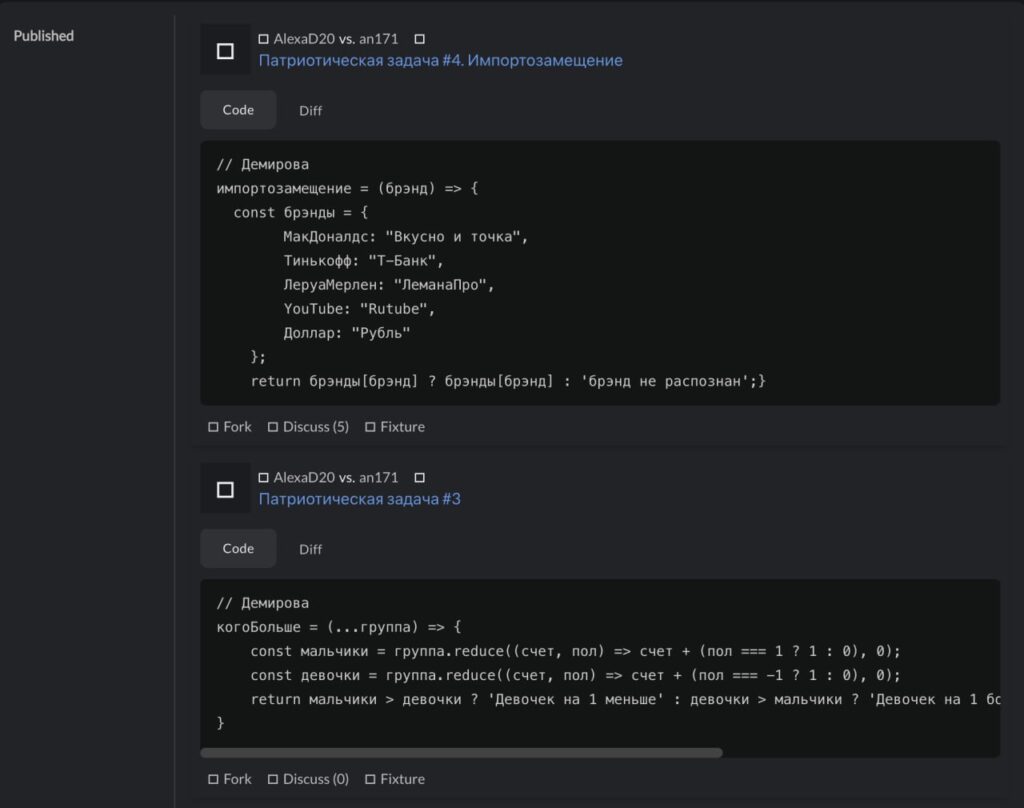
The university’s instructors went beyond simply translating assignments or comments. They effectively created their own version of JavaScript with a Russified syntax and developed a dedicated educational platform. It includes gamification elements, a ranking system, and automatic task validation. Students solve problems, earn points, compete with each other, and write code exclusively in Cyrillic.
The project has already received an official patent titled “Automated Testing of Competitive Programming Tasks in JavaScript with Patriotic Content.” The wording itself reveals much about the philosophy behind the initiative. This is not merely an educational method, but an attempt to build a localized technological environment deliberately detached from the global English-speaking context.
Supporters of the idea argue that the initiative lowers the entry barrier to programming. In their view, the language barrier often discourages beginners, especially those with limited English proficiency. Russian syntax is assumed to make code more intuitive and reduce the initial learning threshold. The logic is simple: if a person thinks in Russian, they should write code in Russian as well.
However, the industry’s response has been restrained. Anton Averyanov, CEO of the ST IT Group, noted that it is too early to speak about the prospects of such an approach. According to him, this is the first documented case, but it does not indicate a broader trend. He also recalled that programming languages with Russian-language syntax existed in the past, but were eventually displaced by more universal international solutions.
Averyanov emphasized that the vast majority of code worldwide is written using English-based programming languages. International libraries, frameworks, documentation, forums, and examples are all built around English. Therefore, developers who want to remain competitive not only domestically but also globally will inevitably need to work within the widely accepted international ecosystem.
A similar view was expressed by Dmitry Komissarov, CEO of the service “New Cloud Technologies.” He pointed out that programming in Russian offers limited practical value. In his opinion, the only real advantage is familiarity with the words. As an example, he cited the 1C platform, whose programming language does use Russian syntax and is widely adopted within the country. However, he noted that the presence or absence of English does not play a decisive role in either the popularity or functionality of solutions.
Komissarov added that from a cognitive development perspective, such an approach may serve as useful training for memory and logic, as students must simultaneously manage two systems – a local one and an international one. At the same time, he stressed that in terms of current market needs, it is far more important to teach people how to work with artificial intelligence, including the ability to formulate queries and prompts, rather than invent alternative syntaxes.

The main concern among experts relates to graduates’ future prospects. Experience gained from programming in Cyrillic may translate poorly into real-world industry practice. International libraries, APIs, standards, and development tools are built around English. Transitioning from a Russified version of JavaScript to the standard syntax may become an additional barrier rather than an advantage.
In essence, the situation reflects a choice between educational comfort and professional universality. It remains unclear whether this experiment will remain a one-off initiative or expand to other universities. What is already clear is that it raises a broader question – whether the education system is preparing specialists for the real global market or creating a closed ecosystem with limited external compatibility.
Ultimately, the story of programming in Cyrillic appears less like a technological breakthrough and more like a sign of the times. An attempt to adapt a complex global industry to local constraints, even if the cost of such adaptation is losing compatibility with the very world for which programming languages were originally created.
All content provided on this website (https://wildinwest.com/) -including attachments, links, or referenced materials — is for informative and entertainment purposes only and should not be considered as financial advice. Third-party materials remain the property of their respective owners.