


South Korea’s tax authority found itself at the center of a major crypto scandal after inadvertently revealing the mnemonic phrase (seed phrase) of a confiscated crypto wallet in an official press release. The mistake cost the state tokens worth approximately $4.8 million and once again raised the question of whether government institutions are prepared to handle digital assets at the level of basic cybersecurity.
The incident occurred on February 26, when the National Tax Service (NTS) published a report on a campaign to collect tax arrears and confiscate assets from debtors. The press release included an image of a Ledger hardware wallet lying next to a sheet of paper. The photo clearly displayed the full mnemonic phrase — without blurring, without redaction, and without any attempt to conceal critically sensitive information. Leading Korean media outlets, including Naver and The Chosun Ilbo, reported on the incident.
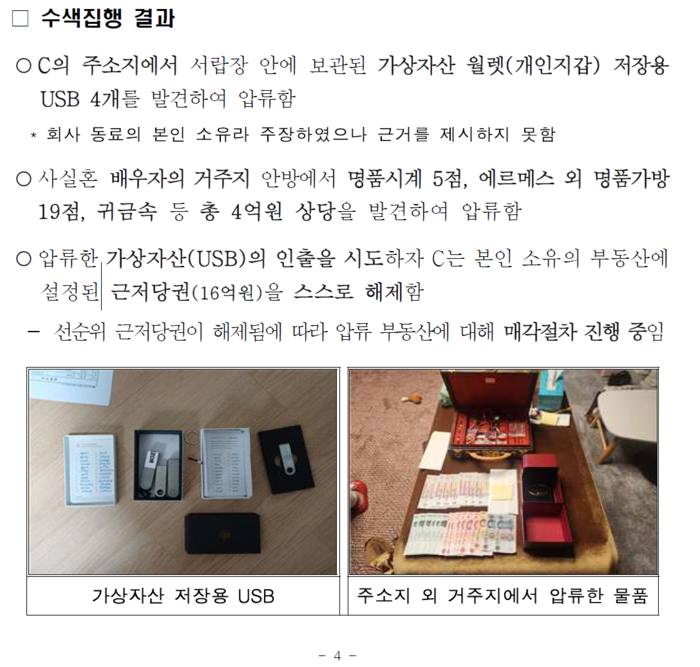
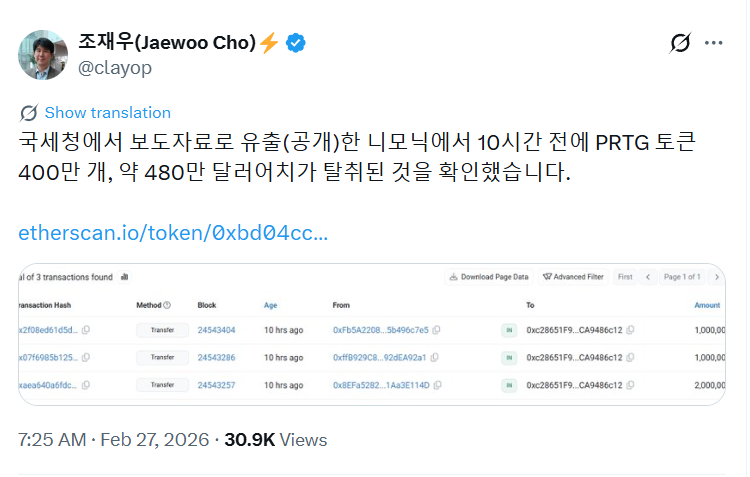
For the crypto community, that was enough. Blockchain analysts quickly identified the Ethereum address linked to the exposed seed phrase. It soon became known that 4 million PRTG (Pre-Retogeum) tokens had been transferred to that address. Almost immediately after the phrase was disclosed, the entire amount was moved in a single transaction to another wallet. Data from blockchain explorer Etherscan recorded three incoming transfers totaling 4 million PRTG and one outgoing transaction for the same amount.
An associate professor at the Blockchain Research Center of Hansung University confirmed on X that tokens worth approximately $4.8 million were withdrawn from the address whose mnemonic phrase had been disclosed in the tax authority’s press release. He noted that other exposed phrases are unlikely to result in comparable losses and that, due to tokenomics specifics and the difficulty of liquidating the stolen assets, the actual damage may be lower than the nominal figure. Nevertheless, the very fact of the compromise highlights a fundamental gap in understanding the principles of digital asset custody.

It is important to emphasize: a mnemonic phrase is not just a password. It represents complete and unconditional control over funds. In the traditional banking system, a leak can be mitigated by freezing an account, reissuing a card, or initiating legal procedures. On the blockchain, things are different: whoever first uses the phrase to sign a transaction gains the funds permanently and irreversibly. There is no “customer support” capable of reversing the operation.
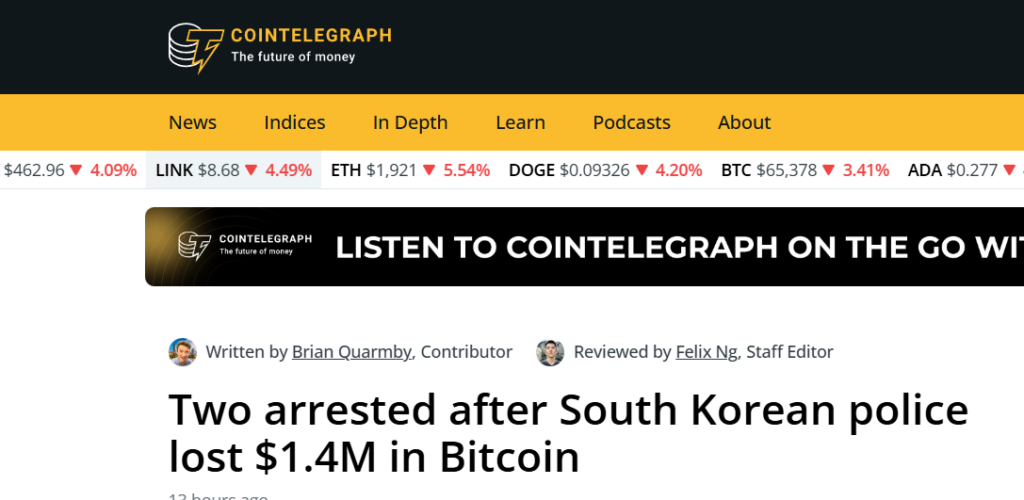
This episode was not the only blow to the reputation of South Korean institutions in the field of crypto asset custody. In February 2026, police reported the disappearance of 22 bitcoins seized during a 2021 hacking investigation. The coins were stored in a cold wallet kept in a safe at a police station in the Gangnam district. However, an internal review revealed that the funds had been moved using a mnemonic phrase that had never actually been under direct police control. Two suspects were detained.
At the same time, regulators faced another high-profile case involving crypto exchange Bithumb, which, due to a technical error during a promotional campaign, mistakenly credited users with approximately $43 billion in nonexistent bitcoins. Following public criticism, the Financial Services Commission extended its investigation into the platform, as systemic issues had not been identified in a timely manner.

Taken together, these incidents point to a deeper structural problem. South Korea is one of the largest cryptocurrency markets in Asia, with a high share of retail investors and active digital asset trading. However, standards for storing confiscated cryptocurrencies within government agencies, judging by recent events, remain insufficiently formalized. The lack of strict protocols, access segregation, multi-factor protection, and specialized custodial solutions creates not only financial but also institutional risks.
From a systemic perspective, the incident reveals a contradiction: government bodies actively confiscate digital assets, acknowledging their economic significance, yet fail to build a robust infrastructure for their secure storage. A hardware wallet alone does not guarantee protection if basic operational security rules are violated — for example, if a seed phrase is stored in plain sight or used in demonstration materials.
In a broader context, this case could become a turning point. It underscores the need to establish specialized state custodial systems, implement multi-layer access control procedures, use multi-signature solutions and hardware security modules, and train officials in the basic principles of blockchain operations.
Digital assets do not forgive negligence. Unlike traditional finance, a mistake here does not remain in an archive — it is instantly recorded on the blockchain and becomes a final transaction. That is precisely what makes custody discipline requirements far stricter than in the conventional banking system.
Here, by the way, you can purchase legendary hardware wallets for beginners with all the essential features!
All content provided on this website (https://wildinwest.com/) -including attachments, links, or referenced materials — is for informative and entertainment purposes only and should not be considered as financial advice. Third-party materials remain the property of their respective owners.