

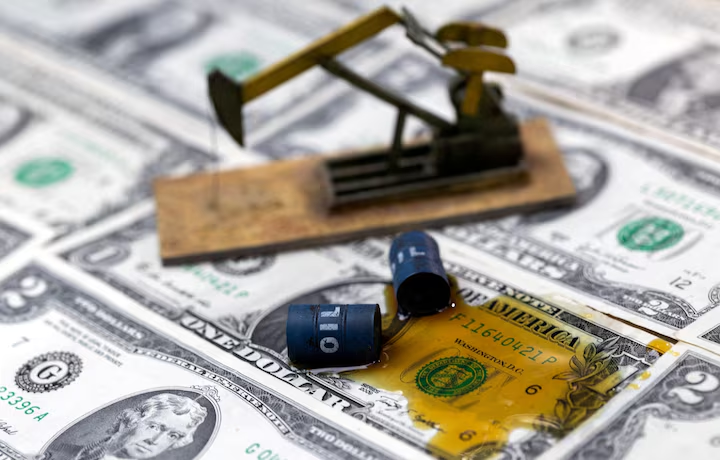
A story that looks like a Wall Street movie script, but is happening in reality. Just hours before the announcement of a ceasefire between the US and Iran, a large trade took place in the oil market – investors shorted futures worth about $950 million. This involved 8,600 contracts on Brent and WTI, executed almost as a single block. Shortly after Donald Trump’s statement, oil dropped by roughly 15%, falling below the psychologically important $100 per barrel level.
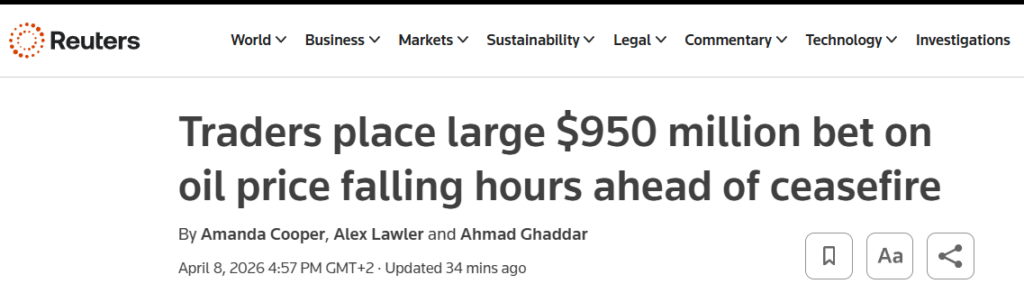
Shorting oil is a common practice. Large players regularly hedge risks or take directional bets. But here, the key point is not the bet itself, but how it was executed. Usually, such volumes are split into hundreds of smaller orders, spread over time and across different venues. This helps avoid moving the market against oneself and avoids drawing attention. In this case, things were different. The order was executed almost as a single block and after the evening clearing session, which is rare. This does not look like careful algorithmic execution, but rather a confident and rapid action with a clear expectation of outcome.
Such episodes immediately raise uncomfortable questions. The market was sensitive enough to future news that someone risked nearly a billion dollars just hours before the announcement. Whether this is coincidence is formally an open question. But the context makes it less neutral.
This is not the first such case. On March 23, the market saw a similar situation: around $500-580 million was placed on a drop in oil just 15 minutes before an announcement about delaying a strike on Iran’s energy infrastructure. The result was the same – prices fell by about 15%. Two episodes with nearly identical logic: a large bet, minimal time gap, and a sharp move after the news.
From a market mechanics perspective, the explanation may be more grounded. Oil is not only a financial instrument but also a physical commodity. Large players may have access to information about flows, supply, logistics, and sentiment at a level not available to the general public. Sometimes that is enough to “predict” direction without knowing the exact statement.

But there is another side. In an era where political decisions directly move markets, information itself becomes an asset. And often the most valuable one. The closer the decision moment, the higher the value of that information. As a result, markets increasingly move not after the news, but before it. Money first, headlines later.
An additional layer comes from platforms like Polymarket, where participants bet on geopolitical outcomes in real time. Hundreds of markets are already open there related to the US-Iran conflict: from the probability of strikes to the timing of potential agreements. Volumes are growing as well, and while this is not the institutional oil market, it reflects sentiment and expectations that can later flow into larger trades.
As a result, an interesting ecosystem is forming. On one side are traditional markets, where futures are traded and funds operate. On the other are decentralized or semi-formal platforms where participants bet on events. Between them flows information, expectations, and sometimes guesses that turn into real money.
It is important to understand that such moves increase distrust in the “purity” of the market, but at the same time highlight its nature. A market is not only a reflection of facts but also a field of expectations, probabilities, and information asymmetry. Someone always knows a bit more, someone reacts faster, and someone is simply willing to take risks where others hesitate.
That is why such stories keep repeating. They do not necessarily imply wrongdoing, but they almost always indicate that the market moves ahead of the news. The winner is not the one who reads the news first, but the one who understands in advance what the news will be.
In the end, the conclusion is quite harsh but honest. In a world where a single political statement can move markets by tens of percent, information becomes the key asset. Oil is just the instrument through which that information turns into profit. And when nearly a billion dollars enters the market hours before an event, it is no longer just a trade. It is a signal of how the game is actually played.
All content provided on this website (https://wildinwest.com/) -including attachments, links, or referenced materials — is for informative and entertainment purposes only and should not be considered as financial advice. Third-party materials remain the property of their respective owners.