

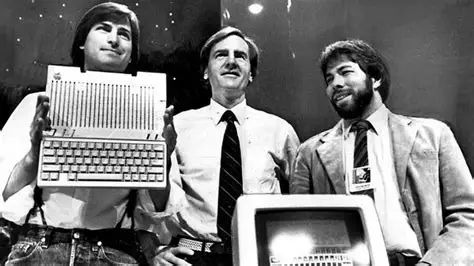
A story that sounds like a joke from the world of big money, but in reality is closer to a financial tragicomedy. Ronald Wayne – a person whose name usually appears in footnotes to Apple’s history – almost half a century later decided to put the dots over the “i”. And he did it in a manner typical for his age: calmly, without pathos, but with an undertone that makes investors involuntarily shiver.
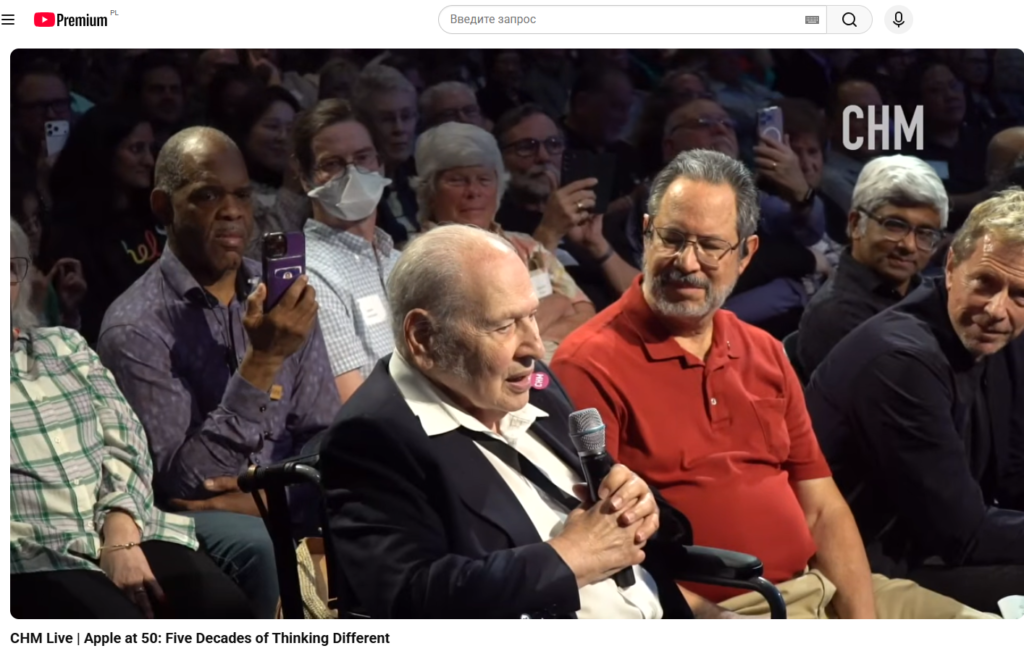
At an event at the Computer History Museum, the 91-year-old Wayne stated something that at first glance sounds like a sensation: he never sold his 10 percent stake in Apple for $800. The story that for decades was retold as a classic example of “the most expensive mistake in history” turned out to be… legally inaccurate. But, as often happens in life, the truth turned out to be no less sad than the legend.
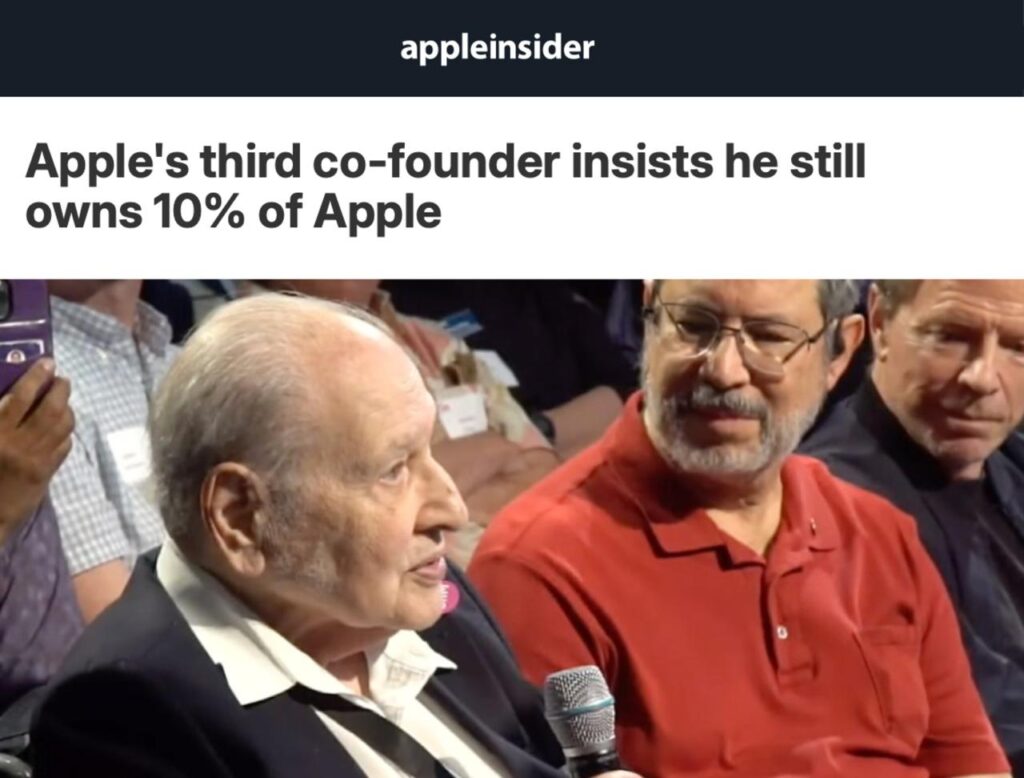
To understand the scale of the situation, one must go back to 1976, when three people – Steve Jobs, Steve Wozniak, and Ronald Wayne – registered the company. Wayne was older, more experienced, and essentially acted as the “adult in the room”. He wrote the first partnership agreement, designed the logo, and even acted as an arbitrator between the two Steves when they argued.
But there is a nuance that is usually overlooked. Unlike Jobs and Wozniak, Wayne bore much greater legal risk. The company was structured as a partnership, which meant that in case of debts or problems, creditors could come personally to him. Jobs and Wozniak did not have much to take, but Wayne did. And this is where the very fork begins, which later would enter textbooks.
Twelve days after the founding, Wayne decided to leave the company. Not because he did not believe in the idea, but because he understood the risks too well. At his age and with his experience, the prospect of being personally liable for the assets of two young enthusiasts’ startup looked, to put it mildly, doubtful.
According to him, a lawyer suggested formalizing his exit with a symbolic compensation – about $800. Not as a market valuation of the share, but simply as a formality: the documents had to show at least some number. A couple of months later, Steve Jobs sent him a check. Without explanations, without comments. Wayne himself recalls it with characteristic dry irony: “I thought it was a tip. And quite a modest one”.
Later, when Mike Markkula came into the picture and Apple was turned into a corporation, Wayne was paid an additional amount to finally close all legal issues. He does not disclose its size, but emphasizes: it was a standard procedure, not a “deal of the century”. And here is the main turning point of the whole story.
Formally, Wayne indeed did not sell his share for $800 – because by the time of the payment, his share in the partnership had already been annulled. Legally, he is right. Financially – there is no difference. He left a company that would later become one of the most expensive businesses in history. And his potential 10% today would be worth hundreds of billions of dollars.
The number sounds almost absurd. About $380 billion – a sum comparable to state budgets. But such calculations are loved by journalists, not life itself. Because they ignore the main question: could he even have held on to that share?
The history of Apple is not a straight line of growth. It is decades of crises, dilution of shares, new investments, changes in strategy, and even Jobs leaving the company. To keep 10%, Wayne would have had to not only stay, but go through all these stages, not selling shares, not being diluted, and not breaking psychologically. This is no longer a story about luck – this is a story about superhuman endurance.
And yet the irony remains. Almost 50 years later, a man effectively says: “I did not sell.” And in this phrase one hears not an attempt to rewrite the past, but a desire to clarify the details of a story that became a legend without his participation.
Interestingly, Wayne does not look like a man stuck in regrets. At the same event, he unexpectedly announced work on a new computer architecture together with Charles Stigger from CMD Supplies. According to him, the system will consume 30% less energy and operate faster than any existing solutions.
It sounds loud. Perhaps even too loud. But there is a certain symbolism in this: a person who stood at the origins of one technological revolution, at 91 speaks again about the next. However, details are still lacking, and skepticism here is quite appropriate. Especially considering that previously Stigger was involved in fundraising for Wayne’s book – about money, not technology.
In the end, this story remains one of the most illustrative in the business world. Not because someone “lost billions”, but because it perfectly illustrates the main principle: decisions are made not with a view to the future, but based on current risks. Wayne did not make a mistake. He made a rational choice under uncertainty. The world simply changed more than anyone could have expected. And perhaps the most
All content provided on this website (https://wildinwest.com/) -including attachments, links, or referenced materials — is for informative and entertainment purposes only and should not be considered as financial advice. Third-party materials remain the property of their respective owners.