

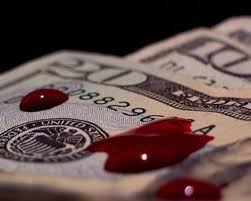
“Time to buy when there is blood in the streets”… Sounds like a cold formula for success, often repeated at conferences and in crypto threads, but history shows: in reality, it works very differently from how it is presented. The phrase, attributed to Baron Nathan Rothschild, has long become an investment meme, but between the legend of Waterloo and real wars lies a huge gap. When global conflicts begin, markets do not rise at first — they disappear, close, freeze, or turn into a state tool. And the main question in such periods is not how to earn, but how to preserve at least something.
World War I did not begin with opportunities, but with panic. The London Stock Exchange closed for months, and New York also halted trading. This alone breaks the logic of “buy on fear” — there was literally nowhere to buy. Money stops being an investment tool and becomes a survival tool. Investors massively exited stocks, sought gold and currency, transferred assets to safe jurisdictions. Those who remained in the market often did not speculate but simply waited, hoping the system would come back to life.
Yes, after U.S. markets reopened, the Dow Jones Industrial Average indeed rose sharply. But this rise is not a story of lucky traders, but of a structural shift. The U.S. was far from the front and became the main supplier of weapons, raw materials, and food. Money flowed there not because someone “bought the dip,” but because the country’s economy became the center of war production. The ones who profited were not investors, but industrial giants like DuPont or US Steel, whose profits multiplied due to government contracts. This is a key point: money in war is made not on the market, but within the resource distribution system.
At the same time, the financial architecture itself collapsed. The gold standard, on which the world economy rested, effectively ceased to function. States began printing money on a scale previously considered unimaginable. A new reality emerged — fiat money, whose value is based not on gold but on trust in the state. Gold did not disappear but changed its role: from an investment tool, it became a “survival currency.” It was not bought for growth — it was hidden, exchanged for food, and smuggled across borders.
War also demonstrated how dangerous “reliable” government assets can be. Bonds sold as patriotic investments, after defeats and revolutions, turned into worthless paper. In Germany and other countries, this was a prelude to hyperinflation. In the Russian Empire, economic chaos and currency devaluation directly contributed to revolutions. In other words, classic safe assets cease to be safe when the state collapses.
World War II pushed this logic to the limit. Money itself began to lose meaning. Under conditions of shortages and economic control, the main asset became not financial paper but access to resources. Bread, fuel, clothing, medicine — these served as real currency. On black markets, butter, coffee, cigarettes, and alcohol were valued. This is no longer an investment economy, but a survival economy, where liquidity is measured not by quotes but by the ability to exchange something for food.
States took full control over the economy: ration cards, price regulation, resource allocation. In such conditions, the market as a mechanism of free pricing simply disappears. Those who profit are not the ones who chose the right asset, but those closer to distribution — warehouses, logistics, government contracts. An access economy emerges: connections, positions, and roles within the system become more important than any money.
Large capital was indeed created during this period, but again — not “on market crashes.” Companies like Boeing or General Motors grew due to military orders. Banks like JPMorgan earned from capital flows, lending, and operations. But this was a game for those already inside the system. For 99% of the population, war meant a decline in living standards, shortages, and a struggle for basic resources.
Stories of individual “successful” players only reinforce the rule. German industrialist Günther Quandt made a fortune from military contracts and close ties to the regime. In the USSR, engineer Nikolai Pavlenko built a whole fictitious military structure and earned for years on the chaos of war. But such stories are almost always linked either to access to power or to outright crime. This is not an investment strategy, but a side effect of system destruction.
The main conclusion from the experience of the two world wars is quite simple, though inconvenient. War does not create wealth — it redistributes it. It can boost statistics, increase GDP, and create an illusion of growth, but in reality, resources go to destruction. As economist Robert Higgs wrote, a war economy may look like prosperity on paper, but it is an accounting effect hiding a decline in real living standards.
Therefore, the phrase “buy when there is blood” in a historical context looks more like a beautiful myth than practical advice. In real wars, markets either close or are distorted, assets may physically disappear, and the rules of the game change faster than investors can adapt. Real safe assets are not stocks or even gold, but far more grounded things: food, energy, safety, and the ability to leave the risk zone.
And if we transfer this to the present, the main lesson remains the same. During serious shocks, the market first thinks not about returns but about survival. Therefore, the “profit from fear” strategy works only in relatively stable systems. When the system begins to crack, priorities change very quickly. At that moment, it is far more important not to catch the perfect entry point, but to retain control over what you already have.
All content provided on this website (https://wildinwest.com/) -including attachments, links, or referenced materials — is for informative and entertainment purposes only and should not be considered as financial advice. Third-party materials remain the property of their respective owners.