

A story worthy not only of legal chronicles but also of a thriller script is unfolding in the United Kingdom, where 2,323 bitcoins are at stake — an amount that at its peak was valued at approximately $176 million.
A UK resident, Pin Fai Yuen, accuses his wife, Fan Yun Li, of a carefully planned theft of crypto assets. According to him, this was not a case of accidental access or a mistake, but a deliberate operation involving surveillance, recording, and subsequent movement of funds through a network of distributed addresses.
The essence of the allegations seems almost paradoxical for the high-tech world: the key tool for the hack was neither a code vulnerability nor a cyberattack, but an ordinary surveillance camera. According to the plaintiff, his wife, together with her sister, installed the equipment in such a way as to record his seed phrase and wallet access codes. In effect, this is a classic “offline attack,” where the main target is not the system but the person.

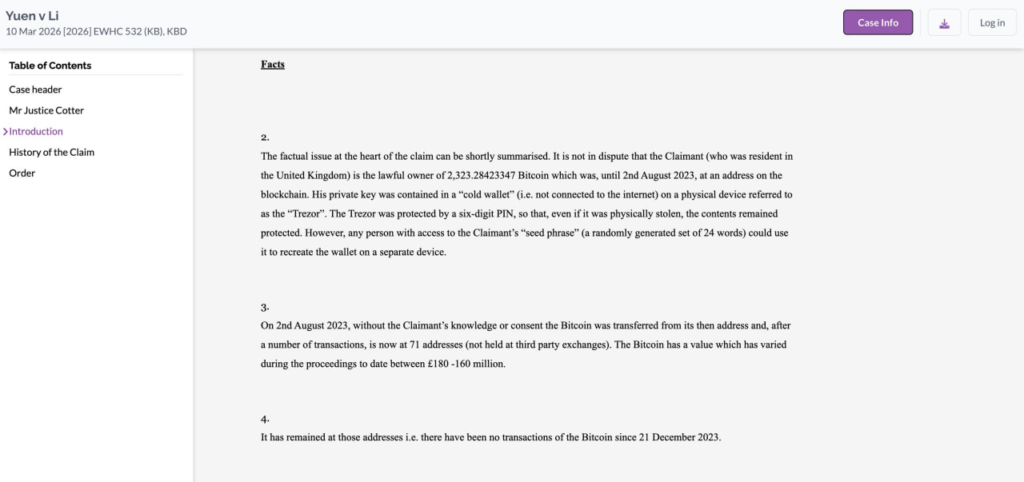
After gaining access, it is claimed that the funds were moved in stages: 2,323 BTC were distributed across more than 70 addresses. This strategy is well known in the crypto community — splitting assets makes tracking more difficult and reduces the likelihood of quickly identifying the final recipient. The last recorded transaction is dated December 21, 2023, and since then the wallets have remained inactive, further reinforcing suspicions of a “lay-low” strategy.
An interesting twist in the case is that, according to Pin Fai Yuen, he was warned about the planned theft by his own daughter. After that, he began collecting evidence himself: installing audio recording equipment and, he claims, recording conversations of his wife discussing details of the completed transfer, as well as methods for moving the funds further without drawing attention from banks or regulators.
After completing the transactions, the man contacted the police. During the investigation, law enforcement conducted a search and seized cold wallets and expensive watches. The wife was arrested but later released on bail. Authorities later stated that further action would only be possible if new evidence emerged — a formulation that often indicates the case is in a complex evidentiary zone.
Nearly two years later, in November of last year, Pin Fai Yuen initiated civil proceedings. He approached the court seeking to freeze all crypto assets linked to the defendant, to recognize his ownership of the stolen bitcoins, and either have them returned or compensated for in fiat currency.
An additional layer of complexity in the case comes from blockchain analytics. The plaintiff stated that he continues to track the movement of funds and has detected signs of so-called “dusting attacks” — a technique in which microscopic amounts of cryptocurrency are sent to wallets to analyze activity and de-anonymize owners. Such actions are often used as a preparatory step for more complex fraud schemes, including phishing.
However, the situation is far from straightforward. There is also a counterstrike: in September 2024, a conflict arose between the spouses, during which the plaintiff himself was accused of violent acts. He admitted guilt in several incidents, which could potentially affect how his position is perceived in court, particularly regarding trust in the evidence presented.
Despite this, the court has already given a preliminary assessment of the case — and it was unexpectedly favorable for the plaintiff. The judge noted that the evidence presented appears convincing, and the defendant did not provide an alternative explanation for the movement of such significant sums. The court’s wording was quite strict: the likelihood of the plaintiff’s success was described as “very high.”
The court also emphasized the need for expedited proceedings. The reasons are pragmatic: cryptocurrencies remain highly volatile assets, and delays could result in significant changes in their value. Additionally, there is a security factor: the longer the funds remain out of control, the higher the risk of their final disappearance through complex movement schemes.
This case has already attracted attention not only from lawyers but also from crypto market participants. It clearly demonstrates that even the most secure storage tools — including hardware wallets — are powerless against the human factor. If the seed phrase becomes accessible to third parties, no cryptography can save it.
The structure of the transactions is also of particular interest. Distribution of funds across dozens of addresses followed by “silence” is a classic attempt to confuse the trail. But the blockchain, as known, forgets nothing. The question is whether there is enough time, resources, and technology to unravel this tangle.
If the court ultimately rules in favor of the plaintiff, the case could set an important precedent for the UK legal system. This is not just about theft but about the recognition and protection of property rights over digital assets within family and property disputes.
And if it was once said that “money loves silence,” in the age of cryptocurrencies one can add: surveillance cameras do too.
All content provided on this website (https://wildinwest.com/) -including attachments, links, or referenced materials — is for informative and entertainment purposes only and should not be considered as financial advice. Third-party materials remain the property of their respective owners.