


debt The US national debt has approached the 39 trillion dollar mark and continues to grow at one of the fastest paces in modern history. Against this backdrop, attention is drawn not only to the dynamics of the debt itself, but also to who exactly finances the American budget deficit – and who, on the contrary, reduces investments in US Treasury bonds (Treasuries).
Despite discussions about “de-dollarization,” the largest net buyers of Treasuries recently have been developed economies of Europe and Asia.
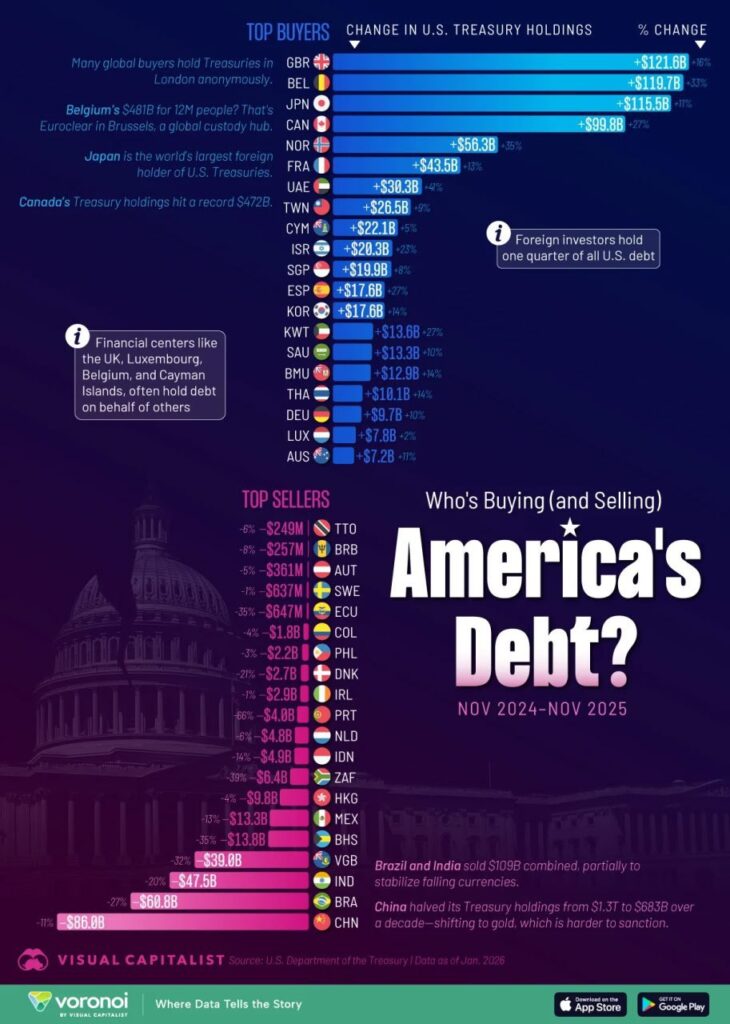
Top 5 buyers:
▪️ United Kingdom: +121.6 billion dollars (+16%) ▪️ Belgium: +119.7 billion dollars (+33%) ▪️ Japan: +115.5 billion dollars (+11%) ▪️ Canada: +99.8 billion dollars (+27%) ▪️ Norway: +56.3 billion dollars (+35%)
United Kingdom
The United Kingdom has significantly increased its investments in American debt. London remains one of the world’s largest financial centers, and British entities often act as intermediaries for global investors, including hedge funds and sovereign funds.
Belgium
Belgium shows particularly sharp growth. In US Treasury statistics, Belgium often reflects transactions of international clearing systems (for example, Euroclear), so part of the increase may be related to the reallocation of assets through European custody infrastructure.
Japan
Japan traditionally ranks among the largest holders of American debt. For Tokyo, Treasuries are an instrument of currency stability and reserve management, as well as a way to place excess liquidity amid low domestic yields.
Canada
Canada is actively increasing its holdings, reflecting close economic integration with the United States and the need for liquid and reliable instruments for reserves and pension funds.
Norway
Norway, through its sovereign wealth fund, continues to diversify assets. A 35% increase is one of the most notable indicators among developed countries.
Overall, the increase in purchases by developed economies indicates that US bonds are still perceived as a key “safe haven” of the global financial system, especially amid geopolitical instability and high market volatility.
Who is reducing holdings
On the opposite side are several large emerging economies and offshore jurisdictions.
Top 5 sellers:
▪️ China: –86.0 billion dollars (–11%) ▪️ Brazil: –60.8 billion dollars (–27%) ▪️ India: –47.5 billion dollars (–20%) ▪️ British Virgin Islands: –39.0 billion dollars (–32%) ▪️ Bahamas: –13.8 billion dollars (–35%)
China
China remains one of the largest holders of Treasuries, but its portfolio is shrinking and is at the lowest levels since 2008. At the same time, Beijing is actively increasing its gold reserves, diversifying the currency structure of its assets and reducing dependence on dollar instruments.
Brazil
Brazil has significantly reduced its holdings, which may be related both to domestic budget needs and to reserve reallocation.
India
India has also reduced its portfolio, reflecting a more flexible approach to reserve management and a desire to balance currency risks.
The British
Virgin Islands often serve as an offshore platform for international funds. The substantial reduction may indicate not so much a strategic decision by the jurisdiction as a relocation of assets to other jurisdictions.
Bahamas
The Bahamas are also offshore financial centers, where statistics may reflect the reallocation of funds by global investors.
China and gold: a strategic pivot?
The dynamics of China deserve special attention. Amid the reduction of investments in American bonds, the country is actively increasing gold purchases. Such a move fits into a long-term strategy of reserve diversification, reduction of sanction risks, and strengthening of financial sovereignty.
In fact, a parallel trend is forming:
- developed Western economies continue to support the Treasury market;
- a number of BRICS countries are gradually reducing dollar assets, strengthening alternative instruments.
What this means for the US and the world
The growth of US debt to nearly 39 trillion dollars implies a constant need for large-scale external and internal financing. As long as demand from developed economies remains stable, the Treasury market maintains stability. However, the structural reallocation of reserves – especially by China – signals gradual changes in the global financial architecture.
US bonds remain the foundation of global liquidity. But the structure of holders is gradually changing: the emphasis is shifting from the largest emerging economies to US allies and institutional investors in developed countries.
And if earlier the question sounded like “who finances US debt?”, today it is increasingly formulated differently: “who is ready to finance it in the long term – and on what terms?”
All content provided on this website (https://wildinwest.com/) -including attachments, links, or referenced materials — is for informative and entertainment purposes only and should not be considered as financial advice. Third-party materials remain the property of their respective owners.