


BitMEX co-founder Arthur Hayes stated that further escalation of the conflict between the United States and Iran could become one of the key factors changing global macroeconomic policy. In his view, rising military spending traditionally puts pressure on government budgets, which in the long term may force the U.S. Federal Reserve to shift toward looser monetary policy, including interest rate cuts and expanded market liquidity.
In his blog, Hayes noted that historically almost every major U.S. military conflict in the Middle East has been accompanied by monetary easing. He cited several examples starting from the late 1980s. During the Gulf War, the U.S. faced the need to maintain economic stability amid rising geopolitical uncertainty and energy risks. After the September 11, 2001 terrorist attacks, the global war on terror began, accompanied by significant increases in defense and security spending, which also coincided with periods of monetary stimulus. Similar processes were observed during the intensification of the Afghan military campaign, when the U.S. economy required additional liquidity to maintain market financial stability.
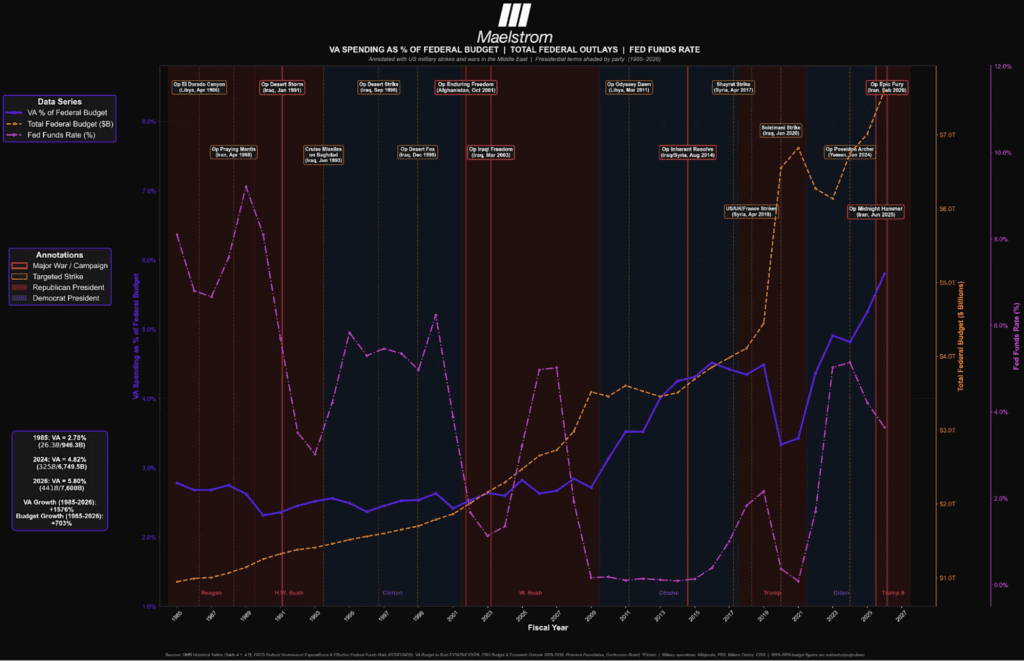
U.S. military operations and federal spending dynamics. Data: Maelstrom
Hayes emphasized that the modern global economic system is closely linked to geopolitical processes. In his view, large military operations require substantial budget financing, increasing national debt levels. In such conditions, central banks often face indirect political and economic pressure, since high interest rates increase debt servicing costs. This can become an incentive to shift toward looser monetary policy.
“The longer the administration engages in extremely costly military and political projects in the region, the higher the probability that the Fed will be forced to cut rates and increase the money supply to maintain financial stability and market liquidity,” he said. In his opinion, such a strategy has historically been viewed as part of U.S. global economic policy aimed at maintaining financial influence within the so-called Pax Americana system.
Inflation and the crypto market
Hayes believes that potential monetary easing would be a positive factor for the cryptocurrency market. Historically, periods of lower interest rates have often been accompanied by increased demand for risk assets, including digital currencies. When the cost of borrowed capital decreases, investors receive stronger incentives to allocate capital to high-yield but more volatile assets.
He recommended that investors remain cautious until clear signals appear from the Fed regarding rate cuts or additional liquidity stimulus programs. In his view, the most favorable investment opportunities may appear precisely at the moment of official policy easing announcements, as markets often react to such news in advance by forming short-term price movements.
In previous months, Hayes had already suggested the possible return of quantitative easing (QE). Among factors that could push regulators toward such decisions, he mentioned instability in the government bond market, rising corporate debt levels, and long-term risks associated with artificial intelligence development and economic automation.
Following reports of U.S. and Israeli airstrikes on targets in Iran, discussions about a possible global military conflict increased significantly in the crypto community. However, professional analysts note that such fears are not yet supported by real macroeconomic consequences.
Market Reactions
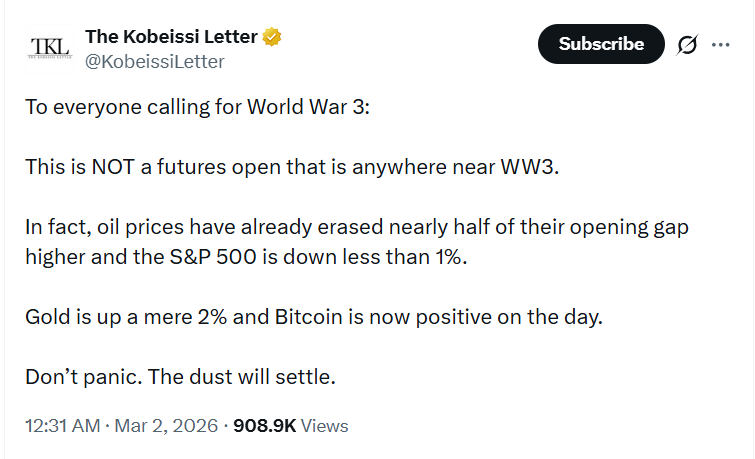
Traditional markets’ reaction to geopolitical tension remains moderate. Futures on U.S. stock indices opened lower, and the S&P 500 lost about 1.5% during trading sessions. Such dynamics are typical during periods of heightened uncertainty, when investors prefer to lock in profits and reduce exposure to risky assets.
Oil prices partially corrected their initial rise. The market first reacted to supply disruption risks, but growth later slowed due to a lack of confirmed data about long-term energy logistics disruptions. This suggests that the market currently views the conflict as a localized geopolitical event rather than the start of a global energy crisis.
According to analysts from The Kobeissi Letter, current market dynamics do not show signs of panic reactions. During truly large-scale crises, capital movements are usually sharper, with mass position liquidations and rapid declines in risk assets. For now, investors remain cautious and prefer a wait-and-see strategy.
Thus, a potential change in Fed policy remains a hypothetical scenario directly dependent on the further development of the geopolitical situation, the scale of military spending, and the state of the U.S. economy. In the short term, markets will continue to react to the news flow, while the long-term trend will be shaped by macroeconomic decisions of regulators and the balance of global financial flows.
All content provided on this website (https://wildinwest.com/) -including attachments, links, or referenced materials — is for informative and entertainment purposes only and should not be considered as financial advice. Third-party materials remain the property of their respective owners.