


Robert Kiyosaki bought bitcoin at a price of $67,000 — and did so not at the peak of euphoria, but during a market downturn. For some this looks like a risky move, for others — a consistent implementation of a long-declared strategy. The investor himself explains his decision not by short-term price fluctuations, but by fundamental reasons related to the monetary system and the limited nature of the asset itself.
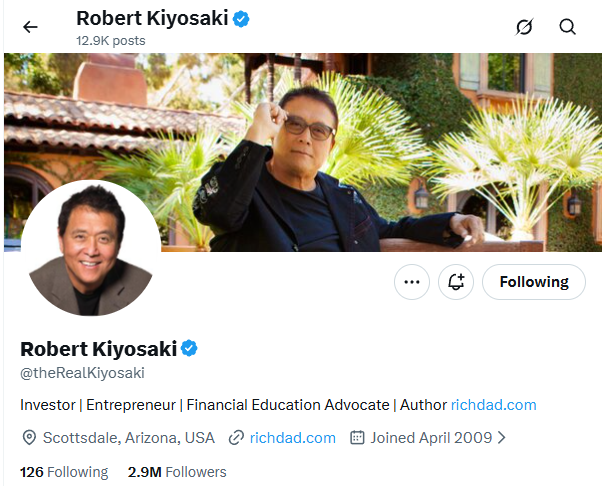
We are talking about Robert Kiyosaki — entrepreneur and author of the book “Rich Dad Poor Dad,” who for many years has criticized the fiat monetary system. He reported that he purchased another BTC for approximately $67,000 despite the market correction. This step fits into his long-standing position: to buy real assets during periods when most investors are pessimistic.
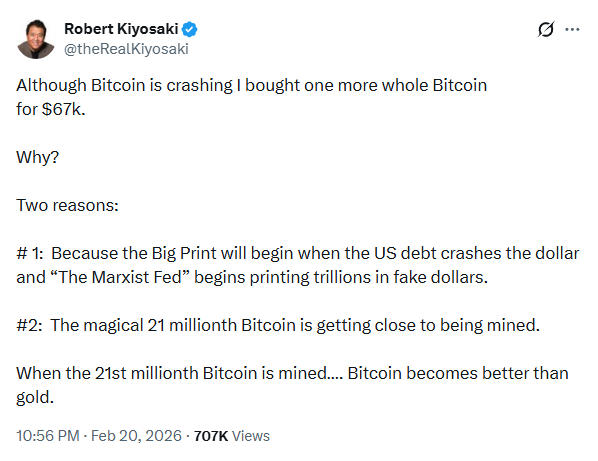
Kiyosaki’s first argument is connected with expectations regarding U.S. monetary policy. He is convinced that the country’s national debt has reached levels at which pressure on the dollar will intensify. In his view, at a certain point this will lead to a large-scale expansion of the money supply. In other words, the Federal Reserve will be forced to print trillions of dollars to stabilize the system. In his logic, this means further erosion of the dollar’s purchasing power. In such an environment, assets with limited supply gain a strategic advantage.
The second argument concerns the very nature of bitcoin. Its issuance is limited to 21 million coins, and most of them are already in circulation. This hard cap is a fundamental difference from fiat currencies, whose supply can be increased by decisions of central banks. Kiyosaki has repeatedly emphasized that it is precisely this mathematically fixed scarcity that makes bitcoin a digital analogue of gold. Moreover, he argues that after mining is completed, bitcoin may even become “better than gold” — primarily due to transparency of accounting, divisibility, and ease of cross-border transactions.
It is important to note that the current purchase was not a sudden decision. In February 2026, Kiyosaki had already stated several times his readiness to increase his position in the leading cryptocurrency. He allowed for a scenario in which, if the price fell to $6,000, he would buy even more. At the same time, he emphasized his intention to increase investments in gold. Such rhetoric indicates a consistent approach: investing in scarce assets during periods of market weakness rather than in phases of hype.
The structure of his portfolio also reflects this philosophy. He owns physical gold and silver, and also holds positions in Ethereum and bitcoin. That is, this is not a bet on a single instrument, but a diversified set of assets which, in his opinion, protect capital under conditions of inflation and debt pressure. At the same time, Kiyosaki remains optimistic about bitcoin and declares his intention to continue buying as the price declines.
His strategy is based on the principle of contrarian behavior. He openly speaks about his readiness to buy during panic — at moments when investors are massively selling assets due to expectations of crisis or collapse. Such tactics imply high volatility and require a long planning horizon. This is not an attempt to profit from a short-term rebound, but a bet on structural changes in the global financial system.
From the perspective of Kiyosaki’s supporters, his arguments are built around three key factors: the U.S. debt burden and the risk of further money printing, bitcoin’s limited supply, and the historical tendency of scarce assets to increase in value over the long term. Skeptics, however, point out that the cryptocurrency market remains extremely volatile, and macroeconomic scenarios may develop differently than proponents of the “big printing” theory assume.
Thus, the purchase of bitcoin at $67,000 in Kiyosaki’s logic is not an emotional move and not an attempt to guess the local bottom. It is a continuation of a long-standing position in which the main role is played not by the current price, but by the belief in the transformation of the monetary system. Whether such an approach will prove justified will be shown by time. But one thing is obvious: the investor acts consistently and in accordance with his philosophy, betting on scarce assets in an era when money, in his opinion, is becoming increasingly less rare.
All content provided on this website (https://wildinwest.com/) -including attachments, links, or referenced materials — is for informative and entertainment purposes only and should not be considered as financial advice. Third-party materials remain the property of their respective owners.