

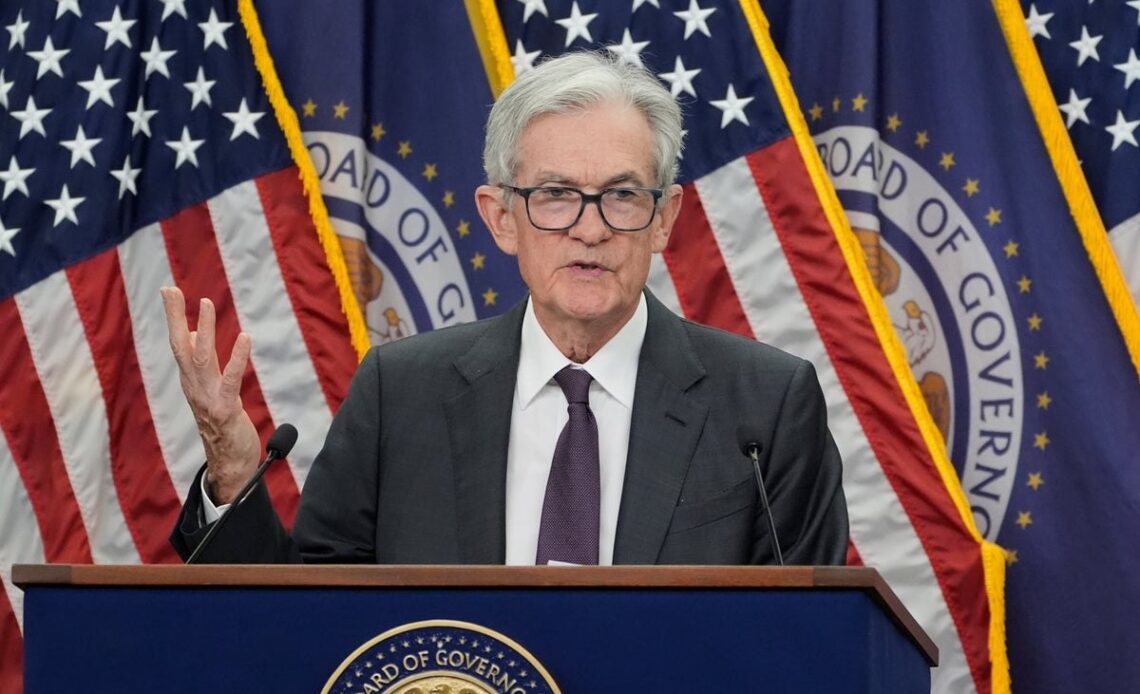
The key takeaways from yesterday’s speech by Jerome Powell are in fact much deeper than they may seem at first glance. This is not just commentary on the current economy – it is a cautious signal to the markets: the regulator is in no hurry to change course and prefers to observe rather than act ahead of time.
Let us start with the key block – rates and inflation. Powell effectively acknowledged that inflationary pressure has not fully disappeared but has simply changed its form. A new factor is tariffs. According to the Fed’s estimates, they may cause a one-time increase in inflation of about 0.5-1.0%. This does not look like a catastrophe, but what matters is something else: inflation is getting a “second wind” again not because of an overheating economy, but due to external factors. And fighting such factors with rate hikes is like treating a fever with a thermometer.
Additional pressure comes from geopolitics. The conflict in the Middle East directly affects energy prices, and therefore the cost of almost everything. This is a classic inflationary impulse that comes from outside and is poorly controlled by monetary policy. In such a situation, the Fed finds itself in an uncomfortable position: it needs to react, but has limited tools.
And here lies the central tension of the speech. Powell directly points to the contradiction between the Fed’s two goals – stable inflation and a strong labor market. Previously, these goals could move in parallel, but now they are beginning to pull the economy in different directions. Lowering rates would support employment but could accelerate inflation. Keeping rates high restrains prices but cools the labor market. This is no longer fine-tuning – it is a choice between two risks.
Hence the main conclusion: the Fed is deliberately choosing to pause. The regulator is not ready either to sharply ease policy or to tighten it further. This is the position of an observer who understands that any sharp move could worsen the situation.
For the crypto market, this means something quite straightforward. As long as rates remain high, money remains expensive. And when money is expensive, investors become cautious and prefer less risky instruments. In such an environment, crypto feels like a startup in an era of expensive credit – there is interest, but funding is scarce.
However, the second block – government debt – is even more interesting. Here Powell sounded much tougher. He directly stated that US debt is growing faster than the economy. This is not just statistics, it is a structural problem. When the debt burden increases faster than the ability to service it, the system sooner or later hits a limit.
The phrase that “this will end badly if action is not taken now” is a rare case of a Fed Chair speaking so directly. Essentially, it is a warning: the current financing model is unsustainable in the long term.
And this is where things get most interesting for the crypto market. Historically, the combination of rising debt and high rates creates tension in the system. At some point, this tension is usually released through policy easing – in simple terms, through the printing press. And it is during such periods that assets like Bitcoin begin to look not like speculation, but like insurance against systemic risks.
But there is a nuance, and it is important. Until the Fed starts actively expanding its balance sheet, until the “cheap money” mechanism is turned on, crypto remains in a suspended state. The potential is there, but there is not enough fuel for growth. It is like a car with a powerful engine but no fuel – it will not go far.
The third block is bond purchases and the Fed’s balance sheet. Powell reminded the basic mechanics: when the Fed buys government bonds, it lowers yields and effectively makes money cheaper in the system. This supports the economy, stimulates lending, and increases risk appetite.
Interestingly, he noted separately that the previous expansion of the Fed’s balance sheet did not cause the inflation that many had feared. This is an important psychological point. The Fed is essentially telling markets: “we have done this before, and the world did not collapse.” Therefore, if needed, they are ready to do it again.
This is already a direct hint at a possible return to QE. Not now, not tomorrow, but it remains on the table as a tool. And the markets read this perfectly well.
For crypto, this is almost a classic scenario. Every cycle of quantitative easing in the past has been accompanied by growth in the crypto market. The reason is simple: when liquidity increases, part of that money inevitably seeks higher-yield and higher-risk assets. And crypto is among the first candidates.
As a result, the picture becomes quite clear. For now – a pause, caution, and high cost of money. This restrains the market. But beneath the surface, factors are accumulating that could eventually shift Fed policy toward easing.
Thus, the main conclusion sounds almost old-fashioned, like from textbooks, but with a modern twist: the market lives on expectations. And if expectations of “cheap money” begin to grow, crypto will react before the Fed itself presses the button.
Financial markets rarely wait for official signals. They prefer to anticipate them. Sometimes they get it right, sometimes they do not. But this is exactly what the strongest market moves are built on.
All content provided on this website (https://wildinwest.com/) -including attachments, links, or referenced materials — is for informative and entertainment purposes only and should not be considered as financial advice. Third-party materials remain the property of their respective owners.