


While Jerome Powell enthusiastically talks about a stable labor market and confidently waves charts around, the reality in the United States looks much more mundane. According to The Kobeissi Letter, only in the past few months, hundreds of thousands of people have been laid off from various companies and institutions.

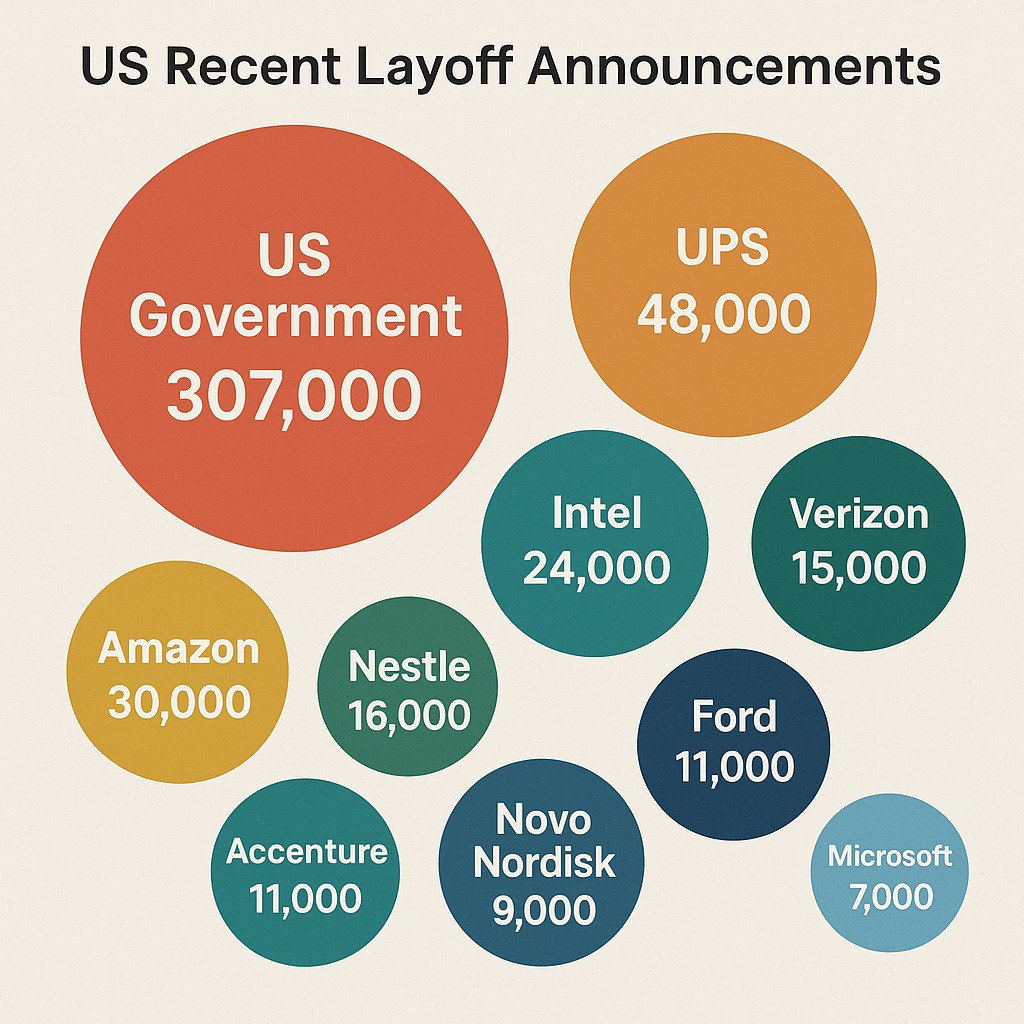
And these aren’t some abstract “optimizations”, but a very concrete list that looks like a report before moving into a new world order.
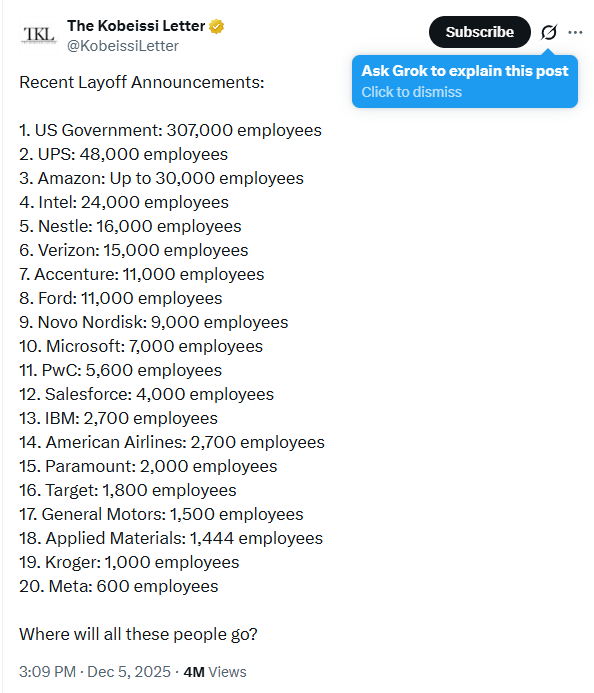
That is, while the head of the Fed assures that the labor market stands like a rock, this rock for some reason is crumbling by thousands of people. Almost all key sectors – logistics, technology, manufacturing, finance, retail – have “tightened their belts”. If this is what stability looks like, it’s scary to imagine what “instability” is.
And here is the main question hanging in the air like a supermarket receipt after going out “just for a couple of things”: Where are all these people supposed to go?
The service sector? But it is already sighing under the influx of “optimized” specialists.
Technology? They’re cutting staff faster than new vacancies appear.
Government structures? They themselves have just sent 300 thousand people home.

A strange picture emerges: the economy is supposedly “stable”, companies are “more efficient than ever”, and people are left standing in front of the closed door of the labor market with a suitcase of resumes and a big question in their eyes.
It feels like modern capitalism quietly switched to the mode: “We will automate everything we can, and even what we can’t. And you… well, good luck!”
So the question “where to go?” doesn’t sound rhetorical but very human.
And the answer, unfortunately, is nowhere to be seen yet – not in reports, not in press conferences, not on the pages of the statistics Powell loves to quote.
If the labor market continues to be “stable” in this manner, very soon people will start looking for stability anywhere – in crafts, in farming, in manual labor that robots haven’t destroyed yet.
And this may sound old-fashioned, but life has repeatedly proven that old professions survive new technologies much better than new technologies survive crises.
All content provided on this website (https://wildinwest.com/) -including attachments, links, or referenced materials — is for informative and entertainment purposes only and should not be considered as financial advice. Third-party materials remain the property of their respective owners.