


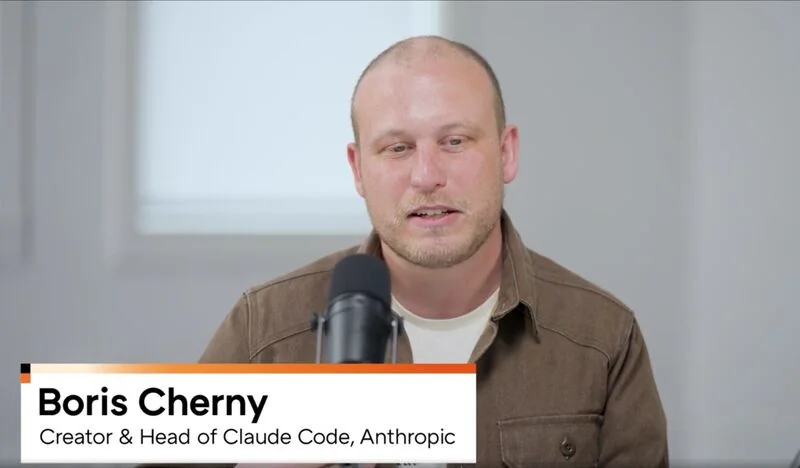
In the professional community, an alarming question is being raised more and more often: will the profession of “programmer” remain in its familiar form by 2026? The trigger for a new wave of discussions was a statement by Boris Cherny — the chief architect of the Claude Code tool at Anthropic.
In a recent episode of Lenny’s Podcast, hosted by former Airbnb top manager Lenny Rachitsky, Cherny stated that the title “software engineer” may disappear in the near future. In his view, by the end of the year “everyone will become product managers, and everyone will code,” and the name of the profession itself will transform into a more general one — “builder.” And, as he emphasized, this will be a painful process for many.
Claude Code is an agent-based AI tool capable of autonomously performing software development tasks with minimal human involvement. Despite debates about the system’s effectiveness (including criticism over the rapid consumption of user credits), the tool has quickly gained popularity in the professional community.
On the podcast, Cherny made a striking statement: since November 2025, he has not personally edited a single line of code by hand. Moreover, he cited the example of a colleague who allegedly completed a year’s worth of work in just one hour thanks to AI.
Similar signals are coming from other companies as well. At Spotify, they note that their leading developers are writing code by hand less and less frequently. Their work is increasingly shifting toward solution architecture, task formulation, and quality control of what artificial intelligence creates.
At the same time, the labor market is changing. Companies are opening fewer and fewer positions for junior specialists. Instead, demand is growing for those who can effectively interact with AI tools, formulate tasks for agents, and verify the results of their work.
If previously a junior developer learned by gradually immersing themselves in the codebase, now the entry barrier has paradoxically become higher: one must not only understand a programming language but also possess skills in working with AI, understand the limitations of algorithms, and be able to detect errors that the machine may make.
Cherny does not hide that the upcoming changes will be painful. He speaks directly about “dark days” for the development industry. At the same time, the architect of Claude Code tries to maintain the image of Anthropic as “the adult in the room” among technology giants.
He acknowledges the limitations of current technologies: it is not yet possible to completely отказаться from human oversight. “You have to make sure that the result is correct. You have to make sure that it is safe,” Cherny emphasizes. This is especially important in projects with large teams and complex architectures.
Nevertheless, he is confident that fundamental programming knowledge will cease to play a decisive role in the next year or two. Today it is still necessary, but in the foreseeable future, in his opinion, the importance of “manual coding” will sharply decline.
In fact, we are talking about a transformation of the role. A programmer becomes less of an executor and more of a director of the process. They formulate tasks, adjust strategy, verify results, and manage several AI agents simultaneously.
If previously the one who wrote code faster and cleaner was valued, now the value shifts to the one who better understands the product, architecture, and business logic. In this sense, the boundary between a product manager and a developer is indeed blurring.
Skeptics note that statements about the “end of the profession” are not new in IT. Automation has more than once “buried” various specialties — from testers to database administrators. However, each time the profession did not disappear but changed.
Nevertheless, the speed of current changes is unprecedented. Generative models have learned to write code, refactor it, find vulnerabilities, and even independently plan development stages. The productivity of individual specialists has indeed increased multiple times over.
Cherny emphasizes that at Anthropic they take the potential labor consequences “very seriously.” In his opinion, society needs to begin a large-scale conversation about how to adapt to these changes.

However, the company does not intend to slow down development so that the market can catch up. Technological progress will continue, even if it proves painful for some specialists.
If Cherny’s forecasts come true, 2026 may become a turning point for the industry. The profession of “programmer” will not literally disappear but may change radically. Pure code writing will become a secondary skill, and the key one will be the ability to manage intelligent systems.
For some, this is a chance to multiply productivity and reach a new level. For others, it is a risk of being left behind in the profession if adaptation proves too slow.
The history of technology shows that when a tool becomes smarter, not only the process changes but also the very structure of the labor market. The only question is whether this will happen smoothly — or truly “painfully for many,” as the architect of Claude Code warns.
All content provided on this website (https://wildinwest.com/) -including attachments, links, or referenced materials — is for informative and entertainment purposes only and should not be considered as financial advice. Third-party materials remain the property of their respective owners.