


Block has announced a large-scale restructuring: around 40% of its employees — approximately 4,000 people — will leave the company. The decision is explained by the rapid development of artificial intelligence tools and the need to rebuild the entire operating model.
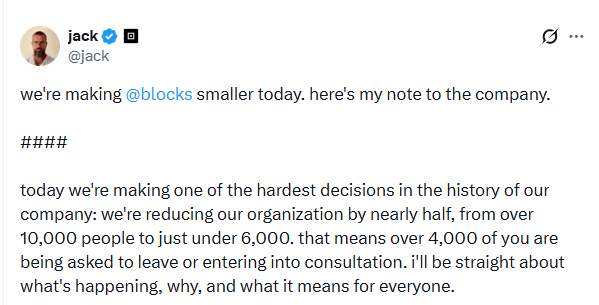
Jack Dorsey published an open letter on the social network X outlining the rationale behind the move. According to him, the combination of AI tools and small autonomous teams is already changing the very principle of how the company operates. Management faced a choice: stretch the layoffs over several years or carry them out at once. Dorsey described gradual waves of job cuts as destructive to internal culture and trust among customers and investors — therefore, the company chose to act quickly and “honestly,” avoiding prolonged uncertainty.

Compensation and scale of change
Laid-off employees will receive 20 weeks of pay plus an additional week for each year of service, six months of health insurance, the option to keep corporate devices, and a one-time payment of $5,000. Notifications were sent on the same day the letter was published.
According to Dorsey, Block employs more than 10,000 people. After the restructuring, the workforce will shrink to fewer than 6,000 employees. For context, Macrotrends data show that in 2019 the company had about 3,835 employees, and by 2023 that number had grown to 12,985 — a 237% increase in just four years, reflecting expansion in the fintech sector and active product development.

A strategic pivot to AI
In a February 26 letter to shareholders, Dorsey expressed confidence that many technology companies will reach similar conclusions within the next year. In his view, Block has simply recognized the inevitability of structural change faster than others. The company plans to increase process automation, accelerate product launches, and shift to a platform model in which users can create functionality themselves using built-in AI tools.
Earlier, Bloomberg reported that up to 10% of employees could be cut as part of an annual performance review. However, the final decision proved significantly more extensive.
In essence, Block is betting on an architecture where AI becomes not an auxiliary tool but the foundation of the business operating system. This implies a reduction in manual engineering work and a transition to a hybrid model in which employees manage intelligent systems rather than perform routine tasks.
Market reaction
The market responded immediately. Block shares (ticker XYZ) rose by more than 31% — to $96.58 at market open compared to the previous close of $73.65, according to Google Finance data. The surge reflects investors’ positive reaction to management’s decisiveness and expectations of improved business margins.
At the same time, the company released its financial results for Q4 2025. Gross profit reached $2.87 billion, up 24% year over year. Cash App revenue increased 33% annually to $1.83 billion. These figures indicate that the layoffs are taking place not amid crisis, but during a period of growth — giving the reform a strategic rather than defensive character.

Historical context and potential risks
The history of corporate transformations shows that companies that move first with large-scale optimization during technological shifts often gain a short-term market advantage. The 31% share price jump in a single day likely reflects a certainty effect: investors received a clear signal about the future direction of development.
However, long-term outcomes depend on how successfully the company preserves key competencies. Similar scenarios were observed in the early 2000s after the dot-com crash: some companies that sharply reduced staff improved efficiency, while others lost strategic expertise and innovative capacity.
Platform model and redistribution of responsibility
Particular attention is drawn to Block’s intention to develop a model in which users can independently create features using AI tools. This brings the company closer to a platform ecosystem where value is generated not only by the internal team but also by external participants.
Such an approach increases scalability and reduces operating costs, yet raises questions about the quality and security of financial services. Fintech products require strict regulatory compliance and data protection. If a significant portion of development shifts to user-level tools, the company will need to ensure effective oversight and auditing of such solutions.
AI as a driver of structural transformation
The situation surrounding Block reflects a broader trend: artificial intelligence is no longer merely a tool for improving efficiency but is becoming a driver of organizational restructuring. Companies are adapting to a world in which intelligent systems can perform tasks that previously required large teams of specialists.
Cutting nearly half the workforce is a radical step, but it demonstrates management’s confidence that the company’s future lies in automation and digital platforms. The market is supporting this choice for now. Whether it remains strategically successful will become clear in the coming years, when it is evident whether the new model can deliver sustainable growth without sacrificing quality and customer trust.
All content provided on this website (https://wildinwest.com/) -including attachments, links, or referenced materials — is for informative and entertainment purposes only and should not be considered as financial advice. Third-party materials remain the property of their respective owners.