


The crypto industry is once again discussing a topic that sounds almost like science fiction – quantum computers. This time, experts at Grayscale Investments are reassuring investors: at the current stage, it is premature to speak about a real threat to public blockchains. In other words, “all bitcoins will be broken tomorrow” is still more talk than reality.
At the same time, Grayscale does not suggest relaxing completely. On the contrary, they believe the industry should already be accelerating preparations for the so-called post-quantum future. The logic is simple and fairly conservative in spirit: it is better to strengthen the foundation in advance than to rebuild the house in panic during a storm. This approach is very much in line with the old school of finance – protection first, growth second.
A similar view is shared by researchers at Google, particularly the Google Quantum AI team. In their materials, they note that despite the current lack of scalable quantum computers, progress in this field may be non-linear. In other words, development may not be gradual but could “jump” to a new level – which is exactly what makes the situation potentially sensitive in the future.
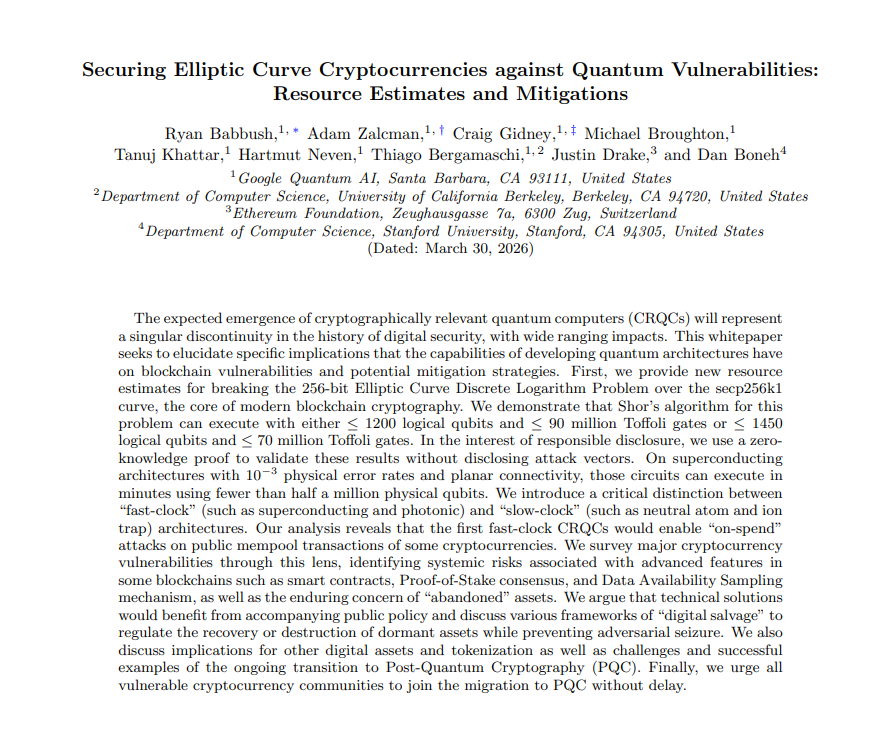
At the same time, Google emphasizes that post-quantum cryptography is not a hypothetical theory, but an already established field with practical solutions. Moreover, transitioning to such standards is technically feasible. Simply put, the tools already exist – the question is their implementation and coordination.
Some blockchain projects are already moving in this direction. Among them are Solana and XRP Ledger, which are testing or considering the implementation of post-quantum solutions. This can be compared to how internet projects once transitioned to HTTPS – first as an experiment, and then as a standard.
However, when it comes to Bitcoin, the focus shifts from technology to the community. According to Grayscale, the main challenge here is not the code, but the people. Bitcoin, as a system, is indeed relatively resilient to quantum threats at the current stage, but its evolution directly depends on decisions made by the community.
Special attention is given to one of the most sensitive topics – lost private keys. These are coins for which access has been permanently lost. Any changes affecting these funds will inevitably spark debate.
Among the potential scenarios discussed in theory are recognizing such assets as “burned,” maintaining the current status quo, or introducing restrictions on their movement. But it is important to understand that none of these options is simple or universally accepted. Any decision would require broad consensus, and in the world of decentralization, that is always a slow process.
Grayscale also highlights the fundamental difference between traditional financial systems and public blockchains. Centralized structures – banks, technology companies, and government institutions – can make decisions and implement changes much faster because they operate top-down.
In contrast, public blockchains function differently. There is no single decision-making center, meaning any change must go through a complex coordination process among network participants. This makes the system more resistant to external control, but at the same time complicates the implementation of even necessary updates.
In the end, quantum computers today are more of a future factor than a real threat. But the very fact that this discussion is taking place shows that the crypto market is beginning to think one step ahead. As the saying goes, wise people fix the roof while the sun is shining – not when the rain has already started.
All content provided on this website (https://wildinwest.com/) -including attachments, links, or referenced materials — is for informative and entertainment purposes only and should not be considered as financial advice. Third-party materials remain the property of their respective owners.