

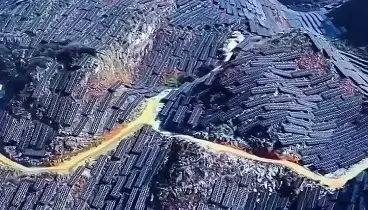
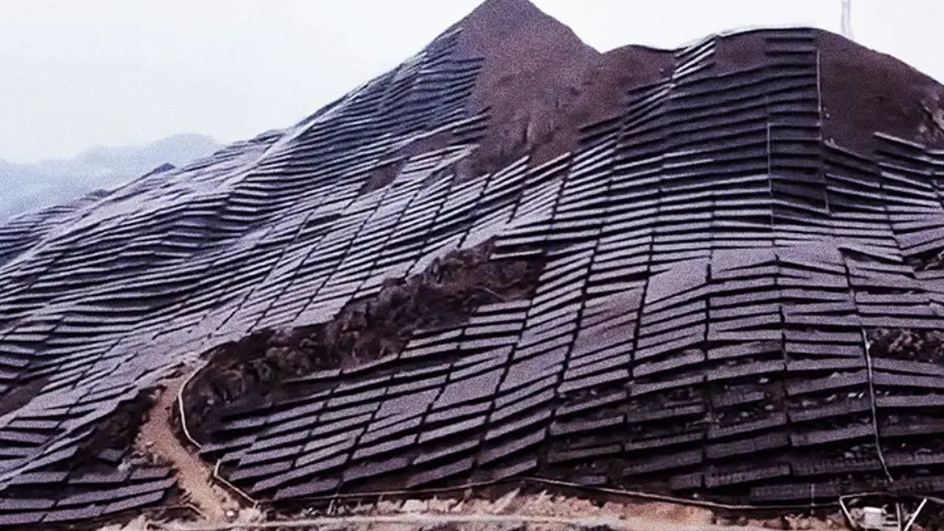
In our Telegram channel, you can watch a video fragment showing what the mountain range in China’s Guizhou province looks like. The picture is impressive and at the same time illustrative. Almost 97% of the region’s territory consists of mountains and hills. There are almost no plains, and land suitable for agriculture and conventional development is extremely limited. For decades, this terrain was considered an economic problem, a constraint, and a headache for development. China chose a different approach and turned it into a source of income.
Mountain slopes are literally being covered with solar panels. Not sporadically and not as an experiment, but systematically and on an industrial scale. What once hindered construction and farming now works and generates money. Mountains have ceased to be ballast and have become an asset.
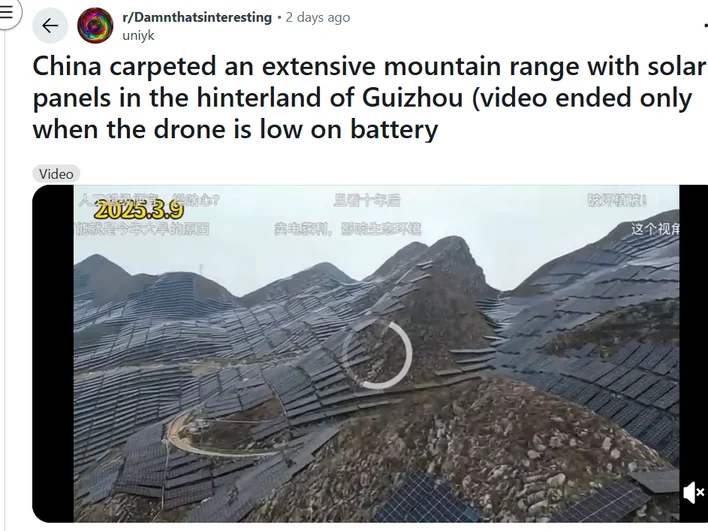
Source: Reddit
Now to the numbers, because without them the whole story would look like a beautiful postcard.
A typical project for the region is a solar power plant with a capacity of about 80 MW. Annual generation of such a plant is approximately 139 million kWh. The electricity price for sales to the grid ranges from 0.4 to 0.6 yuan per kWh. As a result, annual revenue amounts to 56-83 million yuan, or roughly 8-12 million dollars.
Capital expenditures in China are currently among the lowest in the world. Construction costs are around 0.5-0.6 million dollars per megawatt of installed capacity. Accordingly, an 80 MW plant costs about 40-48 million dollars. Operating expenses are minimal – around 1-2% per year, which in monetary terms is less than one million dollars. No hundreds of employees, no complex supply chains, and no constant repairs.
With these inputs, the project payback period is 4-6 years. After that, the plant operates smoothly for another 20-25 years, delivering a predictable cash flow and requiring only a minimal staff for maintenance. Not a startup, not venture capital, but a boring, clear, and very stable economic model.
Looking more broadly, at the scale of the entire province, the effect is even more evident. Guizhou produces almost 24 billion kWh of electricity per year from solar and wind. At the same time, more than 99% of this generation is utilized. That means the energy is actually absorbed by the grid, without massive curtailments, forced shutdowns, or dumping power nowhere. For renewable energy, this is a critically important point where many regions of the world still struggle.
And here a logical question arises: Where is AI in all of this?
Now the most important part, which is usually skipped – and in vain. Green energy is constrained not so much by panels and turbines as by management. The sun is unstable. The weather changes. Load fluctuates. The grid lives its own life. Without intelligent management, all of this turns into chaos and losses.
This is where AI comes in. Forecasting generation based on weather and cloud cover hours and days ahead. Optimizing power output to the grid. Reducing losses. Real-time inverter control. Maintenance planning. Early detection of panel degradation, hot spots, and failures through telemetry. Inspections using drones and computer vision. Integration of solar plants with storage systems and dispatching, so that generation is curtailed as rarely as possible and supply matches demand windows more precisely. That means selling electricity at higher prices and more consistently.
Without all of this, mountain solar plants would be a beautiful but problematic experiment. With it, they become an industrial machine for printing kilowatts and money.
So what is the result?
Skeptics of green energy usually care about two things. Predictability and money. Predictability here is bought with software and management. AI turns weather from chaos into planning. Money comes from a very simple formula. Mountains become an asset. Payback fits into 4-6 years. After that, stable cash flow continues for decades.
In this setup, AI plays the role of an operating director. Less downtime. Fewer losses. Less manual labor. Higher useful output to the grid. Higher margins. And yes, there is enough power left for data centers as well.
Investors should take a closer look. Everyone else may want to think about where mountain hiking is best done now.
All content provided on this website (https://wildinwest.com/) -including attachments, links, or referenced materials — is for informative and entertainment purposes only and should not be considered as financial advice. Third-party materials remain the property of their respective owners.