

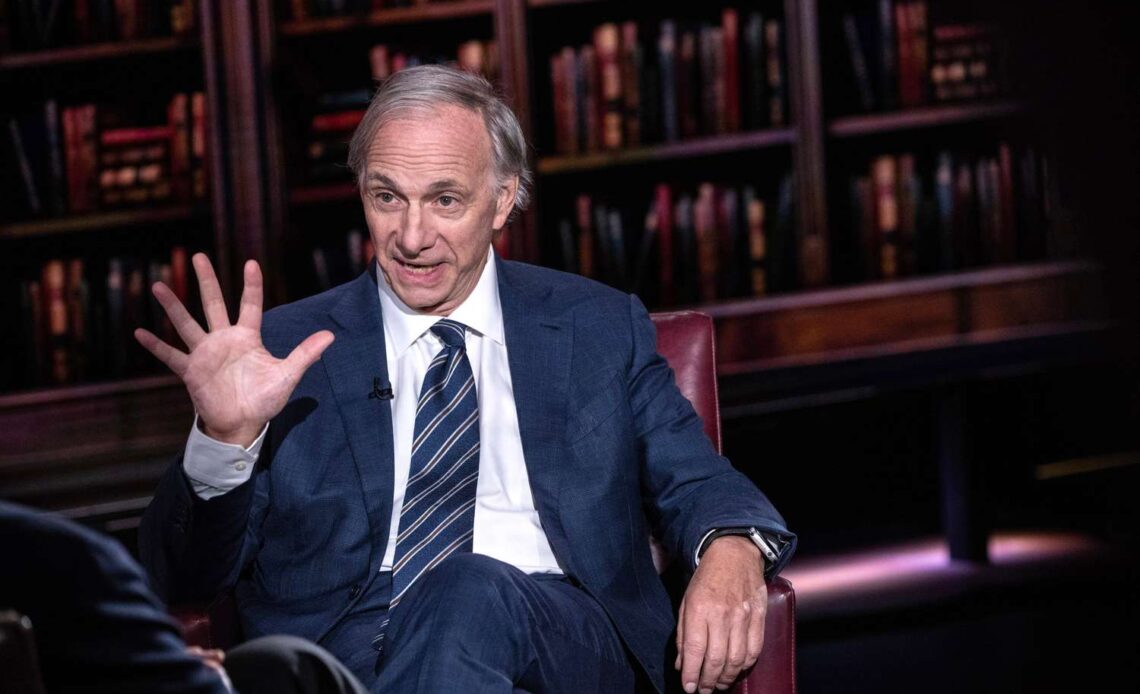
American billionaire and founder of the world’s largest hedge fund, Bridgewater Associates, Ray Dalio stated that the postwar global order has officially broken down. Managing assets of roughly $130 billion, he believes humanity has entered a period he calls a “great disorder,” when the familiar rules of international relations stop working, and the system increasingly operates according to the logic of power rather than agreements.
In his new essay on LinkedIn, Dalio describes what is happening through the lens of his own concept of the “Big Cycle” – a model according to which dominant powers go through stages of rise, peak, and inevitable decline. According to him, the world is now in the so-called “Stage 6,” when the previous order collapses and the struggle among major powers comes to the forefront.
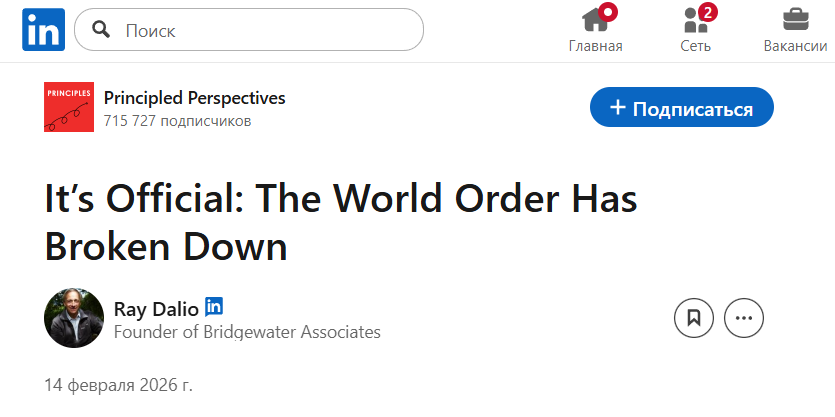
He directly writes that this is a phase in which chaos emerges due to the absence of clear rules, and the international system begins to function by the principle of “might makes right.” For the investor, this is not merely a philosophical observation, but an attempt to explain why the world is becoming less predictable and why economic decisions today cannot be separated from geopolitics.
Dalio draws parallels with the 1930s, which in history became the prelude to World War II. Back then, the combination of a debt crisis, protectionism, rising nationalism, and political extremism gradually undermined global stability. The investor emphasizes that major conflicts rarely begin suddenly. Usually, they mature for a long time in the form of economic pressure, trade restrictions, and financial wars long before the first shots are fired.
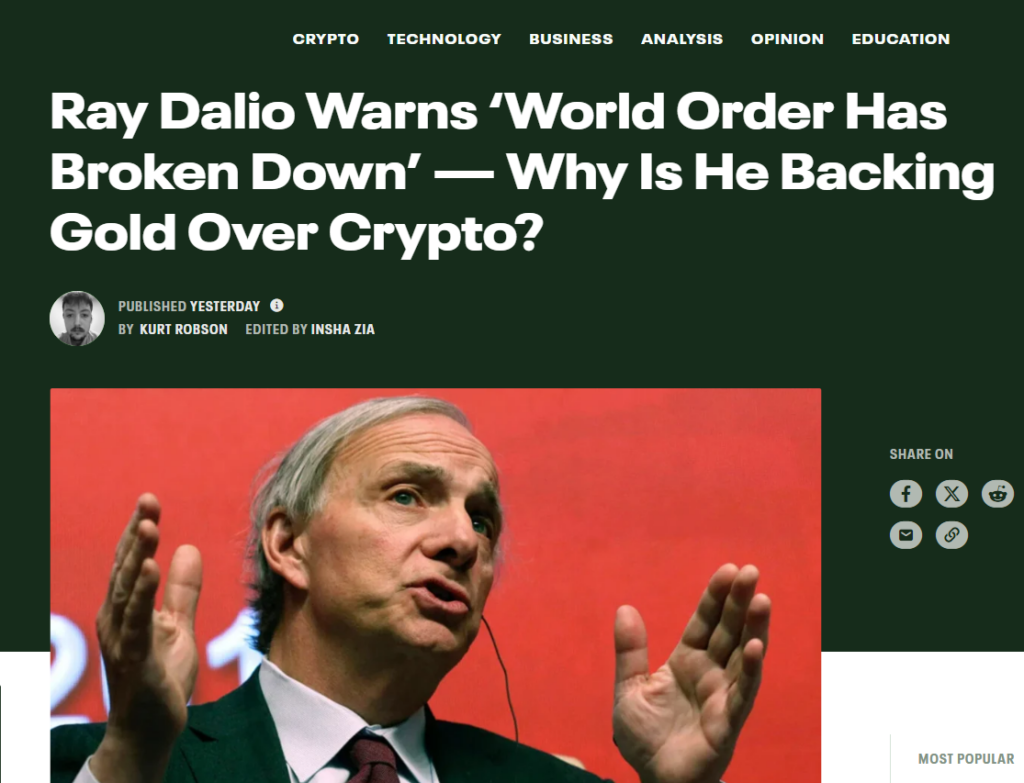
He notes that even before open hostilities, states actively used tariffs, embargoes, asset freezes, and sanctions. And this, in his view, is what most strongly resembles the present. Dalio introduces the concept of “capital wars,” when money and financial infrastructure become weapons. Sanctions turn not just into a diplomatic tool, but into a way to reshape global capital flows and force an opponent to pay a price without direct military confrontation.
Dalio considers the most dangerous point of tension in the current cycle to be the strategic rivalry between the United States and China, especially around Taiwan. He explains that the choice facing great powers is always extremely difficult. War is costly in lives and resources, but retreat is costly in status, because it is perceived as weakness. It is precisely such dilemmas, in his opinion, that make conflicts almost inevitable when the system enters a phase of the breakdown of the previous balance.
Against this backdrop, Dalio offers a rather harsh investment recommendation. He says that in conditions of the разрушение of the international order, one should get rid of debt and buy gold. His logic is simple: wars are almost always financed through borrowing and money printing, which over time devalues both currency and debt obligations. Gold, historically, has retained the role of a neutral asset that survives crises of confidence in financial systems.
He even formulates it almost aphoristically: gold is the currency of empires during wars. In periods when credit systems are undermined by conflicts and political risks, gold becomes the asset perceived as universal and independent.
Notably, in his latest comments Dalio barely mentions Bitcoin or other cryptocurrencies as a protective instrument. Given that many supporters of digital assets consider them an alternative to gold, his silence looks telling. For him, in conditions of geopolitical chaos, cryptocurrencies have not yet become as obvious a refuge as a metal tested by centuries.
Moreover, he expresses skepticism about central bank digital currencies. In an interview with Tucker Carlson, Dalio questioned the attractiveness of CBDCs as a store-of-value instrument, noting that if such currencies do not offer interest, they are of little interest to investors.
But his main concern is not profitability, but control. He warns that there will be no privacy in such systems. All transactions will be known to the state, and therefore digital currencies may give governments unprecedented powers, including the ability for direct taxation or even freezing access to funds.
Dalio’s warnings about instability in the global financial system are not new. For years he has spoken about the fragility of the dollar and the gradual shift in trust toward fiat currencies. At the World Economic Forum in Davos, he explicitly stated that the monetary order is collapsing, and that debt and fiat money are no longer seen by central banks as an unconditional way of preserving wealth as they once were.
He points to changes in the structure of reserves and the fact that countries increasingly act based on their own strategic interests rather than the logic of global rules. Essentially, decades of American leadership, in his view, are coming to an end, and the world is becoming more fragmented and competitive.
Dalio also stresses that the international system differs from domestic political systems in that it lacks effective arbitration and binding laws. This creates a dangerous situation where two competing sides have the power to destroy each other, yet must trust that they will not be attacked first. And trust is the scarcest resource in an era of “great disorder.”
Against this background, the question arises about the future of digital assets under sanctions, freezes, and restrictions on cross-border payments. Cryptocurrencies may attract attention as alternative payment systems operating outside traditional banking channels. However, Dalio himself does not yet see them as a full replacement for gold in the role of a protective asset.
His analysis suggests that the current crisis is not just another wave of market volatility, but a possible structural turning point, when not only asset prices change, but the very architecture of the global financial system.
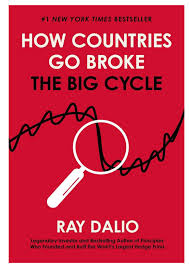
At the same time, it should be noted that Dalio’s concept of the “Big Cycle” relies on historical observations over a 500-year period of the rise and fall of empires. But the modern world is developing under conditions of unprecedented technological interconnectedness, which may alter classic scenarios. Digital infrastructure creates new forms of interdependence that can both accelerate crises and provide additional mechanisms for restraint.
Bridgewater Associates has existed since 1975 and has пережил many shocks – from the 2008 crisis to the 2020 pandemic. Dalio is known for his algorithmic and historical approach to decision-making. Some of his forecasts about debt risks have indeed proven accurate, but predictions of the complete collapse of the dollar as a reserve currency have not yet materialized.
Nevertheless, his main thesis sounds harsh and clear: the world is entering a phase where the old rules no longer guarantee stability, and therefore investors, governments, and societies will have to adapt to an era in which financial security once again becomes a matter of geopolitics.
All content provided on this website (https://wildinwest.com/) -including attachments, links, or referenced materials — is for informative and entertainment purposes only and should not be considered as financial advice. Third-party materials remain the property of their respective owners.