


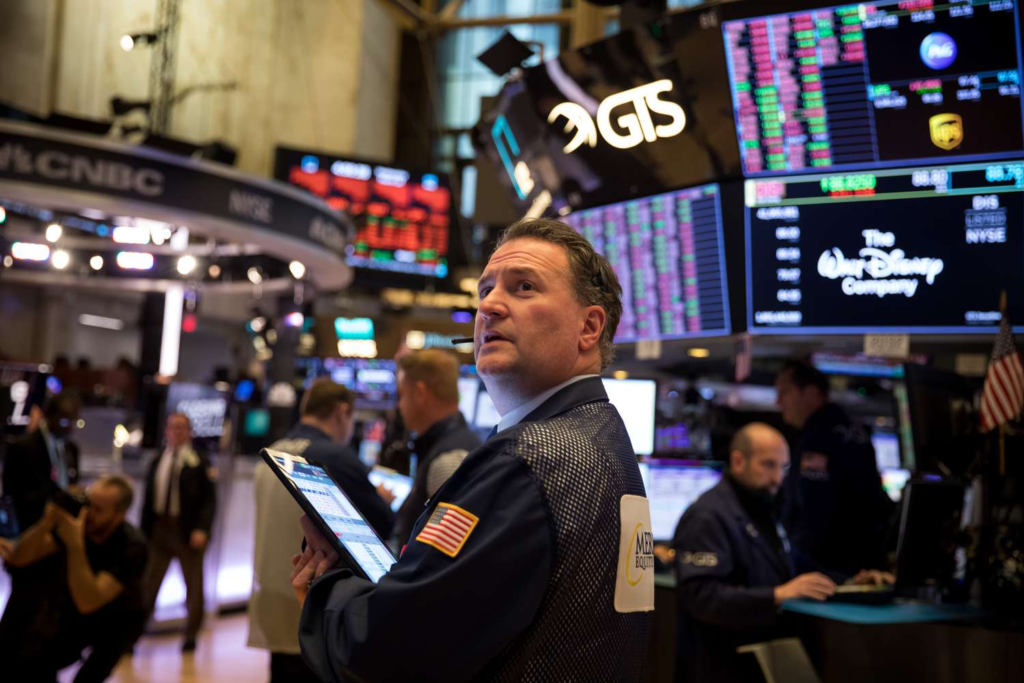
US stock markets finished the week in positive territory despite ongoing pressure from geopolitical tensions and sharp statements by Donald Trump toward Iran. The situation remains tense, but an important signal is visible – buyers are gradually returning to the market, and the decline is not gaining further momentum. This is not rapid growth, but it is no longer panic either – rather a cautious recovery with an eye on external risks.
The Nasdaq gained about 4.4% over the week, showing the best result among the major indices. However, the index still remains below its 200-day moving average, which means there is no confirmed upward trend. In other words, the market has risen, but has not yet proven that this is a sustainable move rather than a temporary bounce.
The S&P 500 also ended the week in positive territory, gaining approximately 3.4%. But the situation here is similar – the index remains below key technical levels, which does not provide confidence in a full reversal.
The Dow Jones showed more modest dynamics, but still rose by about 3%. This indicates that the growth is broad-based, but uneven – some sectors are performing noticeably stronger than others.
Against the backdrop of equities, the commodities market stands out sharply. Oil rose by nearly 11.7%, reaching above $111 per barrel. This is the highest level since 2022, and such a spike rarely passes without consequences for the economy. Rising oil prices increase inflationary pressure and may shift expectations regarding monetary policy.
The yield on 10-year US Treasury bonds remained almost unchanged at around 4.31%. This is an important signal: the bond market is not yet pricing in sharp economic changes, but it is also not showing optimism. Stable yields combined with rising equities suggest a balance between fear and greed – a classic transitional phase.
Among individual companies, Tesla continues to stand out due to weakness. The company’s shares have fallen by about 20% since the beginning of the year. The main reasons are slowing delivery growth and increasing competition in the electric vehicle segment. Technically, a potential negative signal is also forming in the stock structure – the so-called “death cross,” when a short-term moving average crosses below a long-term one. This is often seen as a sign of a strengthening downtrend, although it does not guarantee continuation.
At the moment, the key factor for the market remains macroeconomics. In the near future, investors will closely watch inflation data – CPI and PCE indices. These indicators determine the future actions of the Federal Reserve. If inflation remains high, expectations for rate cuts will be pushed back, which may limit equity growth.
Minutes from Federal Reserve meetings and labor market reports are also important. A strong economy with high employment can support the market, but at the same time complicates the task of reducing inflation. Ultimately, everything comes down again to the balance between growth and central bank policy.
For investors, the current situation requires a cautious approach. The market is showing signs of strength, but has not yet confirmed a sustainable uptrend. In such conditions, aggressive buying carries elevated risk, especially amid geopolitical uncertainty and macroeconomic signals.
A more balanced strategy предполагает maintaining part of capital in cash, gradually building a watchlist of high-quality assets, and waiting for confirmation of a trend reversal. In such periods, discipline is more important than speed – the market will still provide opportunities to enter, but only for those who are patient.

Sectors that currently look stronger than others include oil and gas, technology, and infrastructure. They benefit either from rising commodity prices or from stable demand and long-term investment cycles.
Among the laggards are automakers, the solar energy sector, and consumer companies. They are under pressure from both macroeconomic factors and declining consumer activity.
The conclusion is quite simple and in the spirit of the old school of investing: the market has begun to recover, but it is still far from a confident bull trend. This is not the time for heroic decisions, but a time for observation, patience, and preparation.
All content provided on this website (https://wildinwest.com/) -including attachments, links, or referenced materials — is for informative and entertainment purposes only and should not be considered as financial advice. Third-party materials remain the property of their respective owners.