

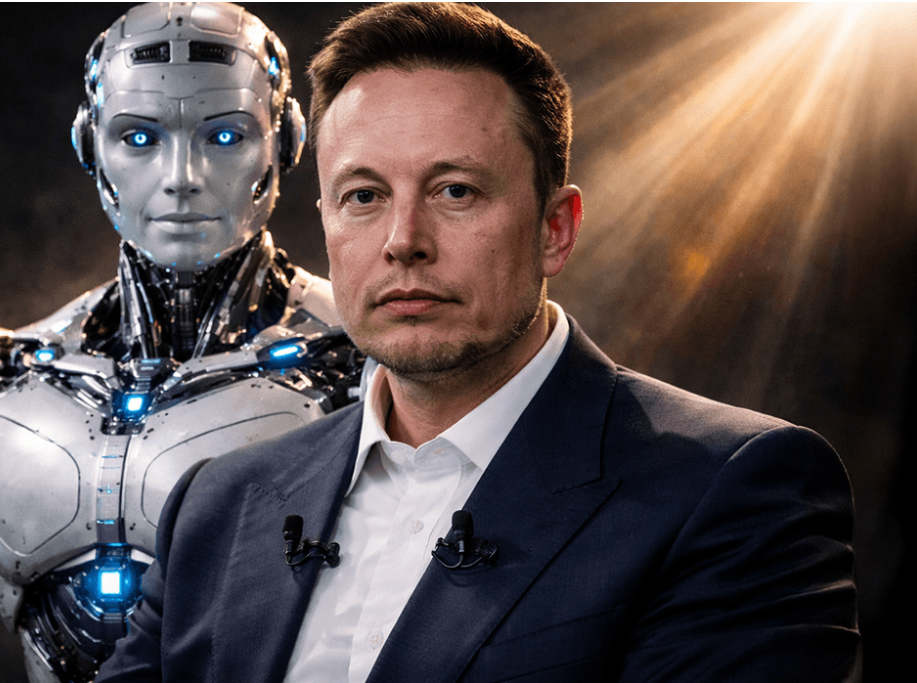
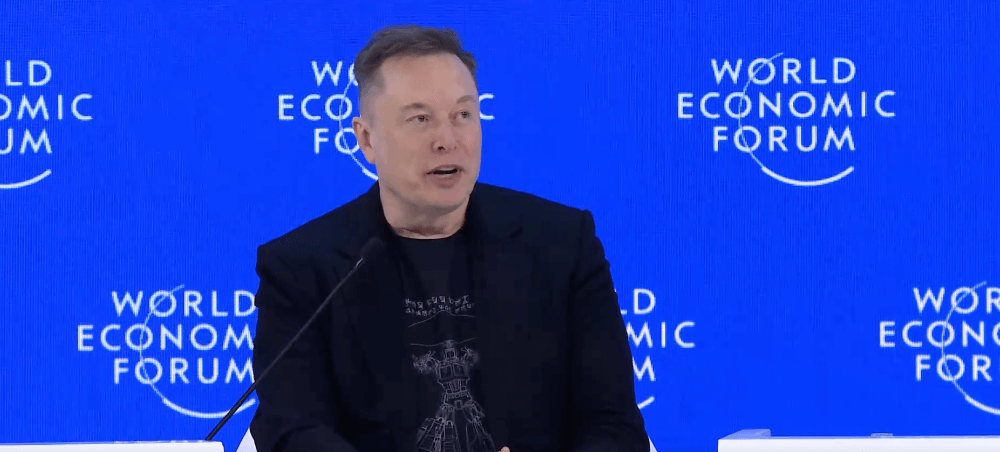
The richest man in the world unexpectedly changed his tone and rhetoric. A person who for years distanced himself from the World Economic Forum and openly criticized it personally appeared in Davos this time. That fact alone became a signal: Musk decided to speak not only to markets and engineers, but also to the global political and economic elite. And he spoke not about taxes or subsidies, but about the future of civilization — in the broadest sense.
Musk began, as usual, with provocation and self-irony. He stated that he is an alien. A phrase that initially sounded like a joke quickly turned into a philosophical reflection on the rarity of intelligent life in the Universe. Musk noted that SpaceX already has about nine thousand satellites in orbit, and during all this time there has not been a single case when it was necessary to maneuver to avoid an alien spacecraft. The conclusion is simple and rather bleak: either aliens do not exist, or intelligent life is so rare that we may be its only carrier.
From this he drew the key conclusion of the entire speech. If consciousness and intelligence are truly unique, humanity is obliged to preserve them at any cost. Not for profit, not for political regimes, and not for short-term gains, but for the very fact of the existence of intelligence in the Universe. This is where Musk’s idea of an “era of abundance” comes from — not as a utopia, but as a technological necessity.
Musk then moved on to specifics. He confirmed that Tesla is moving toward mass production of humanoid robots. According to him, by the end of 2027 the company will most likely begin their broad commercial sale. This is not about expensive laboratory prototypes, but about serial devices that will be able to perform physical work, replacing humans where this is economically and socially justified.
At the same time, Musk gave perhaps the boldest assessments of the development of artificial intelligence. He stated that by the end of the current year an AI may appear that surpasses any individual human in intelligence. And by 2030–2031, in his opinion, artificial intelligence will become smarter than all of humanity combined. This is not a science fiction-style forecast, but a logical continuation of the current rates of growth in computing power and model quality.
At the same time, Musk explicitly spoke not only about opportunities, but also about risks. He once again reminded that AI and robotics require an extremely cautious approach. Without clear restrictions and responsible control, humanity really may find itself in a scenario resembling movies about a machine uprising. The comparison with “Terminator” sounded not as a joke, but as a warning: technologies amplify intentions, they do not replace morality.
Musk also separately touched on the topic of multiplanetarity. He once again outlined his key goal — to make human civilization not dependent on a single planet. In the event of a global catastrophe on Earth, intelligent life must have a chance to continue. In this context, Mars is for him not a symbol and not a PR project, but an element of a species survival strategy. His famous phrase that he wants to die on Mars, but not during landing, sounded this time almost like a business summary of a life plan.
The passage about aging was also interesting. Musk stated that he considers it a solvable technical problem. In his opinion, the key issue is not to “rejuvenate” a person, but to understand the fundamental causes of aging. Once they are clearly described at the biological level, the question will become an engineering one, not a philosophical one.
Overall, Musk’s speech in Davos looked like a manifesto of a new technological realism. Without habitual cynicism, but also without rose-colored glasses. He spoke about abundance not as free resources for everyone, but as a world in which basic constraints are removed by technologies: energy, automation, AI, and the expansion of human presence beyond Earth.
In fact, Musk made it clear: the future will be neither comfortable nor safe by default. But for the first time in history, humanity has tools not just to survive, but to consciously manage its own destiny. The only question is whether we will have enough intelligence and responsibility to use this chance.
A video fragment of the speech can be watched on our Telegram channel.
All content provided on this website (https://wildinwest.com/) -including attachments, links, or referenced materials — is for informative and entertainment purposes only and should not be considered as financial advice. Third-party materials remain the property of their respective owners.