


This formula sounds too good to be true, but it is exactly what some of the largest online scam schemes in Europe are built on today. The story of a 35-year-old woman from Poland who lost 18,000 zlotys is not an exception but a typical example of how modern social engineering works. A journalist from Gazeta Wyborcza deliberately followed the same path to understand from the inside how people are gradually manipulated before their money is taken.

The story starts simply. The woman receives a message from a stranger online offering easy money. No skills required: just like YouTube videos. Promised earnings — from 100 to 3000 zlotys a day. For someone tired of inflation, loans, and economic instability, this sounds like a lifeline. At first, everything seems almost flawless. She is given simple tasks, completes them, and receives real money: first 30 zlotys, then 50, then 80. In total, about 500 zlotys. The money arrives quickly, without delays, on familiar services. This moment is crucial — the brain registers the fact: the scheme “works.”
Next, the victim is invited to “move to the next level.” The mechanics are always the same: higher income — higher responsibility. To earn seriously, one must invest their own money. The wording may vary — “deposit,” “account activation,” “investment task” — but the meaning is the same: transfer money. In this case, it involved cryptocurrency investments. The woman was convinced it was safe, temporary, and fully controlled by the “platform.” She took a bank loan, borrowed money, and eventually transferred around 18,000 zlotys to the scammers.
After some time, the scenario moves to the final phase. A message appears about a “system error,” “security check,” or “fund freeze.” To unlock the money, an additional payment is required. Sometimes it is called a tax, a fee, or mandatory identity verification. After transferring the extra funds, contact is cut off, accounts are blocked, and the money disappears. Only then does the victim realize they have been scammed and contacts the police.
This scheme is known as a task scam — fraud disguised as completing simple tasks. Its strength lies in gradual escalation. At first, the victim is neither sold anything nor asked for money. On the contrary, they are paid. This breaks down natural defenses and creates a sense of control. People begin to trust their own experience rather than promises. That is why these schemes work even on those who consider themselves careful and rational.
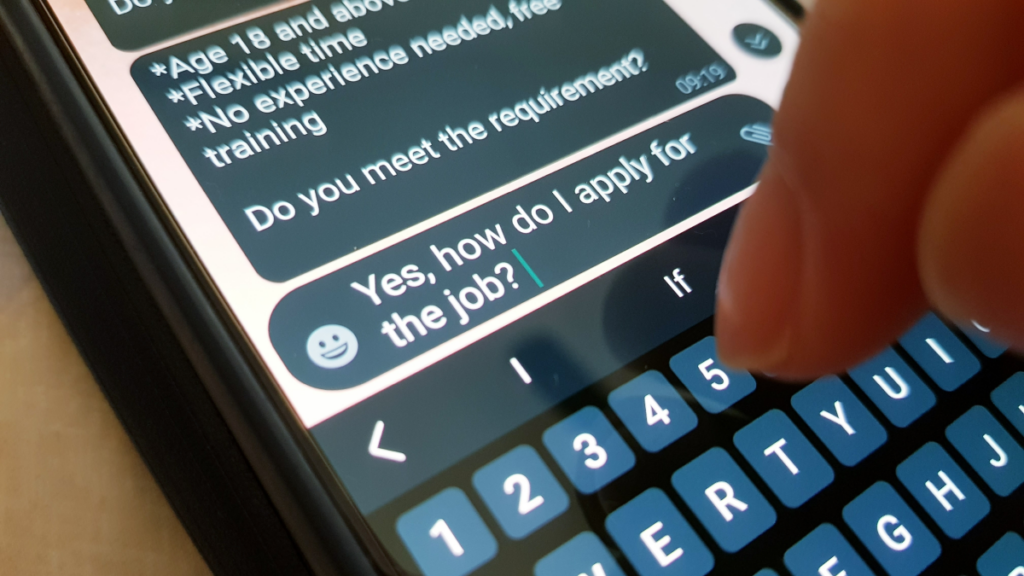
A similar mechanism is used in the so-called pig butchering scheme. Here, the focus is less on tasks and more on relationships. Victims may be engaged for weeks via Tinder, WhatsApp, or Telegram to build trust, flirt, and share “personal stories.” The outcome is always the same — a proposal to invest, help, or participate in a “unique opportunity.” The difference is that in task scams, instead of romance, the illusion of work and earnings is used.
The Wyborcza journalist received invitations in several messengers. The wording was nearly identical: “Earn 100–3000 zlotys a day just by liking YouTube.” Group administrators used phone numbers with codes from Nigeria, Mexico, Bolivia, and the UK. In chats, “Piotr,” “Julia,” and “Szymon” actively wrote — fictional characters created to create the illusion of a normal working team. They asked questions, shared “successes,” and thanked administrators for the opportunity to earn.
For the first test task, the journalist actually received 30 zlotys via Revolut. The money came from a real Polish woman, likely part of the same scheme, whose funds were used to pay other participants. This is another key element: initial payments are almost always real and often come from other victims. Scammers minimize their own risk while building trust.
Next come “investment missions.” Amounts and promises grow: invest 200 — receive 260, invest 1000 — receive 1400, invest 10,000 — receive 15,000. Up to a point, payouts may indeed arrive. This is done intentionally to push the person toward the largest transfer. After this, accounts are blocked, “frozen,” or contacts disappear.

It is important to understand that these schemes are not run by lone scammers, but by well-organized international criminal networks. They use Telegram, WhatsApp, fintech services like Revolut and PayPal, cryptocurrencies, and increasingly — AI tools. Photos of “consultants” are generated by neural networks, messages are perfectly adapted to the language and cultural context, and scenarios are finely tuned. This is not chaos — it is a production line.
The main takeaway is simple and unpleasant. If someone offers you easy money with no skills, effort, or risk — it is almost always a trap. Real markets, real investments, and real earnings never look like a guaranteed game. Modern scams don’t pressure or scare. They smile, pay, and patiently wait for the person to make the most expensive transfer of their life.
All content provided on this website (https://wildinwest.com/) -including attachments, links, or referenced materials — is for informative and entertainment purposes only and should not be considered as financial advice. Third-party materials remain the property of their respective owners.