


I came across an interesting chart from CB Insights that looks almost like a tombstone for startups (touch wood): neatly laid out, showing who and where “didn’t make it” over the past couple of years. And if you look without rose-colored glasses, the takeaway isn’t very pleasant — everyone fails. Just some more often, others a bit less.
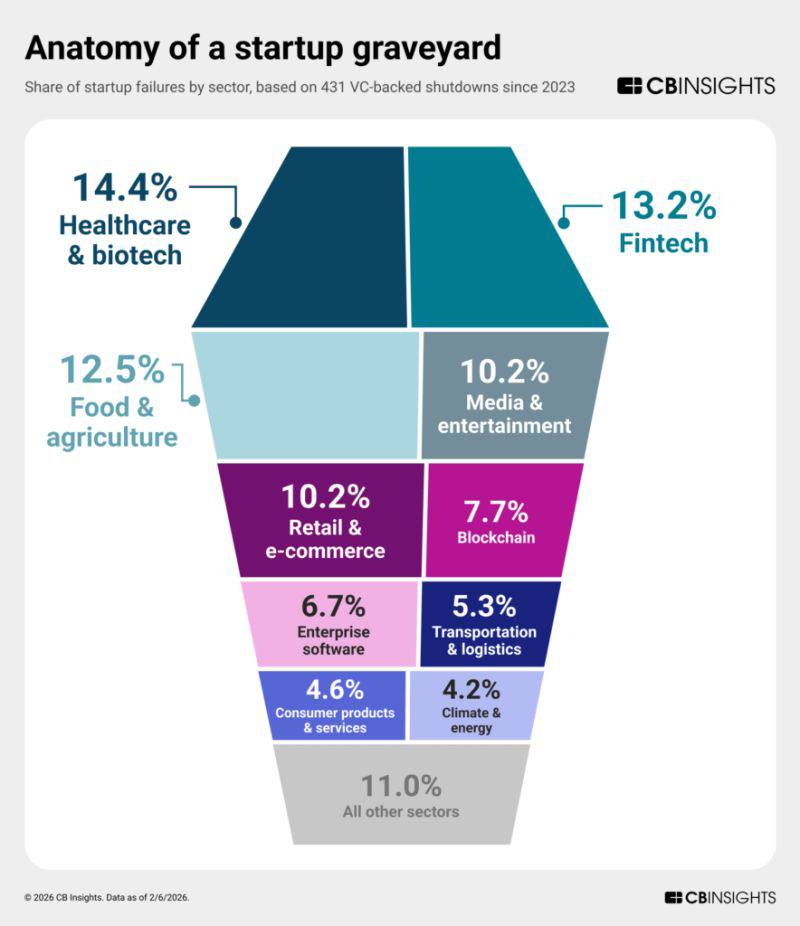
The most closures hit healthcare and biotech — 14.4%. Next comes fintech at 13.2%, then food and agri, media, e-commerce, and even blockchain, which was supposed to “change everything,” but for now more often changes its status from “unicorn” to “closed.” Classic picture: the more money and hype in a sector, the bigger the graveyard.
Against this backdrop, a thought arises that now sounds in almost every other pitch: “AI is different.” Supposedly, mass failures haven’t hit it yet, so it’s safe. The logic is understandable. But there’s a catch — the same was said about fintech in 2018, crypto in 2021, and food delivery during every lockdown.
AI truly looks like the most “alive” zone right now. Money flows in like a river, corporations buy up teams faster than they can come up with a proper name, and the market seems endless — because its boundaries are still unclear. It’s like the Wild West: plenty of land, few rules, and gold seemingly at your feet. Usually, these moments produce the loudest success stories… and the quietest closures.
Why does AI seem safer now? First, demand. Businesses genuinely need efficiency growth, automation, cost reduction — and AI delivers that. Second, infrastructure already exists: clouds, models, APIs — no need to build everything from scratch. Third, investors fear missing the “next big trend,” and fear of missing out is one of the most generous funding sources.
But strip away the marketing, and what remains is the old, good startup reality that hasn’t changed for decades. It doesn’t matter if you do fintech, a marketplace, or “AI-powered something” — if there’s no real value, unit economics, and clear customer, the ending will be the same. In AI, it may just happen a bit later and with a prettier presentation.
There’s another point many ignore. AI commoditizes very quickly. What was “wow” yesterday is already openly available today or embedded in products from major players like Google or Microsoft. This means low entry barriers — and competition becomes ruthless. Making “another AI service” is now easier than opening a coffee shop, but actually making money on it is a different art.
Yes, the market is huge. Very huge. But “big market” doesn’t equal “easy money.” It’s like the ocean: lots of water, but survival is for those who have not only a boat but also know where to sail.
So the main takeaway from this chart isn’t “rush into AI before it’s too late.” It’s that no sector is truly “safe.” There are only good and bad business models. In some niches mistakes are forgiven longer; in others, the bill comes immediately.
AI is an opportunity, yes. But it’s not a free pass from failure. And if you’re going to start a startup, it’s better to do it not because “there’s money there,” but because there’s a real problem someone is willing to pay to solve. Everything else the market has already seen. And judging by this funnel, it buries it with enviable regularity.
All content provided on this website (https://wildinwest.com/) -including attachments, links, or referenced materials — is for informative and entertainment purposes only and should not be considered as financial advice. Third-party materials remain the property of their respective owners.