


Not long ago, cryptocurrencies were perceived as a niche experiment for enthusiasts, and talks about “digital money of the future” sounded more like futuristic fantasy. Today, however, the numbers speak far more convincingly than any predictions.
According to CryptoRank, the global capitalization of the cryptocurrency market has reached $2.4 trillion. This is not just a large sum — it is a level comparable to the largest national stock markets in the world. In fact, the crypto market now ranks 13th globally when compared to the stock exchanges of individual countries.
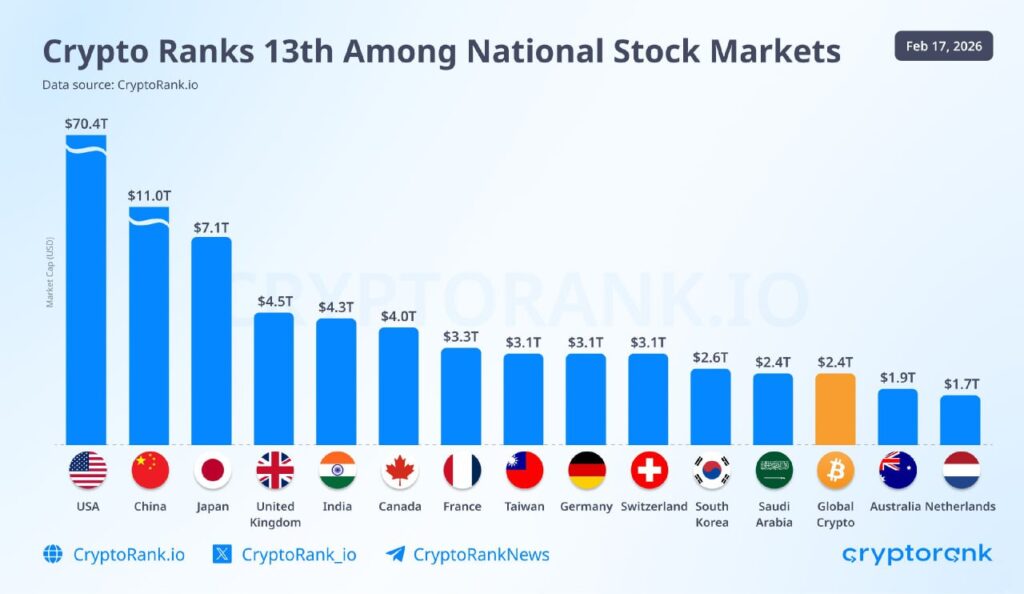
To understand the scale, a simple analogy is enough: today, the cryptocurrency market is larger than the stock markets of Australia or the Netherlands — economies that have spent decades building stable financial systems, attracting international capital, and creating powerful investment platforms. Yet digital assets, which are only about 15 years old, have already surpassed them in total value.
Moreover, the crypto market is approaching the level of Saudi Arabia — one of the key economies in the Middle East, the world’s largest oil exporter, and a country whose financial resources have traditionally been seen as a symbol of global wealth.
This demonstrates how quickly cryptocurrencies have evolved from being a “geek’s toy” to a fully-fledged segment of the global financial system. When a market is valued in the trillions of dollars, it is no longer about speculation on meme coins, but about infrastructure, investment flows, and strategic decisions of major players.
Another important point: the crypto market is global, with no national borders. While stock exchanges are tied to specific countries, their economic policies, and regulatory frameworks, cryptocurrencies exist in a single international space, making them both more flexible and more volatile.
The capitalization growth to $2.4 trillion means cryptocurrencies are increasingly viewed as a separate asset class alongside stocks, bonds, and commodities. Institutional investors enter this sector through ETFs, banks launch custodial services, governments discuss regulations, and tech companies integrate blockchain into their products.
Of course, the crypto market remains young and subject to sharp fluctuations. Yet its size no longer allows it to be considered peripheral to the financial world. It has become too large to ignore and too significant to dismiss as a temporary trend.
If cryptocurrencies have managed to grow in just fifteen years to the scale of the national stock markets of developed countries, it signals one thing: we are witnessing not just a financial trend, but the formation of a new parallel economy that continues to gain weight in the global capital system.
All content provided on this website (https://wildinwest.com/) -including attachments, links, or referenced materials — is for informative and entertainment purposes only and should not be considered as financial advice. Third-party materials remain the property of their respective owners.