

Ethereum co-founder Vitalik Buterin believes that the next generation of cryptocurrency wallets will be closely connected with artificial intelligence tools. In his view, AI will be able to take over a significant portion of routine operations – from transaction analysis to preparing and planning complex financial actions.
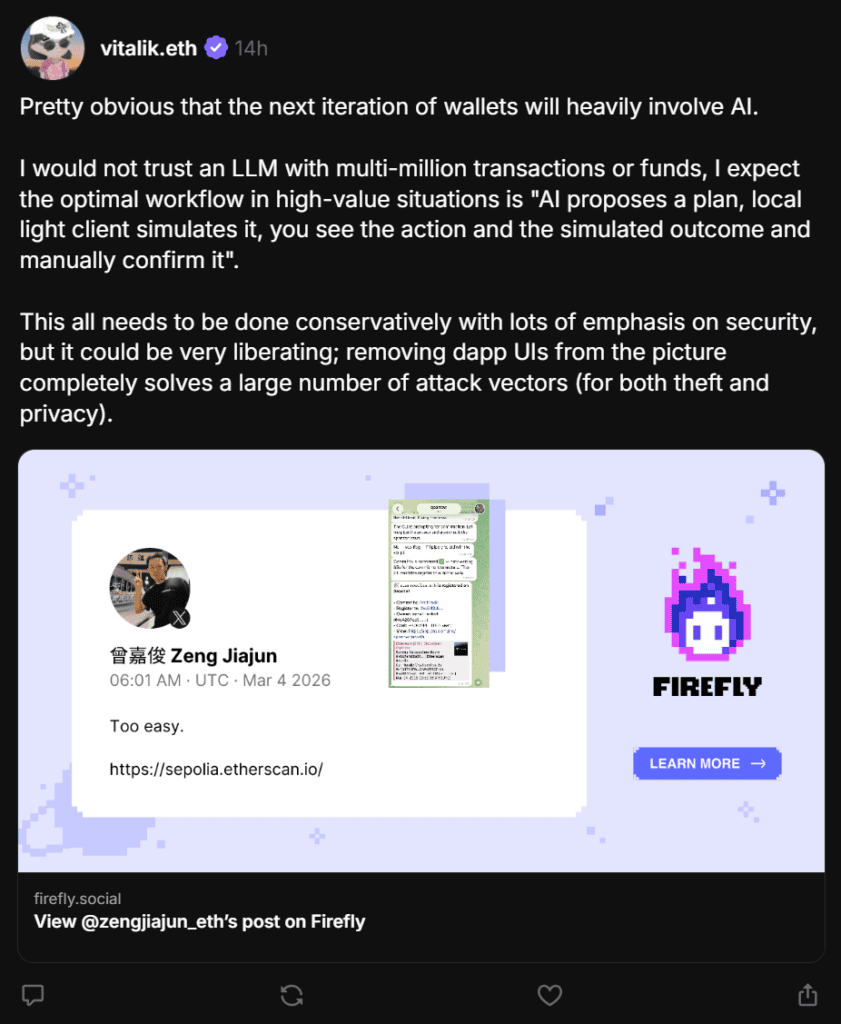
This is not just about auxiliary features but about a new logic of interaction between users and crypto infrastructure. In such a scenario, artificial intelligence would act as a kind of “financial assistant” that helps construct transactions, analyzes risks, and suggests optimal actions.
However, as the developer emphasizes, the final decision must always remain with the human. Buterin notes that it is still too early to fully delegate control over large financial operations to algorithms, especially when it comes to systems based on large language models. “I wouldn’t trust an LLM with transactions worth millions of dollars,” the developer said.
According to him, a secure architecture for interaction between the user and AI should include several verification stages. In the model he proposes, artificial intelligence first creates a plan of action – for example, suggesting the optimal way to transfer funds, interact with a protocol, or allocate assets.
After that, a local artificial intelligence model running on the user’s device simulates the consequences of the proposed operation. The user sees not only the transaction itself but also the predicted outcome of its execution. Only then does the person make the final decision and manually confirm the action. “AI proposes a plan, a local LLM client simulates it, you see the action and the simulated outcome and confirm it manually,” Buterin explained.
In his opinion, such a system could significantly improve the usability of cryptocurrency tools while maintaining a high level of security.
Today, most crypto wallets require users to have a fairly high level of technical literacy. Working with decentralized applications, managing keys, interacting with smart contracts, and understanding transaction fees often become serious barriers to the mass adoption of cryptocurrencies.
Artificial intelligence could greatly simplify this process. Instead of manually interacting with interfaces, users could simply describe a task in natural language. For example: “swap part of my assets into stablecoins,” “place funds in the protocol with the lowest risk,” or “optimally distribute assets across several networks.” AI could analyze the market, select suitable protocols, and create a ready-to-execute action plan. At the same time, the key principle of the crypto industry – user control over their funds – must remain intact.
Buterin also noted that the transition to AI-oriented wallets could change the very structure of interaction with decentralized applications. Today, users usually interact with so-called dApps – web interfaces that connect to a crypto wallet. However, such interfaces often become sources of vulnerabilities. Phishing websites, malicious contracts, or fake interfaces can trick users into signing dangerous transactions.

According to Buterin, integrating AI directly into wallets could partially eliminate this problem. If transactions are created and verified inside the wallet itself rather than through external interfaces, the likelihood of attacks could be significantly reduced. In this way, artificial intelligence could become an additional layer of protection.
Buterin has been discussing the role of AI in the crypto ecosystem for several years. In the past, he published materials exploring possible scenarios of interaction between blockchain and artificial intelligence, but now he believes the process should become much deeper.
According to him, discussions about the development of artificial intelligence are often too abstract. Conversations about building artificial general intelligence frequently reduce the topic to the idea of simply accelerating technological progress. However, the developer believes this approach oversimplifies the picture. Buterin compares it to describing Ethereum merely as “working in finance” or “working on computing.” Such descriptions fail to reflect the real scale of technological change.
In his view, the development of artificial intelligence should take into account the values that lie at the core of the crypto industry. Among them he highlights three key principles:
- decentralization,
- privacy,
- and verifiability.
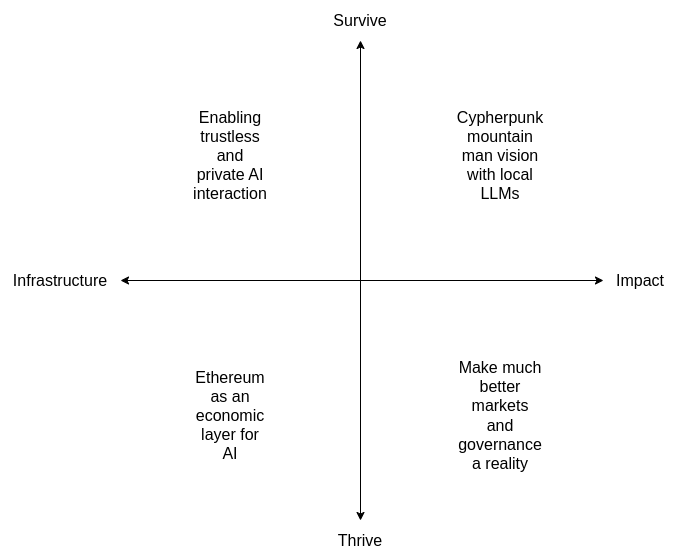
These elements, according to Buterin, can make AI more secure and resilient. For example, blockchain can be used to verify decisions made by algorithms, while cryptographic mechanisms can ensure transparency and immutability of data. In addition, distributed systems may reduce the risk of AI control being concentrated in the hands of a few large corporations.
Buterin emphasizes that the future of technology depends not only on the speed of its development but also on the direction in which it evolves. He believes that the key task of the technological community is not simply to accelerate progress at any cost but to shape a positive trajectory for the development of civilization.
In this context, the interaction between blockchain and artificial intelligence could play an important role. If these technologies develop within the principles of transparency, security, and decentralization, they could help create a more resilient digital infrastructure. That is why, according to Buterin, the future of crypto wallets may become far more intelligent – while control over finances will still remain in the hands of users.
All content provided on this website (https://wildinwest.com/) -including attachments, links, or referenced materials — is for informative and entertainment purposes only and should not be considered as financial advice. Third-party materials remain the property of their respective owners.