


The founder of Wikipedia and well-known internet entrepreneur Jimmy Wales once again delivered sharp criticism of Bitcoin, outlining his position in the most straightforward terms. According to him, Bitcoin has completely failed as a currency and as a store of value — that is, it has not fulfilled the two key narratives on which its popularity was built in its early years.

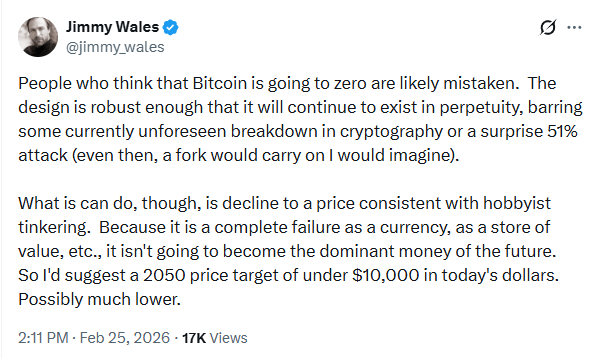
Wales emphasizes that if Bitcoin is considered as a payment instrument, it has not become a universal means of settlement. Price volatility, limited network throughput, and dependence on market speculation, in his view, make it impractical for everyday use. As for the “digital gold” function, he believes the asset has also failed to meet expectations: high price amplitude does not allow it to be considered a stable instrument for long-term capital preservation.
At the same time, Wales does not share the extreme skepticism of those who predict Bitcoin’s collapse to zero. He notes that the network architecture itself is sufficiently resilient and technologically reliable. In his assessment, Bitcoin will continue to exist due to its decentralized nature and resistance to external pressure. He considers only the scenario of a so-called 51% attack or other unforeseen factors capable of undermining trust in the protocol at a fundamental level as vulnerable points. However, even in this case, he is speaking more about theoretical risks than inevitable collapse.
Wales’ key argument is that the main promises accompanying Bitcoin during its formative stage did not materialize. He points to the absence of a large-scale transition by governments to cryptocurrency settlements, limited use of the asset in the real economy, and the dominance of speculative components over utilitarian ones. As a result, he forecasts a long-term decline in Bitcoin’s value and names a benchmark of $10,000 in today’s prices by 2050 — a level that, in his view, would reflect niche interest rather than global financial significance.
Wales is convinced that Bitcoin will not become the currency of the future. He characterizes it as an overvalued speculative asset whose market capitalization is largely sustained by expectations rather than real economic integration. In his assessment, there are no visible prerequisites for large-scale accumulation of Bitcoin reserves by major institutional players, including governments. Even if certain countries experiment with digital assets, he believes this does not indicate a systemic shift in the global financial architecture.
Based on this, Wales urges investors to be prepared for a scenario in which Bitcoin’s price eventually declines to what he calls a “hobby level.” By this he means a situation where the asset retains a community of enthusiasts and technological supporters but loses its status as a mainstream investment instrument. In such a case, Bitcoin would remain part of a digital subculture rather than a foundational element of the global financial system.
A similar position is expressed by Nobel Prize–winning economist Paul Krugman. He has repeatedly stated that Bitcoin does not correspond to the classical functions of money and does not demonstrate stable characteristics of a future currency. According to Krugman, a significant portion of its use is associated with circumventing restrictions, illegal activity, and speculative operations, which undermines supporters’ arguments about its transformational potential.
Regarding Wales’ broader attitude toward the crypto sphere, his position remains consistent and skeptical. He is a supporter of traditional financial institutions (TradFi) and is convinced that the banking system, despite its shortcomings, possesses the necessary regulatory and infrastructural base that crypto assets are unable to fully replace. In his view, decentralization in itself is not a guarantee of efficiency, stability, or public benefit.
He directs separate criticism at initial coin offerings (ICOs), which he considers a form of mass deception and a tool for raising funds without real accountability to investors. In his assessment, a significant portion of projects launched during the ICO boom lacked viable business models and existed solely due to marketing hype.
Moreover, Wales has opposed the integration of cryptocurrencies into Wikipedia’s infrastructure, believing that such steps could affect the project’s reputation and associate it with a high-risk and unstable market segment. In a broader sense, he views the crypto sphere as a bubble dominated by speculation, inflated expectations, and a substantial share of bad-faith practices.
Thus, Jimmy Wales’ position is not based on rejecting the technology as such, but on doubting the economic viability and social necessity of crypto assets in their current form. He acknowledges Bitcoin’s resilience as a protocol, yet does not believe in its long-term role as a system-forming financial instrument.
All content provided on this website (https://wildinwest.com/) -including attachments, links, or referenced materials — is for informative and entertainment purposes only and should not be considered as financial advice. Third-party materials remain the property of their respective owners.