


France is taking another step toward tightening control over the crypto market — and this time it is no longer about exchanges, but about users themselves. The country’s National Assembly has adopted a provision requiring the declaration of funds held in non-custodial wallets if their value exceeds €5,000. In essence, this is an attempt to look into an area where regulators previously preferred not to interfere — users’ private wallets.
The update was reported by The Big Whale co-founder Grégory Raymond, who stressed that this marks a fundamentally new stage of regulation. While previous requirements mainly applied to accounts on centralized platforms, the focus is now shifting toward self-custody wallets. This means users of solutions such as MetaMask, Phantom, Rabby, as well as hardware devices like Ledger, fall under the rule.

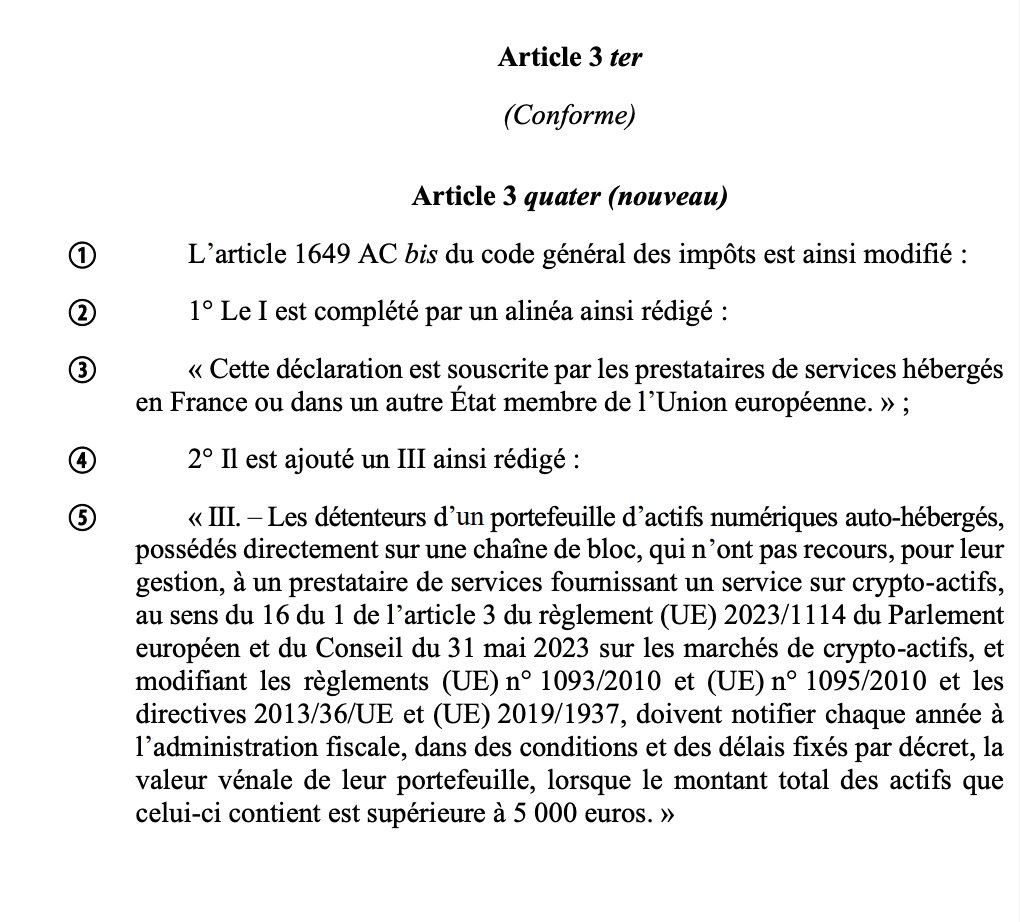
The initiative is part of a broader bill aimed at combating tax and social fraud. Formally, the logic is clear: the state is trying to close “grey zones” through which undeclared assets may flow. But in practice, this represents a significant expansion of surveillance. Users will now be required to annually report to the French tax authority (DGFIP) the value of their crypto assets if they exceed the threshold.
In effect, lawmakers are attempting to equate cryptocurrencies with foreign bank accounts. This is an important shift. Crypto used to sit in a separate category — a financial asset, but not fully a traditional one. Now it is gradually being integrated into the classical tax system, where full transparency is the default principle.
However, this is exactly where logic and reality begin to clash. The initiative was adopted despite opposition from the government and even the tax authority itself. MP Daniel Labaronne openly questioned the feasibility of enforcement, comparing crypto wallet checks to trying to determine whether someone owns a piano at home (“How can she verify whether someone owns such assets? The same way you check if someone has a piano at home.”). The point is simple: if users self-custody their assets without intermediaries, detecting them is extremely difficult.

But even if enforcement becomes possible, another equally serious issue arises — security. DGFIP itself warned about the risks. Centralizing data on crypto holders and their asset values effectively creates a “treasure map” for attackers. In the context of frequent cyberattacks and data breaches, such databases become high-priority targets.
Particularly concerning is the fact that Europe is already seeing so-called wrench attacks — cases where crypto access is obtained not through hacking, but through physical coercion of the owner. In other words, the more information exists about who holds crypto and how much, the higher the risk of both digital and real-world threats.
The paradox is that even the tax authority itself, according to Raymond, admits it lacks effective tools to verify such declarations. In other words, the state demands disclosure but does not fully understand how to enforce or validate it. This creates a legal grey zone where obligations exist, but enforcement mechanisms remain unclear.
The fate of the law is still uncertain. Despite being adopted by the National Assembly, it must go through further stages of approval. It could still be revised or removed during the joint committee process.
There is also a possibility of referral to the Constitutional Council, which could assess whether the measure complies with fundamental rights, including privacy. In the European context, this is a particularly sensitive issue, as the balance between control and freedom is a long-standing point of debate.
More broadly, France is effectively testing a model that could later be expanded across the EU. The only question is how it will be implemented — and whether the price of transparency will turn out to be too high.
In the end, the picture is quite clear. The state is attempting to regulate a decentralized system. But the deeper it goes, the more obvious the core conflict becomes: crypto was originally designed as a system outside centralized oversight. And attempts to integrate it into a traditional regulatory framework will inevitably face resistance — technical, legal, and logical.
All content provided on this website (https://wildinwest.com/) -including attachments, links, or referenced materials — is for informative and entertainment purposes only and should not be considered as financial advice. Third-party materials remain the property of their respective owners.