


The U.S. financial system may soon find itself at the center of a new legal conflict between traditional banks and the cryptocurrency industry. The country’s largest banks are considering filing a lawsuit against a federal regulator that, in their view, has significantly simplified rules for cryptocurrency and fintech companies.
According to sources familiar with the discussions, the issue concerns decisions made by the Office of the Comptroller of the Currency (OCC), one of the key banking regulators in the United States, as reported by The Guardian. This agency is responsible for licensing national banks and overseeing their activities.

Photograph: AP S (uk)/Alamy
The core of the conflict lies in a new OCC policy that makes it easier for cryptocurrency companies to obtain a so-called national trust bank license. Such a status allows firms to operate across the entire United States and serve clients in all 50 states without needing to obtain separate licenses in each jurisdiction.
For the crypto industry, this creates enormous opportunities. For traditional banks, however, it raises serious concerns.

Some of the members of the BPI organization. Data: BPI
The Banking Sector Prepares for a Legal Battle
According to sources, the possibility of a lawsuit is being actively discussed within the Bank Policy Institute (BPI), one of the most influential banking associations in the United States. The organization represents the interests of approximately forty of the country’s largest banks, including financial giants such as JPMorgan Chase, Goldman Sachs, and Citigroup.
Sources say the association’s legal teams are already analyzing various options for challenging the regulator’s decisions in court.
Banks argue that the OCC is effectively creating a softer regulatory regime for cryptocurrency and fintech companies. In their view, the new rules allow such firms to participate in the U.S. financial system without complying with the full set of requirements traditionally imposed on banking institutions. This regulatory gap could create uneven competitive conditions.
What Is a National Trust Charter
At the center of the dispute is the national trust bank license. This status allows companies to provide financial services across the country, including custody of client assets, asset management, and payment operations. The key advantage of this license is unified federal jurisdiction. Companies that receive it can avoid the complex system of state-by-state licensing, which significantly simplifies business expansion.
For cryptocurrency companies, this is particularly important. Their business models often involve international transactions, custody of digital assets, and serving users across multiple regions.
However, banks argue that such licenses do not impose the full range of regulatory requirements applied to traditional financial institutions. These include capital adequacy rules, risk management frameworks, deposit insurance obligations, and a number of other regulatory standards.
The Role of the Trump Administration
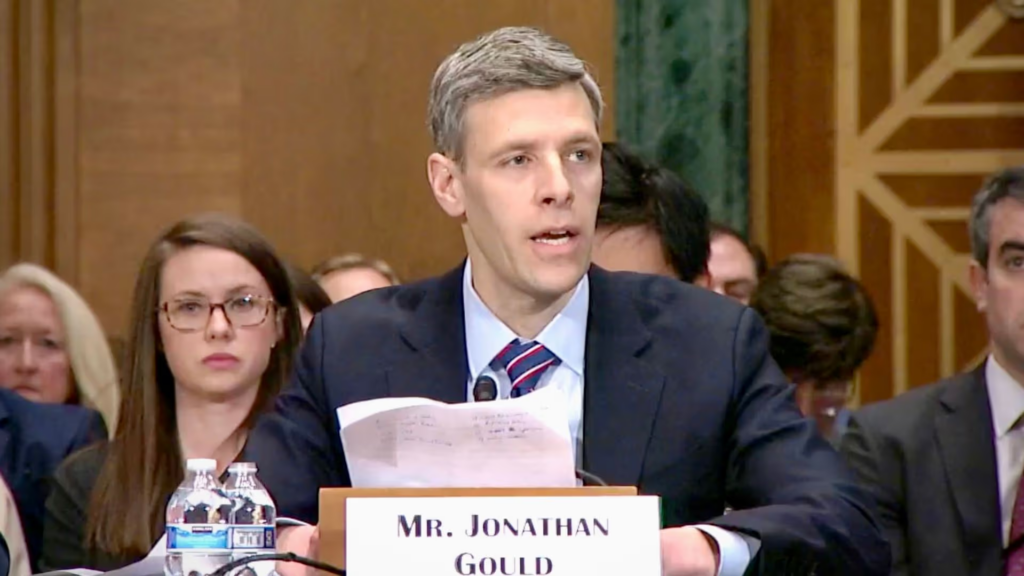
The political context also plays a significant role in the situation. The current head of the OCC is Jonathan Gould, appointed by U.S. President Donald Trump. Before entering public service, Gould worked in the cryptocurrency industry and publicly supported stronger integration of digital assets into the traditional financial system.
Supporters of his policies argue that the U.S. financial sector must adapt to new technological realities. In their view, cryptocurrency companies and fintech platforms can increase competition, reduce the cost of financial services, and accelerate innovation.
Critics, however, believe that loosening regulation too quickly could create new risks for the entire banking system.
Previous Attempts to Block the Reform
The conflict over licensing cryptocurrency companies has been developing for several years. In October 2025, the Bank Policy Institute already asked the OCC to reject several applications for national bank charters.
Among the applicants were well-known crypto industry players such as Circle and Ripple. The British fintech platform Wise, which specializes in international payments, was also among the companies seeking approval.
At the time, the banking association argued that granting such licenses to non-bank companies could blur the lines between traditional banks and other financial institutions. According to BPI representatives, such a policy could create systemic risks and undermine confidence in the U.S. national banking system.
Political Sensitivity of the Issue
Another license application has drawn additional attention to the reform. In January 2026, a company called World Liberty Financial, reportedly linked to Donald Trump’s family, submitted documents seeking a similar license.The move sparked strong reactions from some lawmakers in the U.S. Congress.

Critics worry about a potential conflict of interest, since the regulator responsible for reviewing the license is led by a person appointed by the president. Although there is no direct evidence of political influence over the process, the situation has increased tensions around the reform of financial regulation.
A Possible Lawsuit and Its Consequences
According to sources, if banks ultimately file a lawsuit, it would be a rare but not unprecedented move. Large financial institutions traditionally prefer to influence regulators through negotiations and lobbying. However, in recent years, legal action has increasingly become a tool for challenging government decisions.
There is already a precedent. In 2024, the Bank Policy Institute filed a lawsuit against the Federal Reserve System over changes to bank stress-testing rules. That dispute ended in a compromise, with the Federal Reserve agreeing to review part of its policy and prepare updated proposals.
The Battle Between Old and New Finance
The situation surrounding the OCC reflects a broader transformation of the global financial system. On one side stand traditional banks – institutions with decades of experience, strict regulation, and massive balance sheets. On the other side are cryptocurrency companies and fintech startups building new financial models based on blockchain technology, digital assets, and internet infrastructure. A conflict between these two worlds is almost inevitable.
Traditional banks fear losing market share and control over financial flows. New companies, in contrast, see the existing system as overly regulated and slow.
Potential Impact on the Crypto Market
If banks proceed with legal action, the consequences could extend far beyond the legal arena.
The speed of integration between cryptocurrency companies and the traditional U.S. financial system could come into question. For companies such as Circle or Ripple, access to banking infrastructure means more than business expansion – it enables full-scale cooperation with institutional clients. If regulation becomes stricter, that process could slow down for years.
Who Will Win
For now, the situation remains in the discussion phase, and no final decision has been made about filing a lawsuit. However, the very fact that the largest U.S. banks are considering such a step highlights the scale of tensions surrounding the future of the financial system. At its core, the issue is not only a legal dispute.
It is a struggle over what the financial sector will look like in the coming decades – whether it will maintain its traditional banking architecture or gradually evolve into a hybrid system where banks, fintech firms, and crypto companies operate on equal footing. And as financial history shows, conflicts of this kind rarely end with quick solutions. But they almost always become turning points for the entire industry.
All content provided on this website (https://wildinwest.com/) -including attachments, links, or referenced materials — is for informative and entertainment purposes only and should not be considered as financial advice. Third-party materials remain the property of their respective owners.