

Inflation has finally destroyed the American cent — the last three pennies sold at auction for a record $800,000, turning what seemed like ordinary small change into a priceless numismatic artifact and a symbol of fundamental economic changes. This auction was not just an event for collectors, but a clear illustration of how inflation and economic logic accumulate over more than two centuries, gradually transforming familiar monetary units into historical relics.
When small change becomes history, its value is no longer measured by face value. Producing a single cent cost 3.69 cents, and for 19 consecutive years, the minting cost regularly exceeded the nominal value. In 2024 alone, the U.S. Mint incurred $85.3 million in losses from cent production, creating 3.2 billion coins. It became economically impractical to continue minting. The U.S. followed the 1857 scenario, when the half-cent was abandoned, and in 2025, the penny was discontinued, reflecting the harsh reality of inflation and declining purchasing power of small denominations.
Comparing experiences of other countries, the U.S. is following a path already taken by Canada, which stopped issuing cents in 2012, saving $11 million annually; Australia, which abandoned small change in 1992; and New Zealand, which removed five-cent coins in 2006. These examples show that such practices are a logical adaptation to changes in money value and economic efficiency.
The 1857 half-cent story clearly demonstrates the effect of inflation. Back then, the canceled half-cent had purchasing power equivalent to about 15 modern cents, far exceeding the value of today’s cents. Today, it would make sense in the U.S. to use coins of 25 cents and above, but economic psychology fosters the habit of holding onto familiar denominations, even when they lose economic purpose.
Each penny was stamped with the Ω (omega) symbol, marking the last issue of a coin with a 232-year history. The one-cent coin first appeared in 1793.
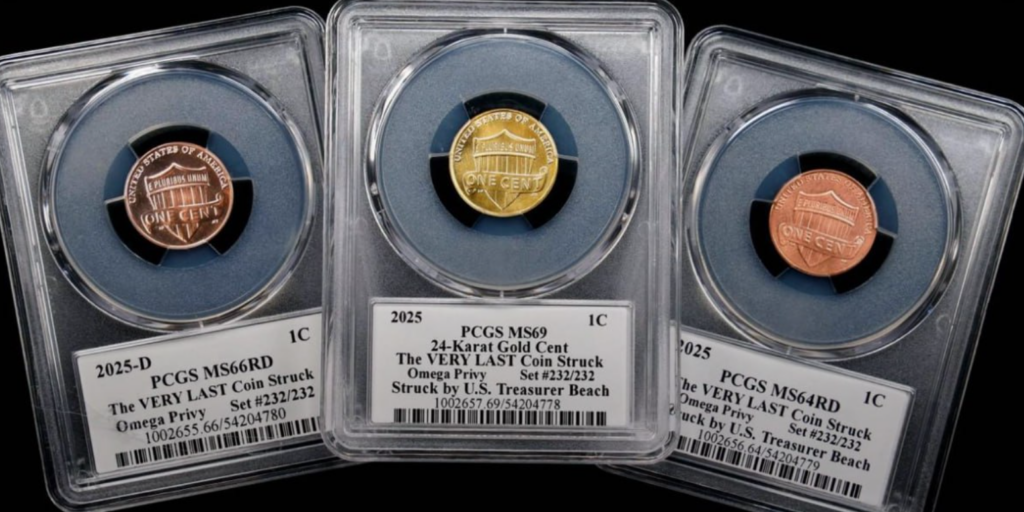
The scale of devaluation is striking. One dollar from that year today equals only $32.72, with cumulative inflation over 232 years totaling 3,172%. A modern dollar buys only about 3% of what could be purchased in the late 18th century. Against this backdrop, the last three pennies gained historical value rather than utilitarian function. The average lot price was $72,000, and the final set sold for $800,000 — hundreds of thousands of times its face value. For comparison, the most expensive coin in history, the 1933 Double Eagle, sold for $18.9 million in 2021. The last American pennies have thus approached the value of the greatest numismatic rarities and set records as coins sold on behalf of the U.S. Mint.
The discontinuation of cents reflects the economic realities of the modern digital payment era. Currently, around 16% of transactions in the U.S. are conducted in cash, and most citizens prefer not to spend cents, but save them in banks or home piggy banks. The Canadian experience showed that rounding payments does not create economic chaos: electronic transactions remain precise, and the economy adapts faster than skeptics expect.
The auction of the last cents symbolizes the transition from a utilitarian monetary unit to a historical artifact. Coins that lost their economic sense gained value thanks to collectors willing to pay millions to own a piece of the history of money evolution. This phenomenon demonstrates a fundamental shift in monetary psychology and reflects the acceleration of financial habit transformation: digitalization of payments occurred in just 20 years, while the transition from the gold standard to fiat money took half a century.
Historical parallels also point to a similarity with the 1960s discontinuation of silver coins, when the metal was worth more than its face value. Collectors bought the last issues anticipating their rarity. Today, the value of cents is purely symbolic and historical. The question arises: will this auction be the last surge of interest in physical money before the final evolution to a fully digital currency system, where physical coins will disappear, and their role will be played by electronic money and digital payment instruments?
All content provided on this website (https://wildinwest.com/) -including attachments, links, or referenced materials — is for informative and entertainment purposes only and should not be considered as financial advice. Third-party materials remain the property of their respective owners.