

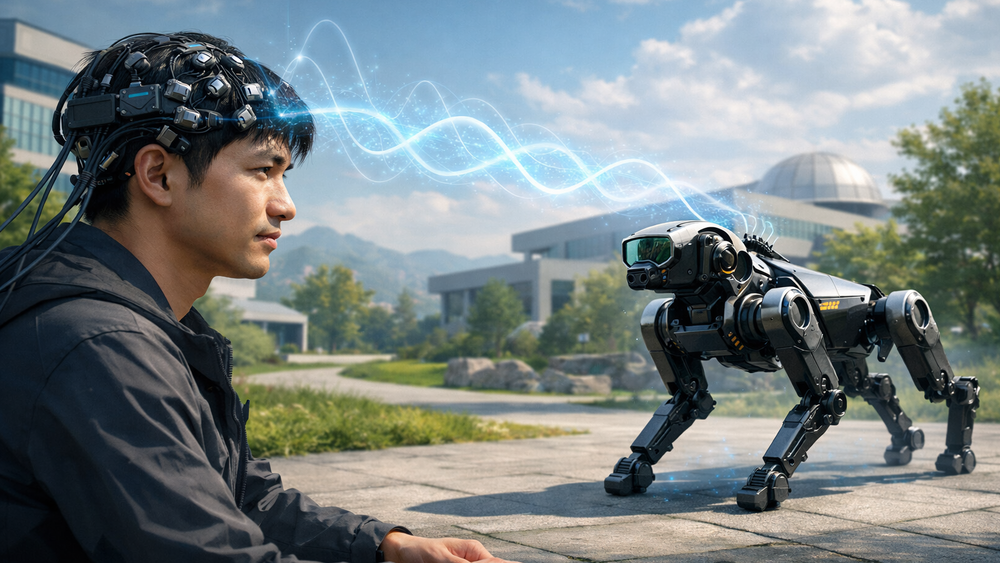
China continues to move confidently toward technologies that until recently seemed like science fiction. This time, it’s about a real breakthrough in brain-computer interfaces (BCI): scientists have managed to teach a user to control a robot dog literally with the power of thought.
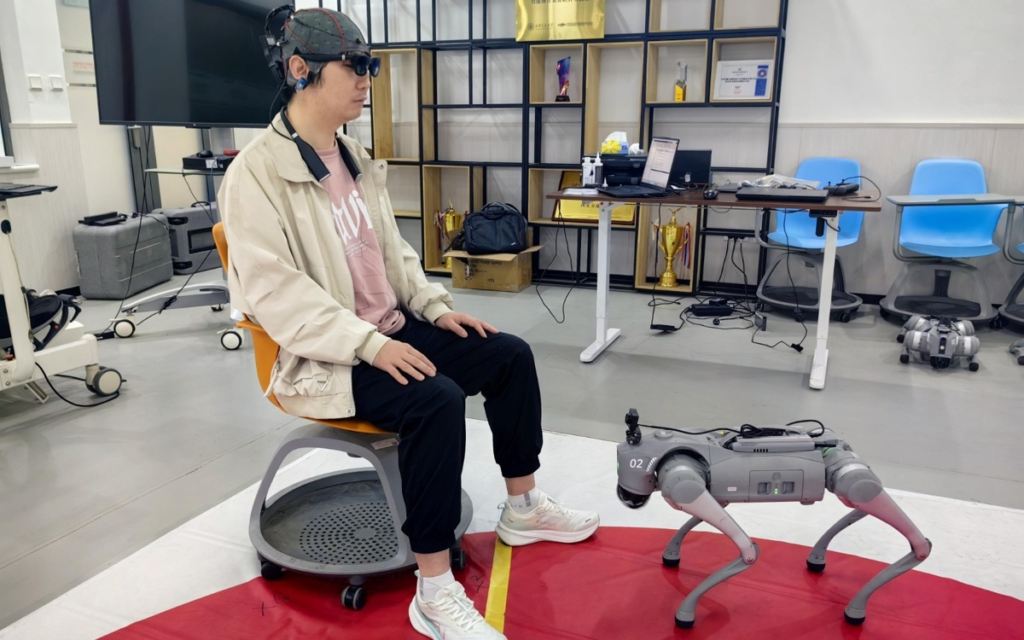
The development belongs to the team of Professor Xu Guanghua from Xi’an Jiaotong University. The idea is simple: instead of pressing buttons or using controllers, a person only needs to form an intention in their mind — for example, “move forward” — and the system converts it into a command for the robot.
The system is based on non-invasive brain-computer interface technology. Special sensors read electroencephalographic (EEG) signals — the electrical activity of the brain generated when thoughts and intentions are formed. The process follows a chain: the brain generates a signal → the system reads it → algorithms recognize the intention → the command is translated into an action → the robot executes the task.
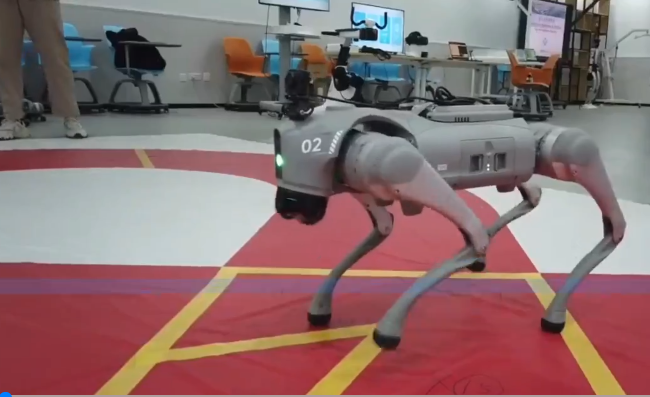
Xu Guanghua describes it as a “remote control inside the head.” Importantly, this is not direct manual control of every movement, but a higher-level approach — the user sets a goal, and the robot figures out how to achieve it.
Technical capabilities. At this stage, the system supports 11 basic mental commands — moving forward, backward, turning, and other simple actions. The recognition accuracy exceeds 95%, and the delay between thought and action is about one second.
This matters because such speed already brings the technology closer to real-world application rather than just laboratory experiments. Why this is not “direct control”
At first glance, one might expect full control over every movement of the robot. However, the researchers deliberately avoided this approach. The reason is simple: non-invasive brain signals lack the precision required for detailed real-time control. If a person had to “think through” every movement, it would be not only difficult but also extremely exhausting.
Instead, the team chose a smarter approach — division of roles. The human is responsible only for the general intention — “where to go” or “what to do.” The robot handles everything else — navigation, environmental analysis, obstacle avoidance, and movement execution. It is essentially a “human-machine partnership,” where each side does what it does best.
This technology has a key advantage — safety. Unlike invasive methods that require surgery, the non-invasive approach carries no risks of operations, infections, or rejection. It is cheaper, easier to use, and potentially scalable. This makes it especially promising for medicine, rehabilitation, and mass-market applications.
However, there are limitations. Non-invasive signals are less precise than invasive ones. This means complex and fine-grained commands remain difficult to implement. Still, researchers found a compromise — instead of trying to extract maximum precision from the brain, they focused on intelligent algorithms on the robot side.
Artificial intelligence and autonomous systems handle the complex tasks: data processing, route planning, dynamic obstacle avoidance, and precise execution. This is where BCI technology closely intersects with AI development.
The robot dog effectively becomes an autonomous agent capable of:
- analyzing the environment
- planning routes
- responding to changes in real time
- adapting its behavior independently
In this model, the human remains the “director,” while the machine is the “executor with intelligence.” This reflects a key trend — a shift from direct control to human-machine collaboration.
The potential of this technology goes far beyond demonstration. Researchers see real-world applications such as:
- assisting people with disabilities
- supporting the elderly
- rehabilitation after injuries and strokes
- medical assistants
- intelligent companions
In the future, such systems could become part of everyday life — from smart assistants to robotic helpers at home.
Professor Xu emphasizes that developing such technologies requires not only engineering solutions but also deep integration with other fields — artificial intelligence, autonomous navigation, and environmental recognition systems. It is this combination that enables the transition from lab experiments to real-world use.
Put simply, the idea follows a kind of old-school wisdom: don’t try to turn humans into machines — make machines work for humans. And it seems that this philosophy captures the essence of the future — when a thought becomes not just an idea, but a real command for technology.
A video of controlling the robot dog can be viewed in our Telegram channel.
All content provided on this website (https://wildinwest.com/) -including attachments, links, or referenced materials — is for informative and entertainment purposes only and should not be considered as financial advice. Third-party materials remain the property of their respective owners.