

In the United States, a new wave of regulation is gaining momentum – something that just a few years ago seemed exotic, but today is becoming a serious part of financial policy. The focus is on prediction markets – platforms where people can bet not on sports, but on events such as elections, Federal Reserve decisions, or even geopolitical conflicts. And this is exactly where lawmakers see a potential problem: too convenient a tool for those who know more than they should.
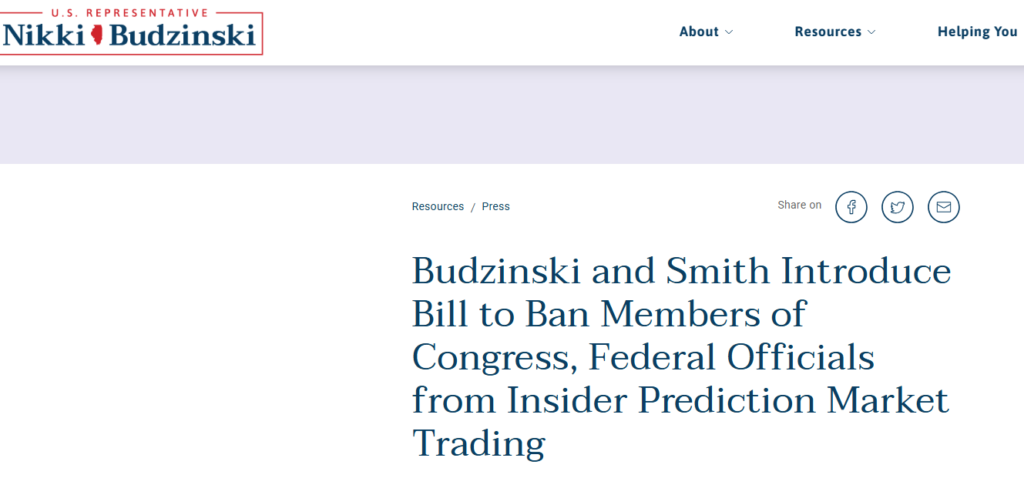
House Representatives Nikki Budzinski and Adrian Smith introduced a bill with the telling name PREDICT Act. Its goal is to prohibit the President, Vice President, and several other high-ranking officials from participating in trading on prediction markets. This applies not only to them personally, but also to their family members and executive branch representatives.
The core issue is that prediction markets are increasingly intersecting with real politics. What used to be niche tools for enthusiasts are now full-fledged platforms with growing volumes and increasingly accurate bets. And when a decision-maker or someone with access to non-public information participates in such markets, an obvious conflict of interest arises.
The unique aspect of the bill is that it goes beyond narrowly defined “political bets.” It covers any contracts related to government actions – from military decisions to economic policy. In other words, if an event is in any way influenced by government decisions, officials participating in bets on it would be acting illegally.
According to Budzinski, the warning signs are already there. In recent months, there have been cases where relatively unknown traders made significant profits on events that were difficult to predict without access to inside information. Examples include developments around the conflict with Iran and even the timing of government shutdowns. While proving insider trading is difficult, the very existence of such coincidences raises growing concerns.
The bill not only introduces prohibitions but also concrete penalties. Violations would result in a fine equal to 10% of the total value of the contracts, along with full confiscation of profits in favor of the Treasury. This is a key point: the goal is not symbolic punishment, but to make such trades economically unviable.
At the same time, the authors of the initiative emphasize that the goal is to close loopholes that allow individuals to exploit their official positions for personal gain. In traditional financial markets, such restrictions have existed for a long time, but prediction markets have remained a “gray area” where rules are still being formed.
It is important to understand that this is not an isolated initiative. Earlier, Representative Ritchie Torres introduced a similar bill, while Senator Chris Murphy is promoting his own version called the BETS OFF Act. This suggests that a consensus is forming in Washington: event markets require separate regulation.
Pressure is also increasing on the platforms themselves. Marketplaces such as Kalshi and Polymarket have already begun implementing additional measures against insider trading. However, as practice shows, self-regulation is not enough – the incentives are too strong and the potential gains too high.

In a broader context, this is part of a global trend. Financial markets are becoming more complex, and the boundaries between investment, betting, and information are gradually blurring. Wherever there is an opportunity to monetize knowledge of the future, the question inevitably arises: who has access to it and under what conditions.
For now, the fate of the PREDICT Act remains uncertain. The bill is in its early stages, and its passage will require time and political will. But its mere introduction is already significant. It shows that the government is beginning to take prediction markets seriously as a risk factor, not just as an exotic tool. In simple terms, the rules of the game are changing. The idea of “profiting from knowledge of the future” no longer looks so harmless when it involves those who help shape that future.
All content provided on this website (https://wildinwest.com/) -including attachments, links, or referenced materials — is for informative and entertainment purposes only and should not be considered as financial advice. Third-party materials remain the property of their respective owners.