


According to Fidelity Investments, approximately $7.1 trillion is gradually being reallocated from gold into Bitcoin. This is not just a nice number for presentations – it reflects a fundamental shift in capital behavior, which usually moves much slower than traders would like, but much faster than economics textbooks suggest.
Jurrien Timmer from Fidelity Investments notes that flows into Bitcoin ETPs (exchange-traded products) are reversing as gold loses momentum. Capital is returning to BTC despite ongoing macroeconomic uncertainty. In simple terms, investors who were seeking a “safe haven” yesterday are now ready to take risk again, but in a more familiar format.

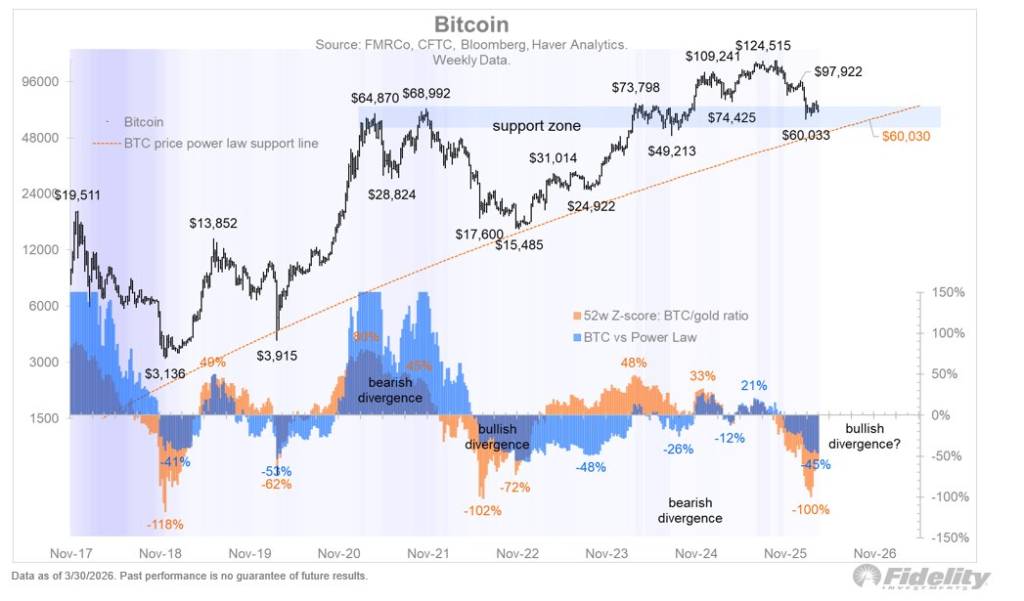
According to Timmer, when Bitcoin reached a local peak last October, investors began pulling money out of Bitcoin-focused products and moving into gold. This was a classic rotation into a defensive asset. But markets do not like static scenarios – and now we are seeing the reverse process.
Gold has lost its upward momentum, while Bitcoin has stabilized and begun holding its range. As a result, capital is once again flowing back into BTC. Timmer describes this as an interesting phenomenon: gold has started behaving more like a volatile risk asset, while Bitcoin is showing relative stability, more like “new digital gold.”
Data on Bitcoin ETP flows, highlighted by analysts including CryptosR_Us, shows an interesting dynamic. When Bitcoin declined, capital moved into gold. Now the situation has reversed – capital is returning to Bitcoin.
Importantly, this is not about retail sentiment but large institutional money. These flows reflect real capital allocation decisions, not headlines. And when such money starts moving, it is no longer noise – it is a signal.
The activity of major players such as BlackRock and Fidelity Investments, increasing their Bitcoin exposure, further reinforces this trend. It confirms that the move is systemic rather than a temporary anomaly.

In recent weeks, the divergence between Bitcoin and gold has been increasing. Correlation levels have dropped to lows not seen in years. In other words, assets that were long considered similar in function (hedges against uncertainty) are now behaving differently.
Gold is declining, while Bitcoin is holding its range. And if investors previously moved automatically into gold during crises, that mechanism is no longer as straightforward.
Kiril Talay also noted that Bitcoin has outperformed gold, the S&P 500, and even major tech stocks (the so-called Mag 7) since the start of the current geopolitical instability.
According to him, gold has dropped around 20%, equities are under pressure, while Bitcoin has held its ground. This is a key point – an asset expected to fail during crisis conditions not only survived but showed relative resilience. This challenges the traditional narrative: “crisis means buy gold.” Reality has turned out to be more complex and more interesting.
What this means for institutional investors
ETP flows show where capital is actually moving. When investors enter gold or exit Bitcoin, it is reflected in this data. Now we are seeing the mirror image: capital is returning to BTC. This is not random, but a behavioral signal. Investors follow momentum – first into gold, then out of it as momentum fades. Bitcoin finds support, and capital shifts again.
Importantly, this coincides with institutional buying through major financial firms. This is no longer an experiment – it is the formation of a new norm.
Another key point is the changing perception of assets. Gold, traditionally seen as a safe haven, is becoming less predictable. Bitcoin, on the other hand, is showing signs of stability. Timmer’s phrase that “gold is starting to behave like Bitcoin, and Bitcoin like gold” captures this role reversal. The market is effectively reshuffling old and new instruments.
Macroeconomic uncertainty has not disappeared. This includes interest rates, inflation, geopolitics, and global liquidity. But what matters is that the reaction to this uncertainty is changing.
Where gold once automatically benefited, Bitcoin is now competing for that role. And judging by capital flows, that competition is already very real.
Conclusion
The rotation of capital from gold into Bitcoin is not just a temporary trend, but a reflection of a deeper market transformation. Large capital is reassessing what truly qualifies as a safe-haven asset in the modern world.If the old strategy was “crisis – buy gold,” the formula is now more complex. A new player has emerged – not just an alternative, but a full-fledged competitor for investor trust.
Whether this reversal will persist will be tested by the next wave of volatility. For now, the market is sending a clear message: capital has already started moving – and when it moves, it rarely asks for permission.
All content provided on this website (https://wildinwest.com/) -including attachments, links, or referenced materials — is for informative and entertainment purposes only and should not be considered as financial advice. Third-party materials remain the property of their respective owners.