


Global energy markets are throwing investors a new surprise – and this time it is not about oil, but about a much less “media-friendly” yet critically important product. Prices for fuel oil, which is used as the main bunker fuel for maritime transport, have surged to historic highs. And, as often happens, the consequences of this increase will be felt even by those who have never seen a tanker in their lives.
In Singapore, which is considered the world’s largest bunkering hub, the price of fuel oil has reached around $140 per barrel. Since the beginning of the year, the increase has been about 146% – a figure that looks striking even against the backdrop of volatile energy markets. For comparison: current levels have already exceeded the peaks of both the 2008 Global Financial Crisis and the 2022 Energy Crisis. In other words, the market has not just “heated up” – it has entered a regime that was previously considered extreme.
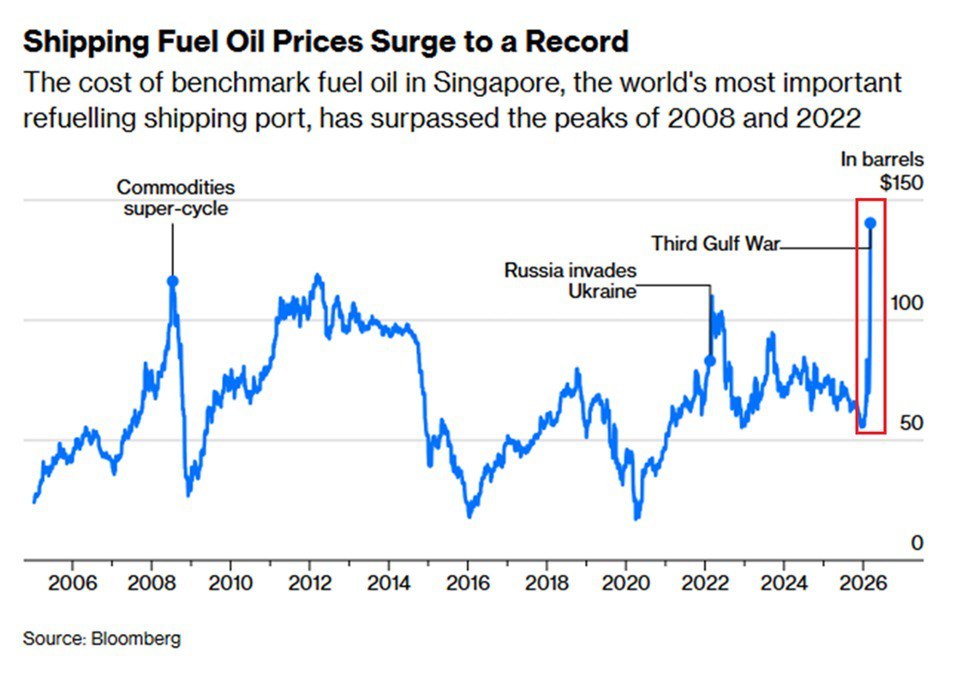
The Middle East is not lagging behind. In Fujairah, a key bunkering port in the United Arab Emirates, located near the Strait of Hormuz, prices are already approaching $160 per barrel, with some types of fuel trading at $170-175. Given the strategic importance of the region for global energy trade, such figures look like a warning signal for the entire global economy.
What makes the situation particularly unusual is the breakdown of the traditional relationship between oil and fuel oil prices. Historically, fuel oil was cheaper or at most slightly more expensive than crude oil – adjusted for refining and logistics costs. But now this logic has failed. While WTI crude oil is trading at around $195 per barrel, fuel oil is showing a premium in the range of 40% to 75%. This is no longer just a market deviation, but a full-fledged structural imbalance.
The reasons behind what is happening lie in several dimensions at once. First, geopolitics. The escalation around Iran and risks to supplies through the Strait of Hormuz have increased tension in fuel markets. Second, changes in demand structure. Maritime logistics remains the backbone of global trade, which means demand for bunker fuel stays consistently high even amid economic turbulence. Third, constraints on refining and supply of certain petroleum products are intensifying the shortage of heavy fractions, to which fuel oil belongs.
But the key issue is the consequences. Bunker fuel is one of the main cost components for shipping companies. When its price rises at such a pace, it automatically increases transportation costs. And then a simple chain reaction kicks in: more expensive shipping – more expensive goods – higher inflation.
In this sense, container ships become a kind of “carriers of inflation.” They physically transport not only goods but also rising costs from one continent to another. Today fuel becomes more expensive in Asia – tomorrow it will be reflected in price tags in Europe. And so on throughout the entire global trade chain.
For businesses, this means revising logistics strategies; for central banks, an additional headache; and for consumers, another round of price increases. Unlike short-term spikes, the current situation may have a longer-lasting effect if geopolitical tensions persist.
A separate point of interest is how much this is related to current military risks in the Middle East. Judging by price dynamics, the market is already pricing in a risk premium for fuel. And, as is often the case, it is not only traders who ultimately pay for this premium, but end consumers around the world.
In the end, the picture is quite simple but неприятная. While attention is focused on oil, the real price explosion is happening in a segment that directly affects the cost of global trade. And if oil is the “blood of the economy,” then fuel oil today can safely be called its nervous system. When it overheats, the consequences are felt everywhere – from ports to supermarkets.
So next time you see prices rising in a store, you might mentally send your regards to a tanker somewhere off the coast of Singapore. It may not be directly to blame – but it has certainly played its part.
All content provided on this website (https://wildinwest.com/) -including attachments, links, or referenced materials — is for informative and entertainment purposes only and should not be considered as financial advice. Third-party materials remain the property of their respective owners.